

246
C. McCammon
many notable contributions were made by the University of Illinois at UrbanaChampaign where H.G. Drickamer and collaborators applied high-pressure Mössbauer spectroscopy to the study of electronic structure and transitions [51]. Early
studies used a press with hardened steel anvils to reach up to 30 GPa [52], but later
adaptation of diamond anvil cell technology to high pressure Mössbauer studies
allowed pressures in excess of 200 GPa to be attained (reviewed, for example, in
[53]).
Radioactive point sources were fabricated initially by individual Mössbauer laboratories, e.g., [7], which restricted the number of installations due to the logistics of
working with open radioactive material. The subsequent development of commercially available sealed radioactive point sources allowed the number of laboratories carrying out point source Mössbauer spectroscopic measurements to expand
substantially, in particular to the geoscience community.
Research topics involving high-pressure phase transitions in geological materials
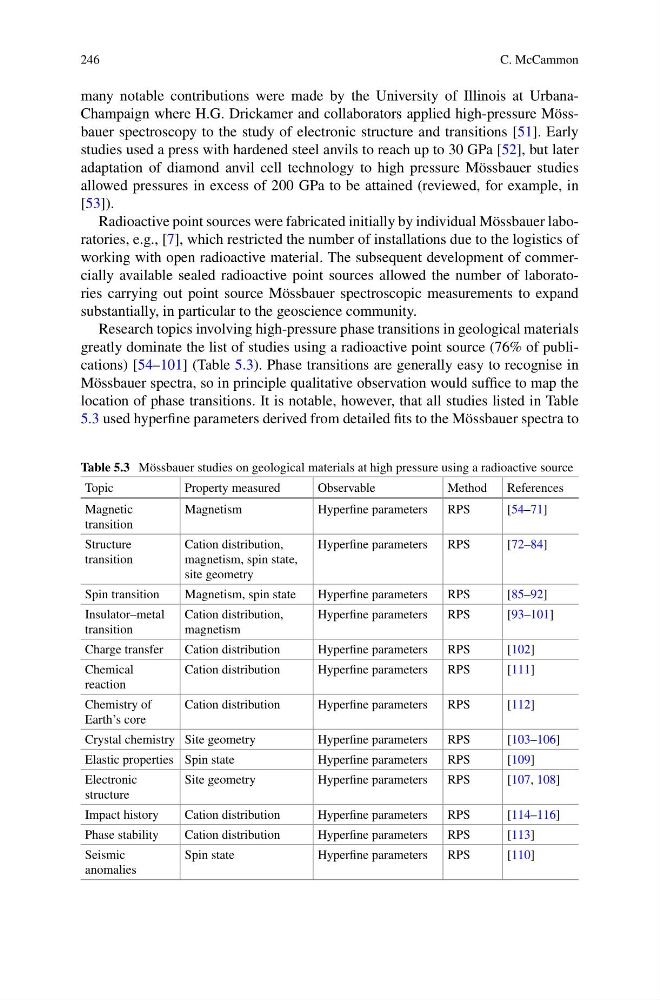
greatly dominate the list of studies using a radioactive point source (76% of publications) [54–101] (Table 5.3). Phase transitions are generally easy to recognise in
Mössbauer spectra, so in principle qualitative observation would suffice to map the
location of phase transitions. It is notable, however, that all studies listed in Table
5.3 used hyperfine parameters derived from detailed fits to the Mössbauer spectra to
Table 5.3 Mössbauer studies on geological materials at high pressure using a radioactive source
Topic
Property measured
Observable
Method
References
Magnetic
transition
Magnetism
Hyperfine parameters
RPS
[54–71]
Structure
transition
Cation distribution,
magnetism, spin state,
site geometry
Hyperfine parameters
RPS
[72–84]
Spin transition
Magnetism, spin state
Hyperfine parameters
RPS
[85–92]
Insulator–metal
transition
Cation distribution,
magnetism
Hyperfine parameters
RPS
[93–101]
Charge transfer
Cation distribution
Hyperfine parameters
RPS
[102]
Chemical
reaction
Cation distribution
Hyperfine parameters
RPS
[111]
Chemistry of
Earth’s core
Cation distribution
Hyperfine parameters
RPS
[112]
Crystal chemistry Site geometry
Hyperfine parameters
RPS
[103–106]
Elastic properties Spin state
Hyperfine parameters
RPS
[109]
Electronic
structure
Site geometry
Hyperfine parameters
RPS
[107, 108]
Impact history
Cation distribution
Hyperfine parameters
RPS
[114–116]
Phase stability
Cation distribution
Hyperfine parameters
RPS
[113]
Seismic
anomalies
Spin state
Hyperfine parameters
RPS
[110]
C. McCammon
many notable contributions were made by the University of Illinois at UrbanaChampaign where H.G. Drickamer and collaborators applied high-pressure Mössbauer spectroscopy to the study of electronic structure and transitions [51]. Early
studies used a press with hardened steel anvils to reach up to 30 GPa [52], but later
adaptation of diamond anvil cell technology to high pressure Mössbauer studies
allowed pressures in excess of 200 GPa to be attained (reviewed, for example, in
[53]).
Radioactive point sources were fabricated initially by individual Mössbauer laboratories, e.g., [7], which restricted the number of installations due to the logistics of
working with open radioactive material. The subsequent development of commercially available sealed radioactive point sources allowed the number of laboratories carrying out point source Mössbauer spectroscopic measurements to expand
substantially, in particular to the geoscience community.
Research topics involving high-pressure phase transitions in geological materials
greatly dominate the list of studies using a radioactive point source (76% of publications) [54–101] (Table 5.3). Phase transitions are generally easy to recognise in
Mössbauer spectra, so in principle qualitative observation would suffice to map the
location of phase transitions. It is notable, however, that all studies listed in Table
5.3 used hyperfine parameters derived from detailed fits to the Mössbauer spectra to
Table 5.3 Mössbauer studies on geological materials at high pressure using a radioactive source
Topic
Property measured
Observable
Method
References
Magnetic
transition
Magnetism
Hyperfine parameters
RPS
[54–71]
Structure
transition
Cation distribution,
magnetism, spin state,
site geometry
Hyperfine parameters
RPS
[72–84]
Spin transition
Magnetism, spin state
Hyperfine parameters
RPS
[85–92]
Insulator–metal
transition
Cation distribution,
magnetism
Hyperfine parameters
RPS
[93–101]
Charge transfer
Cation distribution
Hyperfine parameters
RPS
[102]
Chemical
reaction
Cation distribution
Hyperfine parameters
RPS
[111]
Chemistry of
Earth’s core
Cation distribution
Hyperfine parameters
RPS
[112]
Crystal chemistry Site geometry
Hyperfine parameters
RPS
[103–106]
Elastic properties Spin state
Hyperfine parameters
RPS
[109]
Electronic
structure
Site geometry
Hyperfine parameters
RPS
[107, 108]
Impact history
Cation distribution
Hyperfine parameters
RPS
[114–116]
Phase stability
Cation distribution
Hyperfine parameters
RPS
[113]
Seismic
anomalies
Spin state
Hyperfine parameters
RPS
[110]