

1 Historical Developments and Future Perspectives …
9
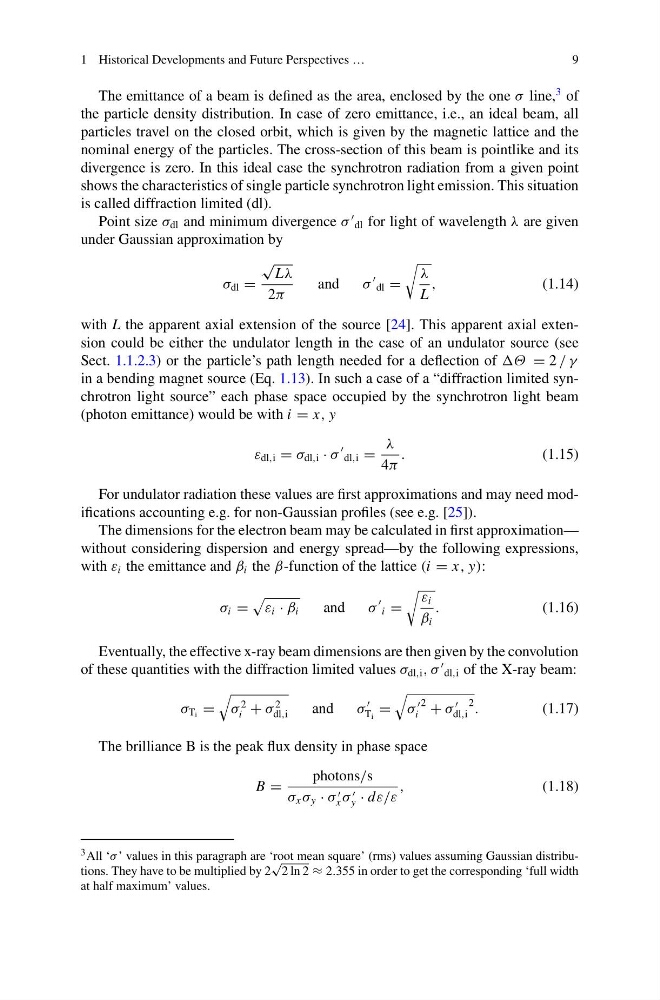
The emittance of a beam is defined as the area, enclosed by the one σ line,
3 of
the particle density distribution. In case of zero emittance, i.e., an ideal beam, all
particles travel on the closed orbit, which is given by the magnetic lattice and the
nominal energy of the particles. The cross-section of this beam is pointlike and its
divergence is zero. In this ideal case the synchrotron radiation from a given point
shows the characteristics of single particle synchrotron light emission. This situation
is called diffraction limited (dl).
Point size σ dl and minimum divergence σ
dl for light of wavelength λ are given
under Gaussian approximation by
σ dl =
√
Lλ
2π
and
σ
dl =
λ
L
,
(1.14)
with L the apparent axial extension of the source [24]. This apparent axial extension could be either the undulator length in the case of an undulator source (see
Sect. 1.1.2.3) or the particle’s path length needed for a deflection of Θ = 2 / γ
in a bending magnet source (Eq. 1.13). In such a case of a “diffraction limited synchrotron light source” each phase space occupied by the synchrotron light beam
(photon emittance) would be with i = x, y
ε dl,i = σ dl,i · σ
dl,i =
λ
4π
.
(1.15)
For undulator radiation these values are first approximations and may need modifications accounting e.g. for non-Gaussian profiles (see e.g. [25]).
The dimensions for the electron beam may be calculated in first approximation—
without considering dispersion and energy spread—by the following expressions,
with ε i the emittance and β i the β-function of the lattice (i = x, y):
σ i =
ε i · β i
and
σ
i =
ε i
β i
.
(1.16)
Eventually, the effective x-ray beam dimensions are then given by the convolution
of these quantities with the diffraction limited values σ dl,i , σ
dl,i of the X-ray beam:
σ T i =
σ
2
i + σ
2
dl,i
and
σ
T i
=
σ
i
2 + σ
dl,i
2 .
(1.17)
The brilliance B is the peak flux density in phase space
B =
photons/s
σ x σ y · σ
x σ
y · dε/ε
,
(1.18)
3 All ‘σ ’ values in this paragraph are ‘root mean square’ (rms) values assuming Gaussian distributions. They have to be multiplied by 2
√
2 ln 2 ≈ 2.355 in order to get the corresponding ‘full width
at half maximum’ values.
9
The emittance of a beam is defined as the area, enclosed by the one σ line,
3 of
the particle density distribution. In case of zero emittance, i.e., an ideal beam, all
particles travel on the closed orbit, which is given by the magnetic lattice and the
nominal energy of the particles. The cross-section of this beam is pointlike and its
divergence is zero. In this ideal case the synchrotron radiation from a given point
shows the characteristics of single particle synchrotron light emission. This situation
is called diffraction limited (dl).
Point size σ dl and minimum divergence σ
dl for light of wavelength λ are given
under Gaussian approximation by
σ dl =
√
Lλ
2π
and
σ
dl =
λ
L
,
(1.14)
with L the apparent axial extension of the source [24]. This apparent axial extension could be either the undulator length in the case of an undulator source (see
Sect. 1.1.2.3) or the particle’s path length needed for a deflection of Θ = 2 / γ
in a bending magnet source (Eq. 1.13). In such a case of a “diffraction limited synchrotron light source” each phase space occupied by the synchrotron light beam
(photon emittance) would be with i = x, y
ε dl,i = σ dl,i · σ
dl,i =
λ
4π
.
(1.15)
For undulator radiation these values are first approximations and may need modifications accounting e.g. for non-Gaussian profiles (see e.g. [25]).
The dimensions for the electron beam may be calculated in first approximation—
without considering dispersion and energy spread—by the following expressions,
with ε i the emittance and β i the β-function of the lattice (i = x, y):
σ i =
ε i · β i
and
σ
i =
ε i
β i
.
(1.16)
Eventually, the effective x-ray beam dimensions are then given by the convolution
of these quantities with the diffraction limited values σ dl,i , σ
dl,i of the X-ray beam:
σ T i =
σ
2
i + σ
2
dl,i
and
σ
T i
=
σ
i
2 + σ
dl,i
2 .
(1.17)
The brilliance B is the peak flux density in phase space
B =
photons/s
σ x σ y · σ
x σ
y · dε/ε
,
(1.18)
3 All ‘σ ’ values in this paragraph are ‘root mean square’ (rms) values assuming Gaussian distributions. They have to be multiplied by 2
√
2 ln 2 ≈ 2.355 in order to get the corresponding ‘full width
at half maximum’ values.