

5 Mössbauer Spectroscopy with High Spatial Resolution …
229
spectrum (Fig. 5.3b) can be reached by measuring the sample using a conventional
source for 36 days, assuming that the count rate remains constant with time. This
possibility may be a feasible alternative to purchasing a point source if measuring
time is not constrained, since the thickness of a conventional source does not change
appreciably with time (Fig. 5.2).
5.2.4.2 Point Source and SMS Comparison
Samples less than 100 μm in diameter can be measured with a point source if effective
sample thickness is high (Sect. 5.4.4), sufficient time is available for the measurement
and good spectrum quality is not a priority. Synthetic bridgmanite with composition
Fe 0.4 Mg 0.6 Si 0.63 Al 0.37 O 3 was prepared at high pressure using iron enriched with 90%
57 Fe [18].
The sample used was approximately 30 μm in diameter and 15 μm thick, giving a
dimensionless effective sample thickness of 20 (Sect. 5.4.4). The sample was loaded
into a diamond anvil cell and compressed to 93 GPa, and spectra were collected until
an acceptable quality was reached, which was 7 days for the point source and 10 min
for SMS.
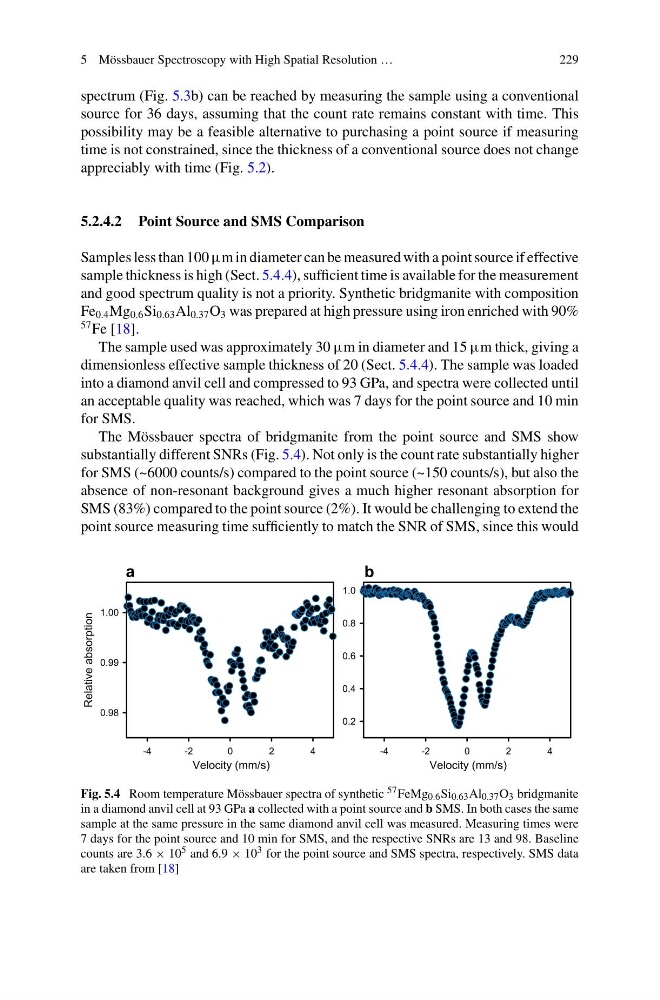
The Mössbauer spectra of bridgmanite from the point source and SMS show
substantially different SNRs (Fig. 5.4). Not only is the count rate substantially higher
for SMS (~6000 counts/s) compared to the point source (~150 counts/s), but also the
absence of non-resonant background gives a much higher resonant absorption for
SMS (83%) compared to the point source (2%). It would be challenging to extend the
point source measuring time sufficiently to match the SNR of SMS, since this would
Fig. 5.4 Room temperature Mössbauer spectra of synthetic 57 FeMg 0.6 Si 0.63 Al 0.37 O 3 bridgmanite
in a diamond anvil cell at 93 GPa a collected with a point source and b SMS. In both cases the same
sample at the same pressure in the same diamond anvil cell was measured. Measuring times were
7 days for the point source and 10 min for SMS, and the respective SNRs are 13 and 98. Baseline
counts are 3.6 × 10 5 and 6.9 × 10 3 for the point source and SMS spectra, respectively. SMS data
are taken from [18]
229
spectrum (Fig. 5.3b) can be reached by measuring the sample using a conventional
source for 36 days, assuming that the count rate remains constant with time. This
possibility may be a feasible alternative to purchasing a point source if measuring
time is not constrained, since the thickness of a conventional source does not change
appreciably with time (Fig. 5.2).
5.2.4.2 Point Source and SMS Comparison
Samples less than 100 μm in diameter can be measured with a point source if effective
sample thickness is high (Sect. 5.4.4), sufficient time is available for the measurement
and good spectrum quality is not a priority. Synthetic bridgmanite with composition
Fe 0.4 Mg 0.6 Si 0.63 Al 0.37 O 3 was prepared at high pressure using iron enriched with 90%
57 Fe [18].
The sample used was approximately 30 μm in diameter and 15 μm thick, giving a
dimensionless effective sample thickness of 20 (Sect. 5.4.4). The sample was loaded
into a diamond anvil cell and compressed to 93 GPa, and spectra were collected until
an acceptable quality was reached, which was 7 days for the point source and 10 min
for SMS.
The Mössbauer spectra of bridgmanite from the point source and SMS show
substantially different SNRs (Fig. 5.4). Not only is the count rate substantially higher
for SMS (~6000 counts/s) compared to the point source (~150 counts/s), but also the
absence of non-resonant background gives a much higher resonant absorption for
SMS (83%) compared to the point source (2%). It would be challenging to extend the
point source measuring time sufficiently to match the SNR of SMS, since this would
Fig. 5.4 Room temperature Mössbauer spectra of synthetic 57 FeMg 0.6 Si 0.63 Al 0.37 O 3 bridgmanite
in a diamond anvil cell at 93 GPa a collected with a point source and b SMS. In both cases the same
sample at the same pressure in the same diamond anvil cell was measured. Measuring times were
7 days for the point source and 10 min for SMS, and the respective SNRs are 13 and 98. Baseline
counts are 3.6 × 10 5 and 6.9 × 10 3 for the point source and SMS spectra, respectively. SMS data
are taken from [18]