

224
C. McCammon
5.2.1 Conventional Radioactive Source
57 Co is the commonly used radioactive parent of
57 Fe 14.4 keV γ-rays. The magnetic
ordering temperature of cobalt is around 1404 K [5], however, so pure
57 Co sources
are not used since they would emit γ-rays with multiple energies. The strategy used
to obtain
57 Co sources that emit a single narrow line is to diffuse
57 Co into a nonmetallic matrix, e.g., [6]. Properties to consider in choosing a matrix include good
chemical stability, high cobalt and iron solubility, favourable crystal and electronic
structure (isotropic and non-magnetic), high recoilless fraction and negligible X-ray
fluorescence near 14.4 keV [7]. Further considerations relate to the intended use of
the source, for example at low temperature or in high external magnetic fields. While
no matrix perfectly satisfies all requirements, rhodium is the best all-around choice
[7] and indeed is currently the most commonly used matrix in commercial sources.
The strength and flux of the source is determined by its physical dimensions as
well as the amount of
57 Co contained in the source matrix. The thickness of the
source foil affects the emission efficiency of γ-rays, where thinner foils allow more
γ-rays to escape the source matrix. The thickness also affects the source line width,
where thinner foils have a higher degree of internal resonance (excitation of
57 Fe in
the source by emitted γ-rays). A useful metric for internal resonance is the effective
source thickness, t s , given by:
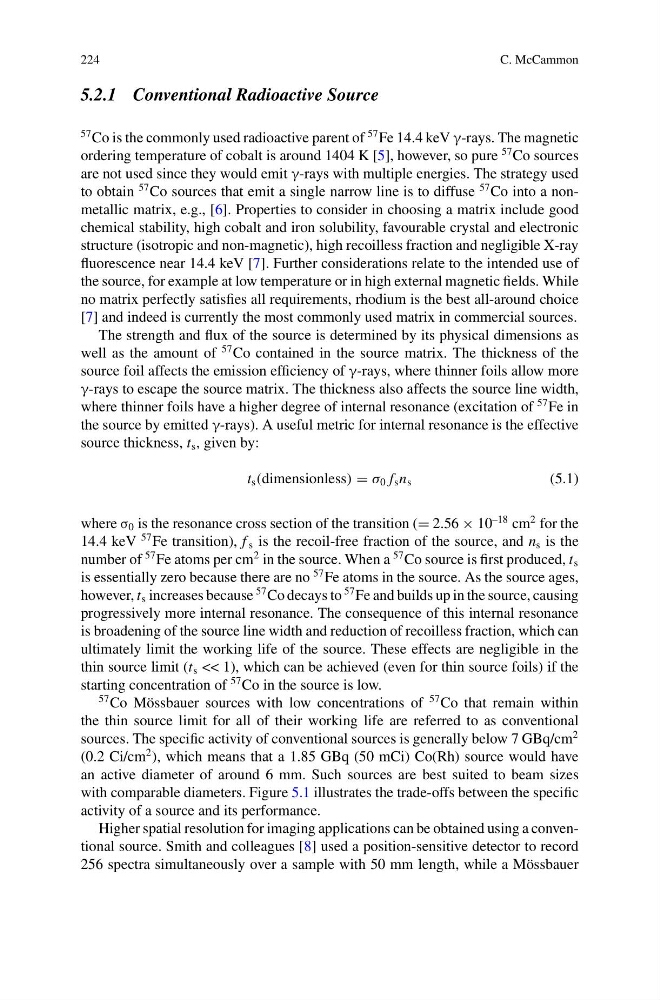
t s (dimensionless) = σ 0 f s n s
(5.1)
where σ 0 is the resonance cross section of the transition (= 2.56 × 10
–18 cm
2 for the
14.4 keV
57 Fe transition), f s is the recoil-free fraction of the source, and n s is the
number of
57 Fe atoms per cm
2 in the source. When a
57 Co source is first produced, t s
is essentially zero because there are no
57 Fe atoms in the source. As the source ages,
however, t s increases because
57 Co decays to
57 Fe and builds up in the source, causing
progressively more internal resonance. The consequence of this internal resonance
is broadening of the source line width and reduction of recoilless fraction, which can
ultimately limit the working life of the source. These effects are negligible in the
thin source limit (t s << 1), which can be achieved (even for thin source foils) if the
starting concentration of
57 Co in the source is low.
57 Co Mössbauer sources with low concentrations of
57 Co that remain within
the thin source limit for all of their working life are referred to as conventional
sources. The specific activity of conventional sources is generally below 7 GBq/cm
2
(0.2 Ci/cm
2 ), which means that a 1.85 GBq (50 mCi) Co(Rh) source would have
an active diameter of around 6 mm. Such sources are best suited to beam sizes
with comparable diameters. Figure 5.1 illustrates the trade-offs between the specific
activity of a source and its performance.
Higher spatial resolution for imaging applications can be obtained using a conventional source. Smith and colleagues [8] used a position-sensitive detector to record
256 spectra simultaneously over a sample with 50 mm length, while a Mössbauer
C. McCammon
5.2.1 Conventional Radioactive Source
57 Co is the commonly used radioactive parent of
57 Fe 14.4 keV γ-rays. The magnetic
ordering temperature of cobalt is around 1404 K [5], however, so pure
57 Co sources
are not used since they would emit γ-rays with multiple energies. The strategy used
to obtain
57 Co sources that emit a single narrow line is to diffuse
57 Co into a nonmetallic matrix, e.g., [6]. Properties to consider in choosing a matrix include good
chemical stability, high cobalt and iron solubility, favourable crystal and electronic
structure (isotropic and non-magnetic), high recoilless fraction and negligible X-ray
fluorescence near 14.4 keV [7]. Further considerations relate to the intended use of
the source, for example at low temperature or in high external magnetic fields. While
no matrix perfectly satisfies all requirements, rhodium is the best all-around choice
[7] and indeed is currently the most commonly used matrix in commercial sources.
The strength and flux of the source is determined by its physical dimensions as
well as the amount of
57 Co contained in the source matrix. The thickness of the
source foil affects the emission efficiency of γ-rays, where thinner foils allow more
γ-rays to escape the source matrix. The thickness also affects the source line width,
where thinner foils have a higher degree of internal resonance (excitation of
57 Fe in
the source by emitted γ-rays). A useful metric for internal resonance is the effective
source thickness, t s , given by:
t s (dimensionless) = σ 0 f s n s
(5.1)
where σ 0 is the resonance cross section of the transition (= 2.56 × 10
–18 cm
2 for the
14.4 keV
57 Fe transition), f s is the recoil-free fraction of the source, and n s is the
number of
57 Fe atoms per cm
2 in the source. When a
57 Co source is first produced, t s
is essentially zero because there are no
57 Fe atoms in the source. As the source ages,
however, t s increases because
57 Co decays to
57 Fe and builds up in the source, causing
progressively more internal resonance. The consequence of this internal resonance
is broadening of the source line width and reduction of recoilless fraction, which can
ultimately limit the working life of the source. These effects are negligible in the
thin source limit (t s << 1), which can be achieved (even for thin source foils) if the
starting concentration of
57 Co in the source is low.
57 Co Mössbauer sources with low concentrations of
57 Co that remain within
the thin source limit for all of their working life are referred to as conventional
sources. The specific activity of conventional sources is generally below 7 GBq/cm
2
(0.2 Ci/cm
2 ), which means that a 1.85 GBq (50 mCi) Co(Rh) source would have
an active diameter of around 6 mm. Such sources are best suited to beam sizes
with comparable diameters. Figure 5.1 illustrates the trade-offs between the specific
activity of a source and its performance.
Higher spatial resolution for imaging applications can be obtained using a conventional source. Smith and colleagues [8] used a position-sensitive detector to record
256 spectra simultaneously over a sample with 50 mm length, while a Mössbauer