

1 Historical Developments and Future Perspectives …
7
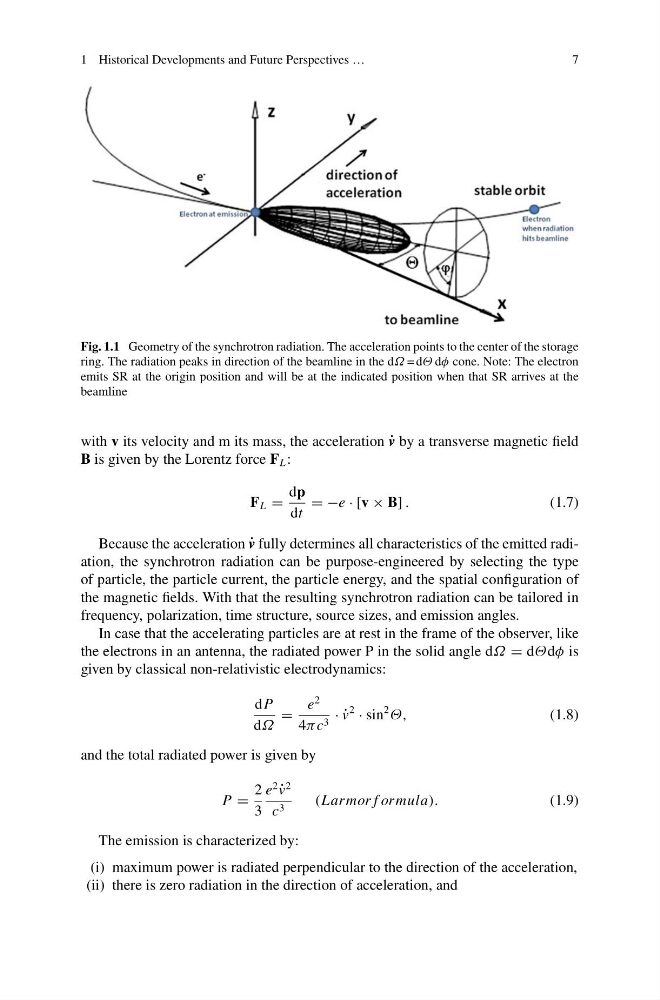
Fig. 1.1 Geometry of the synchrotron radiation. The acceleration points to the center of the storage
ring. The radiation peaks in direction of the beamline in the dΩ = dΘ dφ cone. Note: The electron
emits SR at the origin position and will be at the indicated position when that SR arrives at the
beamline
with v its velocity and m its mass, the acceleration ˙
v by a transverse magnetic field
B is given by the Lorentz force F L :
F L =
dp
dt
= −e · [v × B] .
(1.7)
Because the acceleration ˙
v fully determines all characteristics of the emitted radiation, the synchrotron radiation can be purpose-engineered by selecting the type
of particle, the particle current, the particle energy, and the spatial configuration of
the magnetic fields. With that the resulting synchrotron radiation can be tailored in
frequency, polarization, time structure, source sizes, and emission angles.
In case that the accelerating particles are at rest in the frame of the observer, like
the electrons in an antenna, the radiated power P in the solid angle dΩ = dΘdφ is
given by classical non-relativistic electrodynamics:
d P
dΩ
=
e
2
4π c 3 · ˙
v
2
· sin
2
Θ,
(1.8)
and the total radiated power is given by
P =
2
3
e
2
˙
v
2
c 3
(Larmor f ormula).
(1.9)
The emission is characterized by:
(i) maximum power is radiated perpendicular to the direction of the acceleration,
(ii) there is zero radiation in the direction of acceleration, and
7
Fig. 1.1 Geometry of the synchrotron radiation. The acceleration points to the center of the storage
ring. The radiation peaks in direction of the beamline in the dΩ = dΘ dφ cone. Note: The electron
emits SR at the origin position and will be at the indicated position when that SR arrives at the
beamline
with v its velocity and m its mass, the acceleration ˙
v by a transverse magnetic field
B is given by the Lorentz force F L :
F L =
dp
dt
= −e · [v × B] .
(1.7)
Because the acceleration ˙
v fully determines all characteristics of the emitted radiation, the synchrotron radiation can be purpose-engineered by selecting the type
of particle, the particle current, the particle energy, and the spatial configuration of
the magnetic fields. With that the resulting synchrotron radiation can be tailored in
frequency, polarization, time structure, source sizes, and emission angles.
In case that the accelerating particles are at rest in the frame of the observer, like
the electrons in an antenna, the radiated power P in the solid angle dΩ = dΘdφ is
given by classical non-relativistic electrodynamics:
d P
dΩ
=
e
2
4π c 3 · ˙
v
2
· sin
2
Θ,
(1.8)
and the total radiated power is given by
P =
2
3
e
2
˙
v
2
c 3
(Larmor f ormula).
(1.9)
The emission is characterized by:
(i) maximum power is radiated perpendicular to the direction of the acceleration,
(ii) there is zero radiation in the direction of acceleration, and