

4 From Small Molecules to Complex Systems: A Survey of Chemical …
203
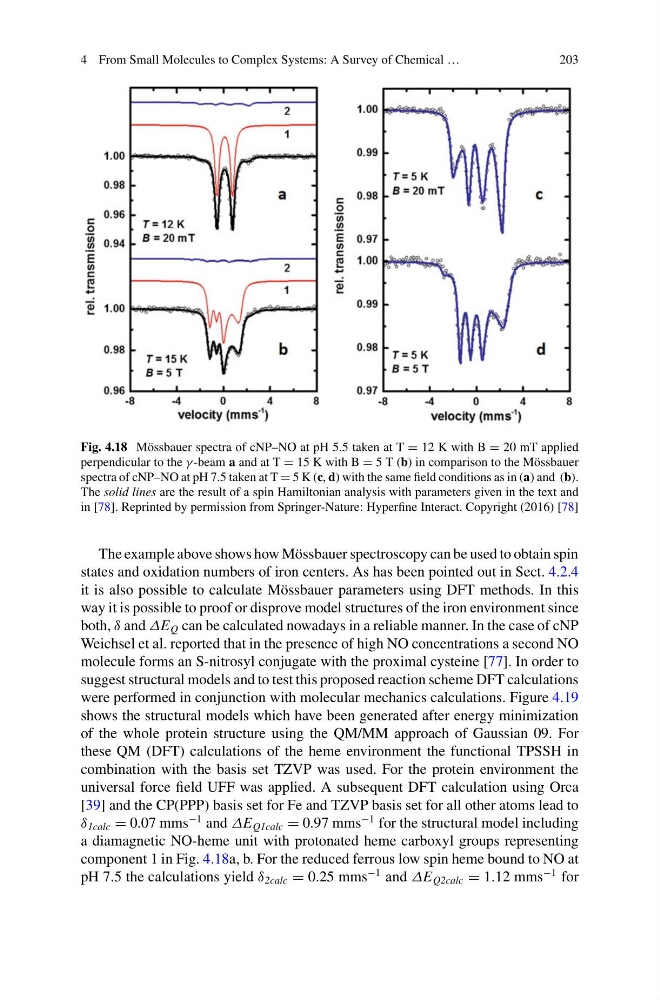
Fig. 4.18 Mössbauer spectra of cNP–NO at pH 5.5 taken at T = 12 K with B = 20 mT applied
perpendicular to the γ -beam a and at T = 15 K with B = 5 T (b) in comparison to the Mössbauer
spectra of cNP–NO at pH 7.5 taken at T = 5 K (c, d) with the same field conditions as in (a) and (b).
The solid lines are the result of a spin Hamiltonian analysis with parameters given in the text and
in [78]. Reprinted by permission from Springer-Nature: Hyperfine Interact. Copyright (2016) [78]
The example above shows how Mössbauer spectroscopy can be used to obtain spin
states and oxidation numbers of iron centers. As has been pointed out in Sect. 4.2.4
it is also possible to calculate Mössbauer parameters using DFT methods. In this
way it is possible to proof or disprove model structures of the iron environment since
both, δ and ΔE Q can be calculated nowadays in a reliable manner. In the case of cNP
Weichsel et al. reported that in the presence of high NO concentrations a second NO
molecule forms an S-nitrosyl conjugate with the proximal cysteine [77]. In order to
suggest structural models and to test this proposed reaction scheme DFT calculations
were performed in conjunction with molecular mechanics calculations. Figure 4.19
shows the structural models which have been generated after energy minimization
of the whole protein structure using the QM/MM approach of Gaussian 09. For
these QM (DFT) calculations of the heme environment the functional TPSSH in
combination with the basis set TZVP was used. For the protein environment the
universal force field UFF was applied. A subsequent DFT calculation using Orca
[39] and the CP(PPP) basis set for Fe and TZVP basis set for all other atoms lead to
δ 1calc = 0.07 mms
−1 and ΔE Q1calc = 0.97 mms
−1 for the structural model including
a diamagnetic NO-heme unit with protonated heme carboxyl groups representing
component 1 in Fig. 4.18a, b. For the reduced ferrous low spin heme bound to NO at
pH 7.5 the calculations yield δ 2calc = 0.25 mms
−1 and ΔE Q2calc = 1.12 mms
−1 for
203
Fig. 4.18 Mössbauer spectra of cNP–NO at pH 5.5 taken at T = 12 K with B = 20 mT applied
perpendicular to the γ -beam a and at T = 15 K with B = 5 T (b) in comparison to the Mössbauer
spectra of cNP–NO at pH 7.5 taken at T = 5 K (c, d) with the same field conditions as in (a) and (b).
The solid lines are the result of a spin Hamiltonian analysis with parameters given in the text and
in [78]. Reprinted by permission from Springer-Nature: Hyperfine Interact. Copyright (2016) [78]
The example above shows how Mössbauer spectroscopy can be used to obtain spin
states and oxidation numbers of iron centers. As has been pointed out in Sect. 4.2.4
it is also possible to calculate Mössbauer parameters using DFT methods. In this
way it is possible to proof or disprove model structures of the iron environment since
both, δ and ΔE Q can be calculated nowadays in a reliable manner. In the case of cNP
Weichsel et al. reported that in the presence of high NO concentrations a second NO
molecule forms an S-nitrosyl conjugate with the proximal cysteine [77]. In order to
suggest structural models and to test this proposed reaction scheme DFT calculations
were performed in conjunction with molecular mechanics calculations. Figure 4.19
shows the structural models which have been generated after energy minimization
of the whole protein structure using the QM/MM approach of Gaussian 09. For
these QM (DFT) calculations of the heme environment the functional TPSSH in
combination with the basis set TZVP was used. For the protein environment the
universal force field UFF was applied. A subsequent DFT calculation using Orca
[39] and the CP(PPP) basis set for Fe and TZVP basis set for all other atoms lead to
δ 1calc = 0.07 mms
−1 and ΔE Q1calc = 0.97 mms
−1 for the structural model including
a diamagnetic NO-heme unit with protonated heme carboxyl groups representing
component 1 in Fig. 4.18a, b. For the reduced ferrous low spin heme bound to NO at
pH 7.5 the calculations yield δ 2calc = 0.25 mms
−1 and ΔE Q2calc = 1.12 mms
−1 for