

4 From Small Molecules to Complex Systems: A Survey of Chemical …
191
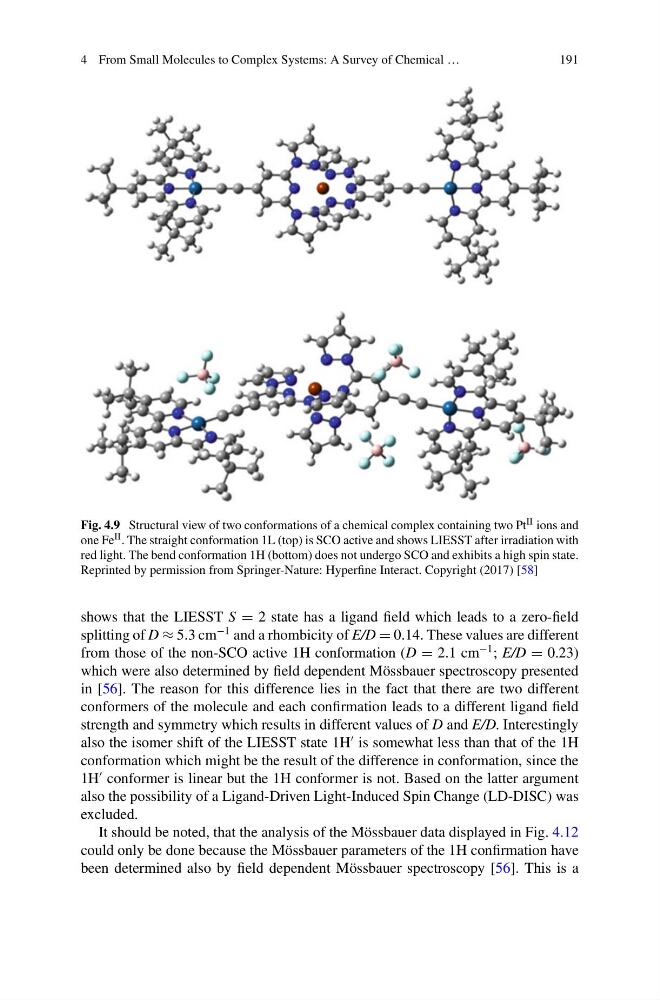
Fig. 4.9 Structural view of two conformations of a chemical complex containing two Pt II ions and
one Fe II . The straight conformation 1L (top) is SCO active and shows LIESST after irradiation with
red light. The bend conformation 1H (bottom) does not undergo SCO and exhibits a high spin state.
Reprinted by permission from Springer-Nature: Hyperfine Interact. Copyright (2017) [58]
shows that the LIESST S = 2 state has a ligand field which leads to a zero-field
splitting of D ≈ 5.3 cm
−1 and a rhombicity of E/D = 0.14. These values are different
from those of the non-SCO active 1H conformation (D = 2.1 cm
−1 ; E/D = 0.23)
which were also determined by field dependent Mössbauer spectroscopy presented
in [56]. The reason for this difference lies in the fact that there are two different
conformers of the molecule and each confirmation leads to a different ligand field
strength and symmetry which results in different values of D and E/D. Interestingly
also the isomer shift of the LIESST state 1H
is somewhat less than that of the 1H
conformation which might be the result of the difference in conformation, since the
1H
conformer is linear but the 1H conformer is not. Based on the latter argument
also the possibility of a Ligand-Driven Light-Induced Spin Change (LD-DISC) was
excluded.
It should be noted, that the analysis of the Mössbauer data displayed in Fig. 4.12
could only be done because the Mössbauer parameters of the 1H confirmation have
been determined also by field dependent Mössbauer spectroscopy [56]. This is a
191
Fig. 4.9 Structural view of two conformations of a chemical complex containing two Pt II ions and
one Fe II . The straight conformation 1L (top) is SCO active and shows LIESST after irradiation with
red light. The bend conformation 1H (bottom) does not undergo SCO and exhibits a high spin state.
Reprinted by permission from Springer-Nature: Hyperfine Interact. Copyright (2017) [58]
shows that the LIESST S = 2 state has a ligand field which leads to a zero-field
splitting of D ≈ 5.3 cm
−1 and a rhombicity of E/D = 0.14. These values are different
from those of the non-SCO active 1H conformation (D = 2.1 cm
−1 ; E/D = 0.23)
which were also determined by field dependent Mössbauer spectroscopy presented
in [56]. The reason for this difference lies in the fact that there are two different
conformers of the molecule and each confirmation leads to a different ligand field
strength and symmetry which results in different values of D and E/D. Interestingly
also the isomer shift of the LIESST state 1H
is somewhat less than that of the 1H
conformation which might be the result of the difference in conformation, since the
1H
conformer is linear but the 1H conformer is not. Based on the latter argument
also the possibility of a Ligand-Driven Light-Induced Spin Change (LD-DISC) was
excluded.
It should be noted, that the analysis of the Mössbauer data displayed in Fig. 4.12
could only be done because the Mössbauer parameters of the 1H confirmation have
been determined also by field dependent Mössbauer spectroscopy [56]. This is a