

4
R. Rüffer and A. I. Chumakov
are the same nuclear resonance scattering was only discovered by Mößbauer in 1958
[1]. What are the reasons for this late discovery?
There are some important differences in the scattering of “optical” x-rays and γ -
rays. First of all the transition energies E 0 are in the range of 1–10 eV and 10–100 keV,
respectively. Further, the relative energy width E/E 0 of the involved atomic and
nuclear levels are quite different partly due to the different excitation energies. As
a consequence the recoil connected with the absorption and emission of a photon
is a special problem for γ -rays because their recoil energy is so large that there is
virtually no overlap of the absorption and emission lines in single atoms.
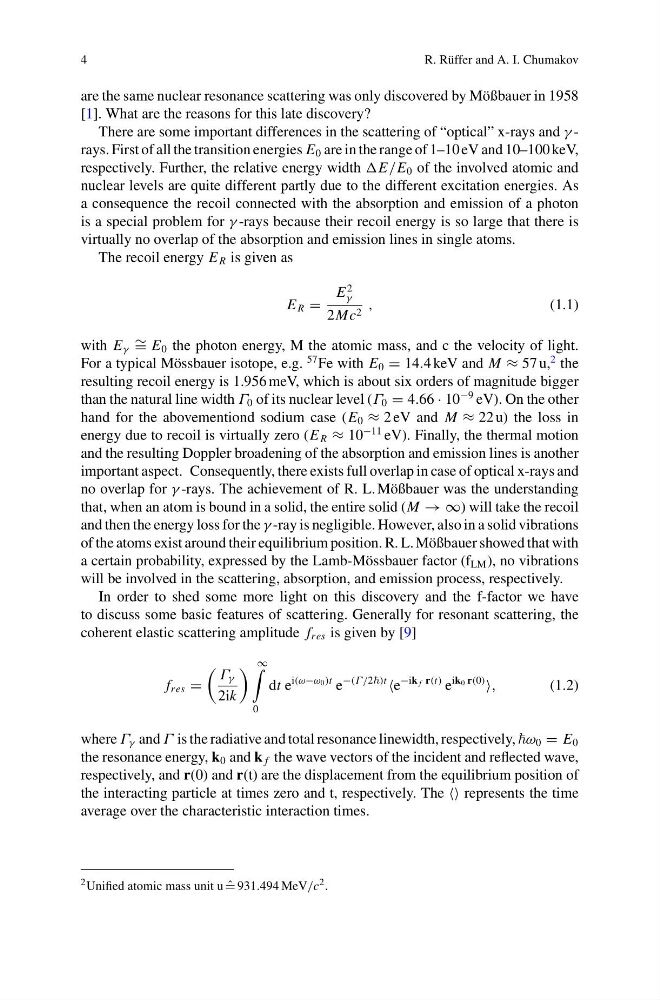
The recoil energy E R is given as
E R =
E
2
γ
2Mc 2 ,
(1.1)
with E γ ∼ = E 0 the photon energy, M the atomic mass, and c the velocity of light.
For a typical Mössbauer isotope, e.g.
57 Fe with E 0 = 14.4 keV and M ≈ 57 u,
2 the
resulting recoil energy is 1.956 meV, which is about six orders of magnitude bigger
than the natural line width Γ 0 of its nuclear level (Γ 0 = 4.66 · 10
−9 eV). On the other
hand for the abovementiond sodium case (E 0 ≈ 2 eV and M ≈ 22 u) the loss in
energy due to recoil is virtually zero (E R ≈ 10
−11 eV). Finally, the thermal motion
and the resulting Doppler broadening of the absorption and emission lines is another
important aspect. Consequently, there exists full overlap in case of optical x-rays and
no overlap for γ -rays. The achievement of R. L. Mößbauer was the understanding
that, when an atom is bound in a solid, the entire solid (M → ∞) will take the recoil
and then the energy loss for the γ -ray is negligible. However, also in a solid vibrations
of the atoms exist around their equilibrium position. R. L. Mößbauer showed that with
a certain probability, expressed by the Lamb-Mössbauer factor (f LM ), no vibrations
will be involved in the scattering, absorption, and emission process, respectively.
In order to shed some more light on this discovery and the f-factor we have
to discuss some basic features of scattering. Generally for resonant scattering, the
coherent elastic scattering amplitude f res is given by [9]
f res =
Γ γ
2ik
∞
0
dt e
i(ω−ω 0 )t e
−(Γ /2)t
e
−ik f r(t) e
ik 0 r(0)
,
(1.2)
where Γ γ and Γ is the radiative and total resonance linewidth, respectively, ω 0 = E 0
the resonance energy, k 0 and k f the wave vectors of the incident and reflected wave,
respectively, and r(0) and r(t) are the displacement from the equilibrium position of
the interacting particle at times zero and t, respectively. The represents the time
average over the characteristic interaction times.
2 Unified atomic mass unit u ˆ
= 931.494 MeV/c 2 .
R. Rüffer and A. I. Chumakov
are the same nuclear resonance scattering was only discovered by Mößbauer in 1958
[1]. What are the reasons for this late discovery?
There are some important differences in the scattering of “optical” x-rays and γ -
rays. First of all the transition energies E 0 are in the range of 1–10 eV and 10–100 keV,
respectively. Further, the relative energy width E/E 0 of the involved atomic and
nuclear levels are quite different partly due to the different excitation energies. As
a consequence the recoil connected with the absorption and emission of a photon
is a special problem for γ -rays because their recoil energy is so large that there is
virtually no overlap of the absorption and emission lines in single atoms.
The recoil energy E R is given as
E R =
E
2
γ
2Mc 2 ,
(1.1)
with E γ ∼ = E 0 the photon energy, M the atomic mass, and c the velocity of light.
For a typical Mössbauer isotope, e.g.
57 Fe with E 0 = 14.4 keV and M ≈ 57 u,
2 the
resulting recoil energy is 1.956 meV, which is about six orders of magnitude bigger
than the natural line width Γ 0 of its nuclear level (Γ 0 = 4.66 · 10
−9 eV). On the other
hand for the abovementiond sodium case (E 0 ≈ 2 eV and M ≈ 22 u) the loss in
energy due to recoil is virtually zero (E R ≈ 10
−11 eV). Finally, the thermal motion
and the resulting Doppler broadening of the absorption and emission lines is another
important aspect. Consequently, there exists full overlap in case of optical x-rays and
no overlap for γ -rays. The achievement of R. L. Mößbauer was the understanding
that, when an atom is bound in a solid, the entire solid (M → ∞) will take the recoil
and then the energy loss for the γ -ray is negligible. However, also in a solid vibrations
of the atoms exist around their equilibrium position. R. L. Mößbauer showed that with
a certain probability, expressed by the Lamb-Mössbauer factor (f LM ), no vibrations
will be involved in the scattering, absorption, and emission process, respectively.
In order to shed some more light on this discovery and the f-factor we have
to discuss some basic features of scattering. Generally for resonant scattering, the
coherent elastic scattering amplitude f res is given by [9]
f res =
Γ γ
2ik
∞
0
dt e
i(ω−ω 0 )t e
−(Γ /2)t
e
−ik f r(t) e
ik 0 r(0)
,
(1.2)
where Γ γ and Γ is the radiative and total resonance linewidth, respectively, ω 0 = E 0
the resonance energy, k 0 and k f the wave vectors of the incident and reflected wave,
respectively, and r(0) and r(t) are the displacement from the equilibrium position of
the interacting particle at times zero and t, respectively. The represents the time
average over the characteristic interaction times.
2 Unified atomic mass unit u ˆ
= 931.494 MeV/c 2 .