

4 From Small Molecules to Complex Systems: A Survey of Chemical …
183
E
B
E
M s
Free Ion
Ion in axial
ligand field
Zeeman splitting in a magnetic
field
Kramers
doublets
B
a
b
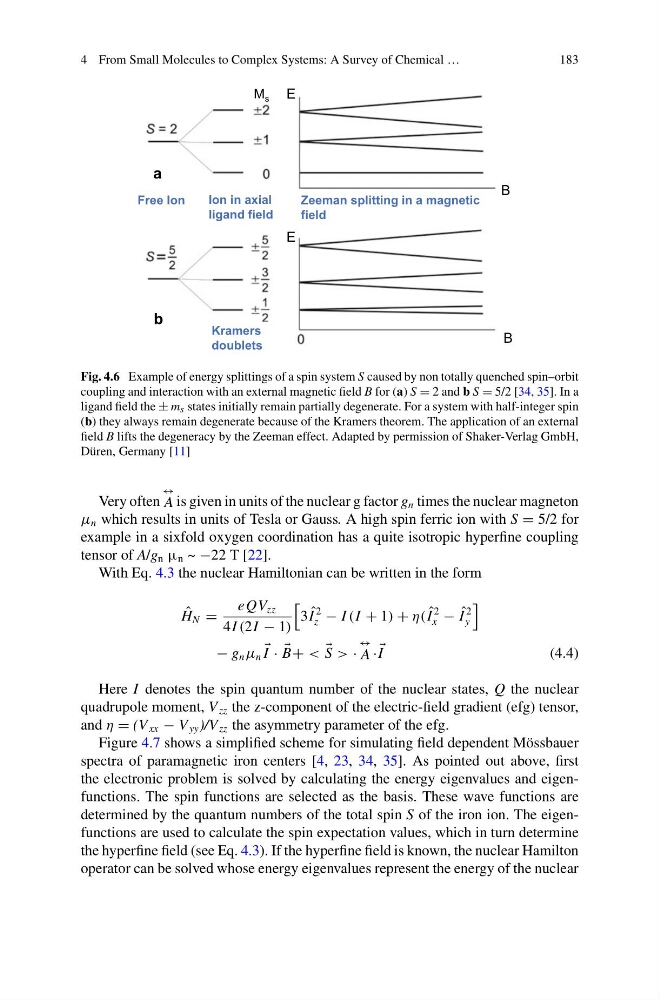
Fig. 4.6 Example of energy splittings of a spin system S caused by non totally quenched spin–orbit
coupling and interaction with an external magnetic field B for (a) S = 2 and b S = 5/2 [34, 35]. In a
ligand field the ± m s states initially remain partially degenerate. For a system with half-integer spin
(b) they always remain degenerate because of the Kramers theorem. The application of an external
field B lifts the degeneracy by the Zeeman effect. Adapted by permission of Shaker-Verlag GmbH,
Düren, Germany [11]
Very often
↔
A is given in units of the nuclear g factor g n times the nuclear magneton
μ n which results in units of Tesla or Gauss. A high spin ferric ion with S = 5/2 for
example in a sixfold oxygen coordination has a quite isotropic hyperfine coupling
tensor of A/g n μ n ~ −22 T [22].
With Eq. 4.3 the nuclear Hamiltonian can be written in the form
ˆ
H N =
eQV zz
4I (2I − 1)
3 ˆ
I
2
z − I (I + 1) + η( ˆ
I
2
x − ˆ
I
2
y
− g n μ n
I ·
B+ <
S > ·
↔
A ·
I
(4.4)
Here I denotes the spin quantum number of the nuclear states, Q the nuclear
quadrupole moment, V zz the z-component of the electric-field gradient (efg) tensor,
and η = (V xx − V yy )/V zz the asymmetry parameter of the efg.
Figure 4.7 shows a simplified scheme for simulating field dependent Mössbauer
spectra of paramagnetic iron centers [4, 23, 34, 35]. As pointed out above, first
the electronic problem is solved by calculating the energy eigenvalues and eigenfunctions. The spin functions are selected as the basis. These wave functions are
determined by the quantum numbers of the total spin S of the iron ion. The eigenfunctions are used to calculate the spin expectation values, which in turn determine
the hyperfine field (see Eq. 4.3). If the hyperfine field is known, the nuclear Hamilton
operator can be solved whose energy eigenvalues represent the energy of the nuclear
183
E
B
E
M s
Free Ion
Ion in axial
ligand field
Zeeman splitting in a magnetic
field
Kramers
doublets
B
a
b
Fig. 4.6 Example of energy splittings of a spin system S caused by non totally quenched spin–orbit
coupling and interaction with an external magnetic field B for (a) S = 2 and b S = 5/2 [34, 35]. In a
ligand field the ± m s states initially remain partially degenerate. For a system with half-integer spin
(b) they always remain degenerate because of the Kramers theorem. The application of an external
field B lifts the degeneracy by the Zeeman effect. Adapted by permission of Shaker-Verlag GmbH,
Düren, Germany [11]
Very often
↔
A is given in units of the nuclear g factor g n times the nuclear magneton
μ n which results in units of Tesla or Gauss. A high spin ferric ion with S = 5/2 for
example in a sixfold oxygen coordination has a quite isotropic hyperfine coupling
tensor of A/g n μ n ~ −22 T [22].
With Eq. 4.3 the nuclear Hamiltonian can be written in the form
ˆ
H N =
eQV zz
4I (2I − 1)
3 ˆ
I
2
z − I (I + 1) + η( ˆ
I
2
x − ˆ
I
2
y
− g n μ n
I ·
B+ <
S > ·
↔
A ·
I
(4.4)
Here I denotes the spin quantum number of the nuclear states, Q the nuclear
quadrupole moment, V zz the z-component of the electric-field gradient (efg) tensor,
and η = (V xx − V yy )/V zz the asymmetry parameter of the efg.
Figure 4.7 shows a simplified scheme for simulating field dependent Mössbauer
spectra of paramagnetic iron centers [4, 23, 34, 35]. As pointed out above, first
the electronic problem is solved by calculating the energy eigenvalues and eigenfunctions. The spin functions are selected as the basis. These wave functions are
determined by the quantum numbers of the total spin S of the iron ion. The eigenfunctions are used to calculate the spin expectation values, which in turn determine
the hyperfine field (see Eq. 4.3). If the hyperfine field is known, the nuclear Hamilton
operator can be solved whose energy eigenvalues represent the energy of the nuclear