

4 From Small Molecules to Complex Systems: A Survey of Chemical …
179
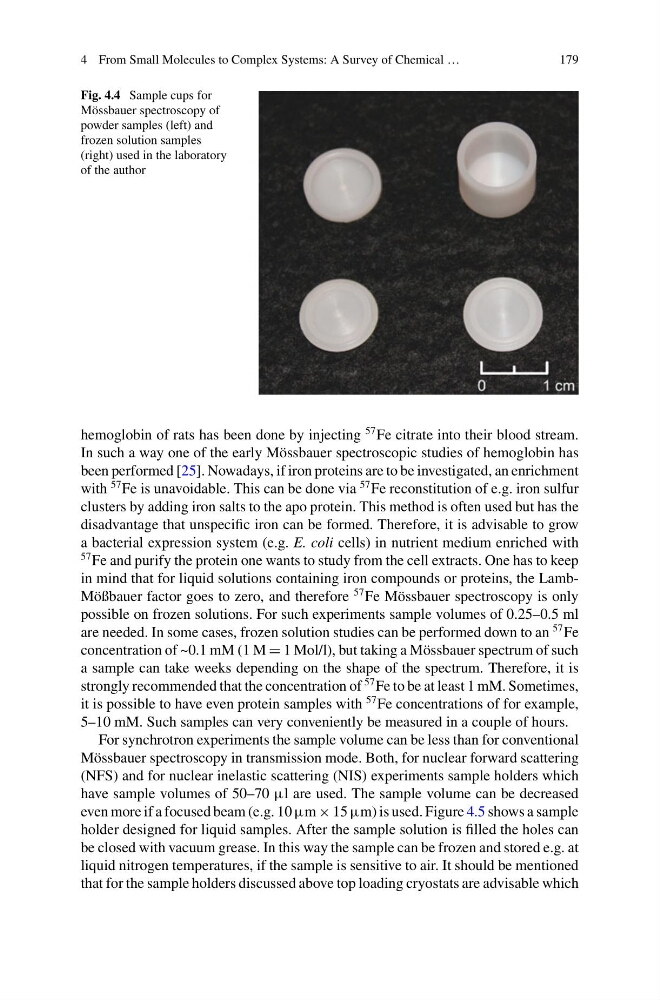
Fig. 4.4 Sample cups for
Mössbauer spectroscopy of
powder samples (left) and
frozen solution samples
(right) used in the laboratory
of the author
hemoglobin of rats has been done by injecting
57 Fe citrate into their blood stream.
In such a way one of the early Mössbauer spectroscopic studies of hemoglobin has
been performed [25]. Nowadays, if iron proteins are to be investigated, an enrichment
with
57 Fe is unavoidable. This can be done via
57 Fe reconstitution of e.g. iron sulfur
clusters by adding iron salts to the apo protein. This method is often used but has the
disadvantage that unspecific iron can be formed. Therefore, it is advisable to grow
a bacterial expression system (e.g. E. coli cells) in nutrient medium enriched with
57 Fe and purify the protein one wants to study from the cell extracts. One has to keep
in mind that for liquid solutions containing iron compounds or proteins, the LambMößbauer factor goes to zero, and therefore
57 Fe Mössbauer spectroscopy is only
possible on frozen solutions. For such experiments sample volumes of 0.25–0.5 ml
are needed. In some cases, frozen solution studies can be performed down to an
57 Fe
concentration of ~0.1 mM (1 M = 1 Mol/l), but taking a Mössbauer spectrum of such
a sample can take weeks depending on the shape of the spectrum. Therefore, it is
strongly recommended that the concentration of
57 Fe to be at least 1 mM. Sometimes,
it is possible to have even protein samples with
57 Fe concentrations of for example,
5–10 mM. Such samples can very conveniently be measured in a couple of hours.
For synchrotron experiments the sample volume can be less than for conventional
Mössbauer spectroscopy in transmission mode. Both, for nuclear forward scattering
(NFS) and for nuclear inelastic scattering (NIS) experiments sample holders which
have sample volumes of 50–70 μl are used. The sample volume can be decreased
even more if a focused beam (e.g. 10 μm × 15 μm) is used. Figure 4.5 shows a sample
holder designed for liquid samples. After the sample solution is filled the holes can
be closed with vacuum grease. In this way the sample can be frozen and stored e.g. at
liquid nitrogen temperatures, if the sample is sensitive to air. It should be mentioned
that for the sample holders discussed above top loading cryostats are advisable which
179
Fig. 4.4 Sample cups for
Mössbauer spectroscopy of
powder samples (left) and
frozen solution samples
(right) used in the laboratory
of the author
hemoglobin of rats has been done by injecting
57 Fe citrate into their blood stream.
In such a way one of the early Mössbauer spectroscopic studies of hemoglobin has
been performed [25]. Nowadays, if iron proteins are to be investigated, an enrichment
with
57 Fe is unavoidable. This can be done via
57 Fe reconstitution of e.g. iron sulfur
clusters by adding iron salts to the apo protein. This method is often used but has the
disadvantage that unspecific iron can be formed. Therefore, it is advisable to grow
a bacterial expression system (e.g. E. coli cells) in nutrient medium enriched with
57 Fe and purify the protein one wants to study from the cell extracts. One has to keep
in mind that for liquid solutions containing iron compounds or proteins, the LambMößbauer factor goes to zero, and therefore
57 Fe Mössbauer spectroscopy is only
possible on frozen solutions. For such experiments sample volumes of 0.25–0.5 ml
are needed. In some cases, frozen solution studies can be performed down to an
57 Fe
concentration of ~0.1 mM (1 M = 1 Mol/l), but taking a Mössbauer spectrum of such
a sample can take weeks depending on the shape of the spectrum. Therefore, it is
strongly recommended that the concentration of
57 Fe to be at least 1 mM. Sometimes,
it is possible to have even protein samples with
57 Fe concentrations of for example,
5–10 mM. Such samples can very conveniently be measured in a couple of hours.
For synchrotron experiments the sample volume can be less than for conventional
Mössbauer spectroscopy in transmission mode. Both, for nuclear forward scattering
(NFS) and for nuclear inelastic scattering (NIS) experiments sample holders which
have sample volumes of 50–70 μl are used. The sample volume can be decreased
even more if a focused beam (e.g. 10 μm × 15 μm) is used. Figure 4.5 shows a sample
holder designed for liquid samples. After the sample solution is filled the holes can
be closed with vacuum grease. In this way the sample can be frozen and stored e.g. at
liquid nitrogen temperatures, if the sample is sensitive to air. It should be mentioned
that for the sample holders discussed above top loading cryostats are advisable which