

154
R. Röhlsberger and J. Evers
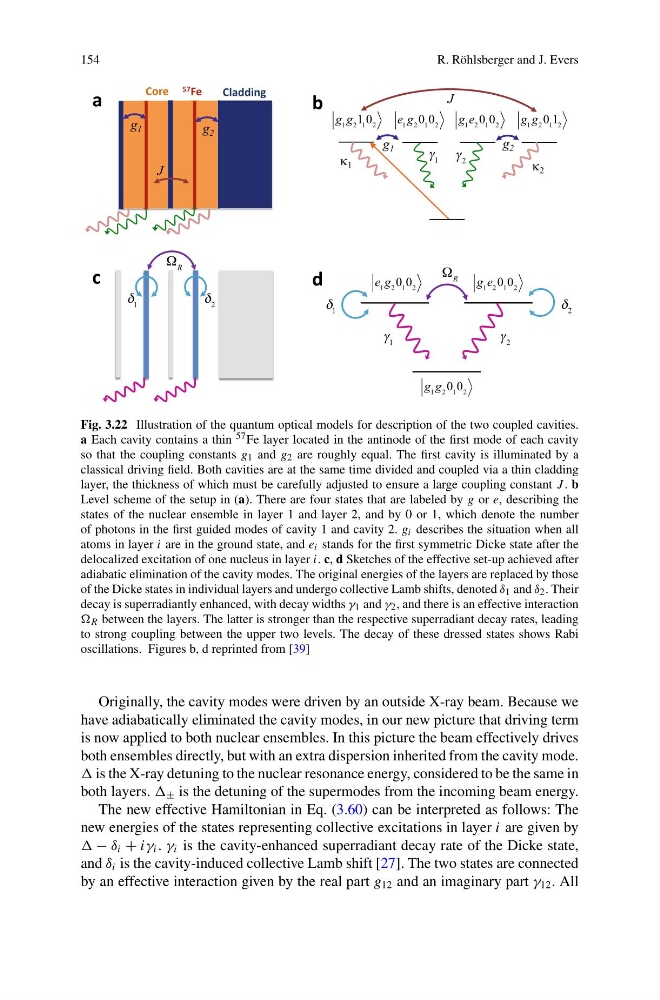
Fig. 3.22 Illustration of the quantum optical models for description of the two coupled cavities.
a Each cavity contains a thin 57 Fe layer located in the antinode of the first mode of each cavity
so that the coupling constants g 1 and g 2 are roughly equal. The first cavity is illuminated by a
classical driving field. Both cavities are at the same time divided and coupled via a thin cladding
layer, the thickness of which must be carefully adjusted to ensure a large coupling constant J . b
Level scheme of the setup in (a). There are four states that are labeled by g or e, describing the
states of the nuclear ensemble in layer 1 and layer 2, and by 0 or 1, which denote the number
of photons in the first guided modes of cavity 1 and cavity 2. g i describes the situation when all
atoms in layer i are in the ground state, and e i stands for the first symmetric Dicke state after the
delocalized excitation of one nucleus in layer i. c, d Sketches of the effective set-up achieved after
adiabatic elimination of the cavity modes. The original energies of the layers are replaced by those
of the Dicke states in individual layers and undergo collective Lamb shifts, denoted δ 1 and δ 2 . Their
decay is superradiantly enhanced, with decay widths γ 1 and γ 2 , and there is an effective interaction
R between the layers. The latter is stronger than the respective superradiant decay rates, leading
to strong coupling between the upper two levels. The decay of these dressed states shows Rabi
oscillations. Figures b, d reprinted from [39]
Originally, the cavity modes were driven by an outside X-ray beam. Because we
have adiabatically eliminated the cavity modes, in our new picture that driving term
is now applied to both nuclear ensembles. In this picture the beam effectively drives
both ensembles directly, but with an extra dispersion inherited from the cavity mode.
is the X-ray detuning to the nuclear resonance energy, considered to be the same in
both layers. ± is the detuning of the supermodes from the incoming beam energy.
The new effective Hamiltonian in Eq. (3.60) can be interpreted as follows: The
new energies of the states representing collective excitations in layer i are given by
− δ i + iγ i . γ i is the cavity-enhanced superradiant decay rate of the Dicke state,
and δ i is the cavity-induced collective Lamb shift [27]. The two states are connected
by an effective interaction given by the real part g 12 and an imaginary part γ 12 . All
R. Röhlsberger and J. Evers
Fig. 3.22 Illustration of the quantum optical models for description of the two coupled cavities.
a Each cavity contains a thin 57 Fe layer located in the antinode of the first mode of each cavity
so that the coupling constants g 1 and g 2 are roughly equal. The first cavity is illuminated by a
classical driving field. Both cavities are at the same time divided and coupled via a thin cladding
layer, the thickness of which must be carefully adjusted to ensure a large coupling constant J . b
Level scheme of the setup in (a). There are four states that are labeled by g or e, describing the
states of the nuclear ensemble in layer 1 and layer 2, and by 0 or 1, which denote the number
of photons in the first guided modes of cavity 1 and cavity 2. g i describes the situation when all
atoms in layer i are in the ground state, and e i stands for the first symmetric Dicke state after the
delocalized excitation of one nucleus in layer i. c, d Sketches of the effective set-up achieved after
adiabatic elimination of the cavity modes. The original energies of the layers are replaced by those
of the Dicke states in individual layers and undergo collective Lamb shifts, denoted δ 1 and δ 2 . Their
decay is superradiantly enhanced, with decay widths γ 1 and γ 2 , and there is an effective interaction
R between the layers. The latter is stronger than the respective superradiant decay rates, leading
to strong coupling between the upper two levels. The decay of these dressed states shows Rabi
oscillations. Figures b, d reprinted from [39]
Originally, the cavity modes were driven by an outside X-ray beam. Because we
have adiabatically eliminated the cavity modes, in our new picture that driving term
is now applied to both nuclear ensembles. In this picture the beam effectively drives
both ensembles directly, but with an extra dispersion inherited from the cavity mode.
is the X-ray detuning to the nuclear resonance energy, considered to be the same in
both layers. ± is the detuning of the supermodes from the incoming beam energy.
The new effective Hamiltonian in Eq. (3.60) can be interpreted as follows: The
new energies of the states representing collective excitations in layer i are given by
− δ i + iγ i . γ i is the cavity-enhanced superradiant decay rate of the Dicke state,
and δ i is the cavity-induced collective Lamb shift [27]. The two states are connected
by an effective interaction given by the real part g 12 and an imaginary part γ 12 . All