

152
R. Röhlsberger and J. Evers
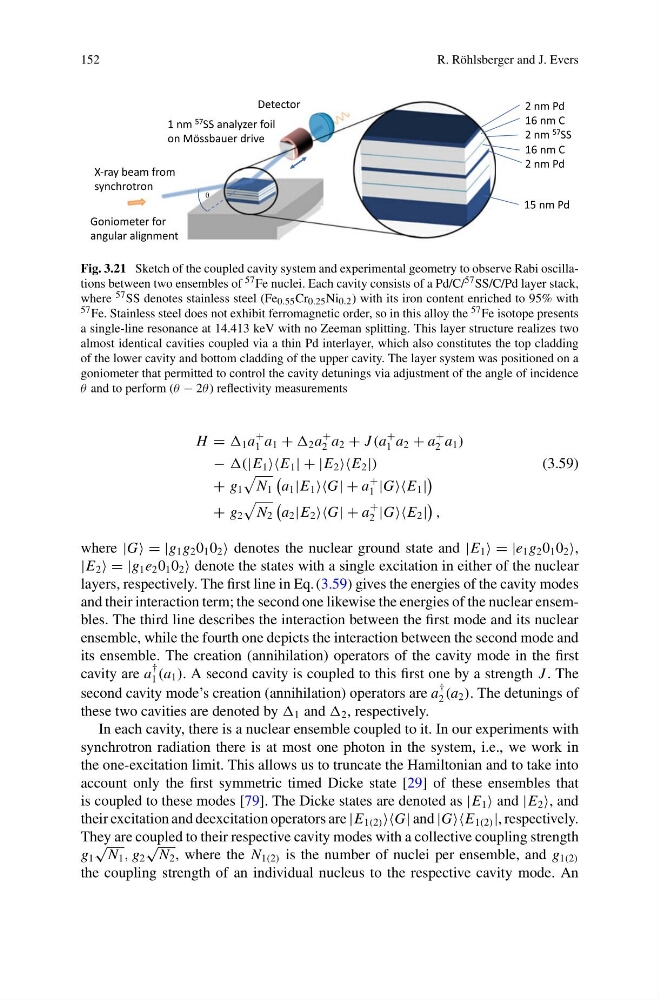
Fig. 3.21 Sketch of the coupled cavity system and experimental geometry to observe Rabi oscillations between two ensembles of 57 Fe nuclei. Each cavity consists of a Pd/C/ 57 SS/C/Pd layer stack,
where 57 SS denotes stainless steel (Fe 0.55 Cr 0.25 Ni 0.2 ) with its iron content enriched to 95% with
57 Fe. Stainless steel does not exhibit ferromagnetic order, so in this alloy the 57 Fe isotope presents
a single-line resonance at 14.413 keV with no Zeeman splitting. This layer structure realizes two
almost identical cavities coupled via a thin Pd interlayer, which also constitutes the top cladding
of the lower cavity and bottom cladding of the upper cavity. The layer system was positioned on a
goniometer that permitted to control the cavity detunings via adjustment of the angle of incidence
θ and to perform (θ − 2θ) reflectivity measurements
H = 1 a
+
1 a 1 + 2 a
+
2 a 2 + J (a
+
1 a 2 + a
+
2 a 1 )
− 1 1 | + |E 2 2 |)
(3.59)
+ g 1
N 1
a 1 |E 1 + a
+
1 |G 1 |
+ g 2
N 2
a 2 |E 2 + a
+
2 |G 2 |
,
where |G = |g 1 g 2 0 1 0 2 denotes the nuclear ground state and |E 1 = |e 1 g 2 0 1 0 2 ,
|E 2 = |g 1 e 2 0 1 0 2 denote the states with a single excitation in either of the nuclear
layers, respectively. The first line in Eq. (3.59) gives the energies of the cavity modes
and their interaction term; the second one likewise the energies of the nuclear ensembles. The third line describes the interaction between the first mode and its nuclear
ensemble, while the fourth one depicts the interaction between the second mode and
its ensemble. The creation (annihilation) operators of the cavity mode in the first
cavity are a
†
1 (a 1 ). A second cavity is coupled to this first one by a strength J . The
second cavity mode’s creation (annihilation) operators are a
†
2 (a 2 ). The detunings of
these two cavities are denoted by 1 and 2 , respectively.
In each cavity, there is a nuclear ensemble coupled to it. In our experiments with
synchrotron radiation there is at most one photon in the system, i.e., we work in
the one-excitation limit. This allows us to truncate the Hamiltonian and to take into
account only the first symmetric timed Dicke state [29] of these ensembles that
is coupled to these modes [79]. The Dicke states are denoted as |E 1 and |E 2 , and
their excitation and deexcitation operators are |E 1(2) and |G 1(2) |, respectively.
They are coupled to their respective cavity modes with a collective coupling strength
g 1
√
N 1 , g 2
√
N 2 , where the N 1(2) is the number of nuclei per ensemble, and g 1(2)
the coupling strength of an individual nucleus to the respective cavity mode. An
R. Röhlsberger and J. Evers
Fig. 3.21 Sketch of the coupled cavity system and experimental geometry to observe Rabi oscillations between two ensembles of 57 Fe nuclei. Each cavity consists of a Pd/C/ 57 SS/C/Pd layer stack,
where 57 SS denotes stainless steel (Fe 0.55 Cr 0.25 Ni 0.2 ) with its iron content enriched to 95% with
57 Fe. Stainless steel does not exhibit ferromagnetic order, so in this alloy the 57 Fe isotope presents
a single-line resonance at 14.413 keV with no Zeeman splitting. This layer structure realizes two
almost identical cavities coupled via a thin Pd interlayer, which also constitutes the top cladding
of the lower cavity and bottom cladding of the upper cavity. The layer system was positioned on a
goniometer that permitted to control the cavity detunings via adjustment of the angle of incidence
θ and to perform (θ − 2θ) reflectivity measurements
H = 1 a
+
1 a 1 + 2 a
+
2 a 2 + J (a
+
1 a 2 + a
+
2 a 1 )
− 1 1 | + |E 2 2 |)
(3.59)
+ g 1
N 1
a 1 |E 1 + a
+
1 |G 1 |
+ g 2
N 2
a 2 |E 2 + a
+
2 |G 2 |
,
where |G = |g 1 g 2 0 1 0 2 denotes the nuclear ground state and |E 1 = |e 1 g 2 0 1 0 2 ,
|E 2 = |g 1 e 2 0 1 0 2 denote the states with a single excitation in either of the nuclear
layers, respectively. The first line in Eq. (3.59) gives the energies of the cavity modes
and their interaction term; the second one likewise the energies of the nuclear ensembles. The third line describes the interaction between the first mode and its nuclear
ensemble, while the fourth one depicts the interaction between the second mode and
its ensemble. The creation (annihilation) operators of the cavity mode in the first
cavity are a
†
1 (a 1 ). A second cavity is coupled to this first one by a strength J . The
second cavity mode’s creation (annihilation) operators are a
†
2 (a 2 ). The detunings of
these two cavities are denoted by 1 and 2 , respectively.
In each cavity, there is a nuclear ensemble coupled to it. In our experiments with
synchrotron radiation there is at most one photon in the system, i.e., we work in
the one-excitation limit. This allows us to truncate the Hamiltonian and to take into
account only the first symmetric timed Dicke state [29] of these ensembles that
is coupled to these modes [79]. The Dicke states are denoted as |E 1 and |E 2 , and
their excitation and deexcitation operators are |E 1(2) and |G 1(2) |, respectively.
They are coupled to their respective cavity modes with a collective coupling strength
g 1
√
N 1 , g 2
√
N 2 , where the N 1(2) is the number of nuclei per ensemble, and g 1(2)
the coupling strength of an individual nucleus to the respective cavity mode. An