

146
R. Röhlsberger and J. Evers
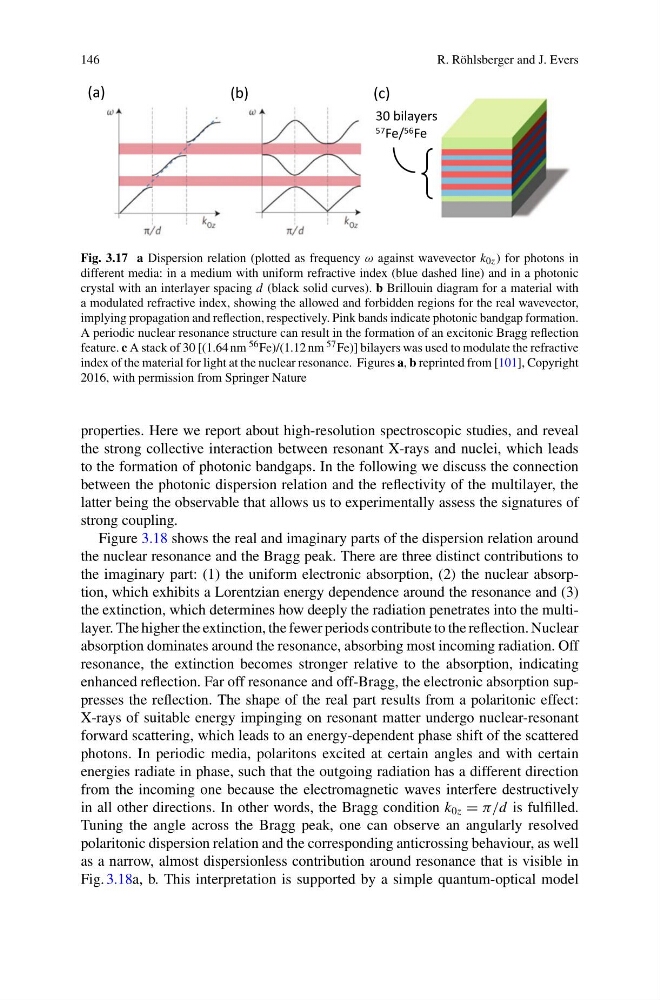
Fig. 3.17 a Dispersion relation (plotted as frequency ω against wavevector k 0z ) for photons in
different media: in a medium with uniform refractive index (blue dashed line) and in a photonic
crystal with an interlayer spacing d (black solid curves). b Brillouin diagram for a material with
a modulated refractive index, showing the allowed and forbidden regions for the real wavevector,
implying propagation and reflection, respectively. Pink bands indicate photonic bandgap formation.
A periodic nuclear resonance structure can result in the formation of an excitonic Bragg reflection
feature. c A stack of 30 [(1.64 nm 56 Fe)/(1.12 nm 57 Fe)] bilayers was used to modulate the refractive
index of the material for light at the nuclear resonance. Figures a, b reprinted from [101], Copyright
2016, with permission from Springer Nature
properties. Here we report about high-resolution spectroscopic studies, and reveal
the strong collective interaction between resonant X-rays and nuclei, which leads
to the formation of photonic bandgaps. In the following we discuss the connection
between the photonic dispersion relation and the reflectivity of the multilayer, the
latter being the observable that allows us to experimentally assess the signatures of
strong coupling.
Figure 3.18 shows the real and imaginary parts of the dispersion relation around
the nuclear resonance and the Bragg peak. There are three distinct contributions to
the imaginary part: (1) the uniform electronic absorption, (2) the nuclear absorption, which exhibits a Lorentzian energy dependence around the resonance and (3)
the extinction, which determines how deeply the radiation penetrates into the multilayer. The higher the extinction, the fewer periods contribute to the reflection. Nuclear
absorption dominates around the resonance, absorbing most incoming radiation. Off
resonance, the extinction becomes stronger relative to the absorption, indicating
enhanced reflection. Far off resonance and off-Bragg, the electronic absorption suppresses the reflection. The shape of the real part results from a polaritonic effect:
X-rays of suitable energy impinging on resonant matter undergo nuclear-resonant
forward scattering, which leads to an energy-dependent phase shift of the scattered
photons. In periodic media, polaritons excited at certain angles and with certain
energies radiate in phase, such that the outgoing radiation has a different direction
from the incoming one because the electromagnetic waves interfere destructively
in all other directions. In other words, the Bragg condition k 0z = π/d is fulfilled.
Tuning the angle across the Bragg peak, one can observe an angularly resolved
polaritonic dispersion relation and the corresponding anticrossing behaviour, as well
as a narrow, almost dispersionless contribution around resonance that is visible in
Fig. 3.18a, b. This interpretation is supported by a simple quantum-optical model
R. Röhlsberger and J. Evers
Fig. 3.17 a Dispersion relation (plotted as frequency ω against wavevector k 0z ) for photons in
different media: in a medium with uniform refractive index (blue dashed line) and in a photonic
crystal with an interlayer spacing d (black solid curves). b Brillouin diagram for a material with
a modulated refractive index, showing the allowed and forbidden regions for the real wavevector,
implying propagation and reflection, respectively. Pink bands indicate photonic bandgap formation.
A periodic nuclear resonance structure can result in the formation of an excitonic Bragg reflection
feature. c A stack of 30 [(1.64 nm 56 Fe)/(1.12 nm 57 Fe)] bilayers was used to modulate the refractive
index of the material for light at the nuclear resonance. Figures a, b reprinted from [101], Copyright
2016, with permission from Springer Nature
properties. Here we report about high-resolution spectroscopic studies, and reveal
the strong collective interaction between resonant X-rays and nuclei, which leads
to the formation of photonic bandgaps. In the following we discuss the connection
between the photonic dispersion relation and the reflectivity of the multilayer, the
latter being the observable that allows us to experimentally assess the signatures of
strong coupling.
Figure 3.18 shows the real and imaginary parts of the dispersion relation around
the nuclear resonance and the Bragg peak. There are three distinct contributions to
the imaginary part: (1) the uniform electronic absorption, (2) the nuclear absorption, which exhibits a Lorentzian energy dependence around the resonance and (3)
the extinction, which determines how deeply the radiation penetrates into the multilayer. The higher the extinction, the fewer periods contribute to the reflection. Nuclear
absorption dominates around the resonance, absorbing most incoming radiation. Off
resonance, the extinction becomes stronger relative to the absorption, indicating
enhanced reflection. Far off resonance and off-Bragg, the electronic absorption suppresses the reflection. The shape of the real part results from a polaritonic effect:
X-rays of suitable energy impinging on resonant matter undergo nuclear-resonant
forward scattering, which leads to an energy-dependent phase shift of the scattered
photons. In periodic media, polaritons excited at certain angles and with certain
energies radiate in phase, such that the outgoing radiation has a different direction
from the incoming one because the electromagnetic waves interfere destructively
in all other directions. In other words, the Bragg condition k 0z = π/d is fulfilled.
Tuning the angle across the Bragg peak, one can observe an angularly resolved
polaritonic dispersion relation and the corresponding anticrossing behaviour, as well
as a narrow, almost dispersionless contribution around resonance that is visible in
Fig. 3.18a, b. This interpretation is supported by a simple quantum-optical model