

136
R. Röhlsberger and J. Evers
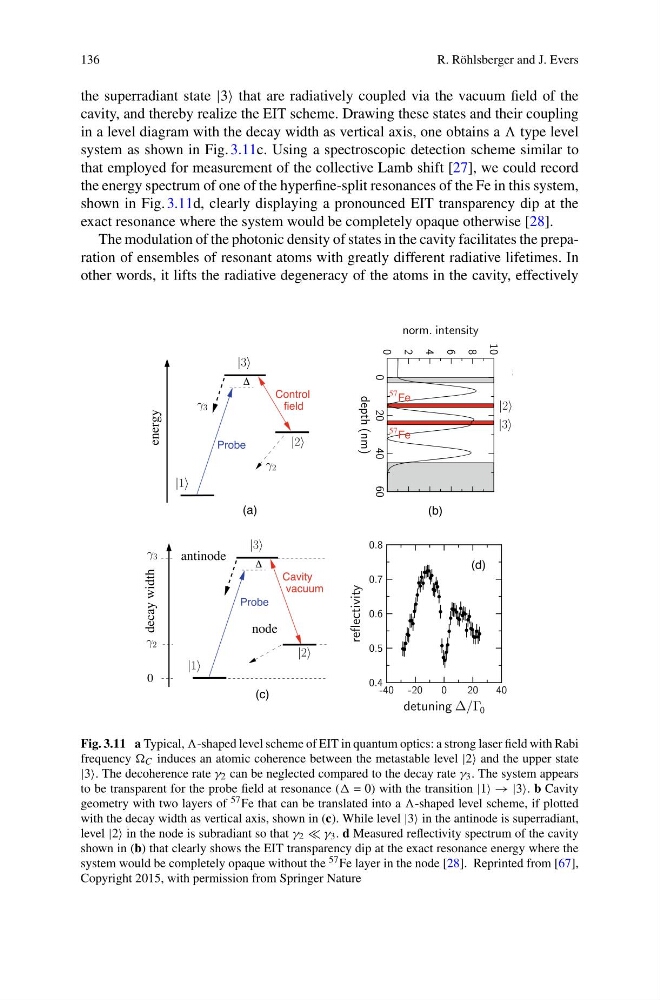
the superradiant state |3 that are radiatively coupled via the vacuum field of the
cavity, and thereby realize the EIT scheme. Drawing these states and their coupling
in a level diagram with the decay width as vertical axis, one obtains a type level
system as shown in Fig. 3.11c. Using a spectroscopic detection scheme similar to
that employed for measurement of the collective Lamb shift [27], we could record
the energy spectrum of one of the hyperfine-split resonances of the Fe in this system,
shown in Fig. 3.11d, clearly displaying a pronounced EIT transparency dip at the
exact resonance where the system would be completely opaque otherwise [28].
The modulation of the photonic density of states in the cavity facilitates the preparation of ensembles of resonant atoms with greatly different radiative lifetimes. In
other words, it lifts the radiative degeneracy of the atoms in the cavity, effectively
Fig. 3.11 a Typical, -shaped level scheme of EIT in quantum optics: a strong laser field with Rabi
frequency C induces an atomic coherence between the metastable level |2 and the upper state
|3. The decoherence rate γ 2 can be neglected compared to the decay rate γ 3 . The system appears
to be transparent for the probe field at resonance ( = 0) with the transition |1 → |3 b Cavity
geometry with two layers of 57 Fe that can be translated into a level scheme, if plotted
with the decay width as vertical axis, shown in (c). While level |3 in the antinode is superradiant,
level |2 in the node is subradiant so that γ 2 γ 3 . d Measured reflectivity spectrum of the cavity
shown in (b) that clearly shows the EIT transparency dip at the exact resonance energy where the
system would be completely opaque without the 57 Fe layer in the node [28]. Reprinted from [67],
Copyright 2015, with permission from Springer Nature
R. Röhlsberger and J. Evers
the superradiant state |3 that are radiatively coupled via the vacuum field of the
cavity, and thereby realize the EIT scheme. Drawing these states and their coupling
in a level diagram with the decay width as vertical axis, one obtains a type level
system as shown in Fig. 3.11c. Using a spectroscopic detection scheme similar to
that employed for measurement of the collective Lamb shift [27], we could record
the energy spectrum of one of the hyperfine-split resonances of the Fe in this system,
shown in Fig. 3.11d, clearly displaying a pronounced EIT transparency dip at the
exact resonance where the system would be completely opaque otherwise [28].
The modulation of the photonic density of states in the cavity facilitates the preparation of ensembles of resonant atoms with greatly different radiative lifetimes. In
other words, it lifts the radiative degeneracy of the atoms in the cavity, effectively
Fig. 3.11 a Typical, -shaped level scheme of EIT in quantum optics: a strong laser field with Rabi
frequency C induces an atomic coherence between the metastable level |2 and the upper state
|3. The decoherence rate γ 2 can be neglected compared to the decay rate γ 3 . The system appears
to be transparent for the probe field at resonance ( = 0) with the transition |1 → |3 b Cavity
geometry with two layers of 57 Fe that can be translated into a level scheme, if plotted
with the decay width as vertical axis, shown in (c). While level |3 in the antinode is superradiant,
level |2 in the node is subradiant so that γ 2 γ 3 . d Measured reflectivity spectrum of the cavity
shown in (b) that clearly shows the EIT transparency dip at the exact resonance energy where the
system would be completely opaque without the 57 Fe layer in the node [28]. Reprinted from [67],
Copyright 2015, with permission from Springer Nature