

132
R. Röhlsberger and J. Evers
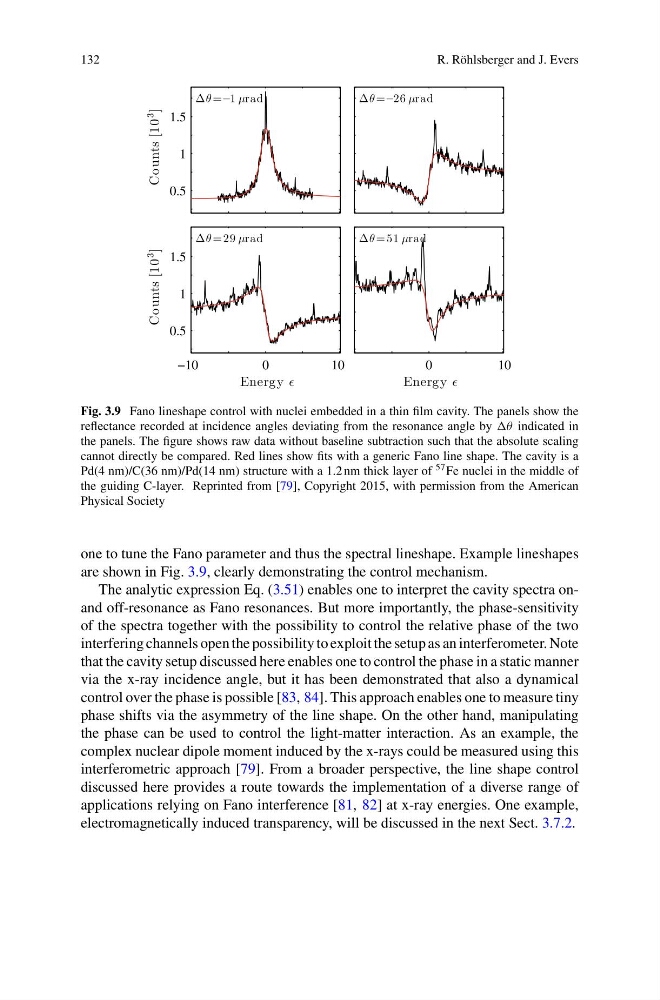
Fig. 3.9 Fano lineshape control with nuclei embedded in a thin film cavity. The panels show the
reflectance recorded at incidence angles deviating from the resonance angle by θ indicated in
the panels. The figure shows raw data without baseline subtraction such that the absolute scaling
cannot directly be compared. Red lines show fits with a generic Fano line shape. The cavity is a
Pd(4 nm)/C(36 nm)/Pd(14 nm) structure with a 1.2 nm thick layer of 57 Fe nuclei in the middle of
the guiding C-layer. Reprinted from [79], Copyright 2015, with permission from the American
Physical Society
one to tune the Fano parameter and thus the spectral lineshape. Example lineshapes
are shown in Fig. 3.9, clearly demonstrating the control mechanism.
The analytic expression Eq. (3.51) enables one to interpret the cavity spectra onand off-resonance as Fano resonances. But more importantly, the phase-sensitivity
of the spectra together with the possibility to control the relative phase of the two
interfering channels open the possibility to exploit the setup as an interferometer. Note
that the cavity setup discussed here enables one to control the phase in a static manner
via the x-ray incidence angle, but it has been demonstrated that also a dynamical
control over the phase is possible [83, 84]. This approach enables one to measure tiny
phase shifts via the asymmetry of the line shape. On the other hand, manipulating
the phase can be used to control the light-matter interaction. As an example, the
complex nuclear dipole moment induced by the x-rays could be measured using this
interferometric approach [79]. From a broader perspective, the line shape control
discussed here provides a route towards the implementation of a diverse range of
applications relying on Fano interference [81, 82] at x-ray energies. One example,
electromagnetically induced transparency, will be discussed in the next Sect. 3.7.2.
R. Röhlsberger and J. Evers
Fig. 3.9 Fano lineshape control with nuclei embedded in a thin film cavity. The panels show the
reflectance recorded at incidence angles deviating from the resonance angle by θ indicated in
the panels. The figure shows raw data without baseline subtraction such that the absolute scaling
cannot directly be compared. Red lines show fits with a generic Fano line shape. The cavity is a
Pd(4 nm)/C(36 nm)/Pd(14 nm) structure with a 1.2 nm thick layer of 57 Fe nuclei in the middle of
the guiding C-layer. Reprinted from [79], Copyright 2015, with permission from the American
Physical Society
one to tune the Fano parameter and thus the spectral lineshape. Example lineshapes
are shown in Fig. 3.9, clearly demonstrating the control mechanism.
The analytic expression Eq. (3.51) enables one to interpret the cavity spectra onand off-resonance as Fano resonances. But more importantly, the phase-sensitivity
of the spectra together with the possibility to control the relative phase of the two
interfering channels open the possibility to exploit the setup as an interferometer. Note
that the cavity setup discussed here enables one to control the phase in a static manner
via the x-ray incidence angle, but it has been demonstrated that also a dynamical
control over the phase is possible [83, 84]. This approach enables one to measure tiny
phase shifts via the asymmetry of the line shape. On the other hand, manipulating
the phase can be used to control the light-matter interaction. As an example, the
complex nuclear dipole moment induced by the x-rays could be measured using this
interferometric approach [79]. From a broader perspective, the line shape control
discussed here provides a route towards the implementation of a diverse range of
applications relying on Fano interference [81, 82] at x-ray energies. One example,
electromagnetically induced transparency, will be discussed in the next Sect. 3.7.2.