

3 Quantum Optical Phenomena in Nuclear Resonant Scattering
123
E(z) =
A (e
ik z z
+ r m e
−ik z z
),
(z > 0)
B (e
−ik z z
+ r m e
ik z z
),
(z < 0)
(3.30)
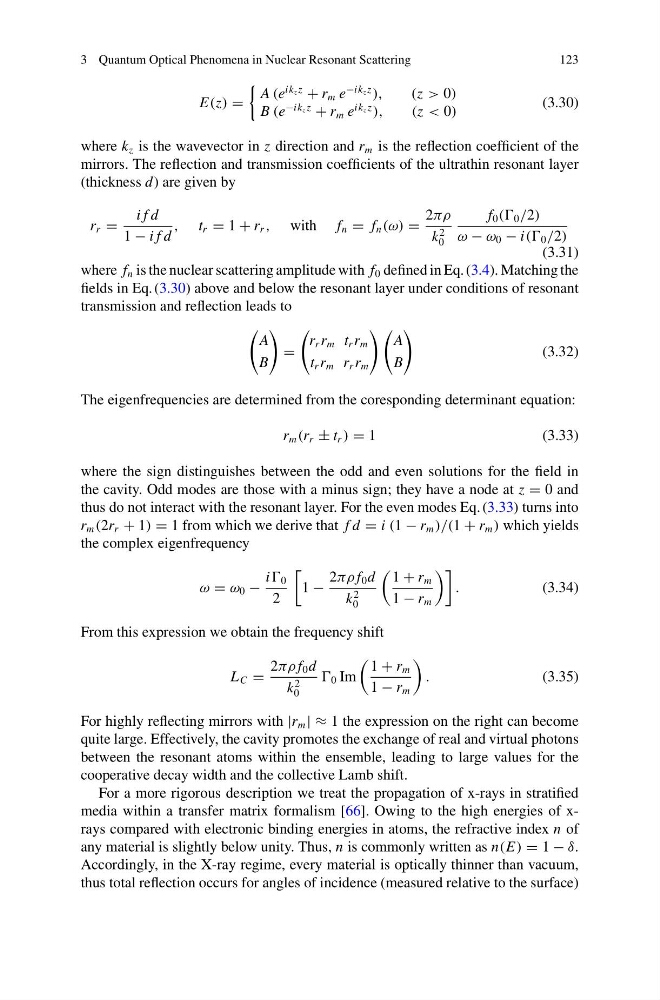
where k z is the wavevector in z direction and r m is the reflection coefficient of the
mirrors. The reflection and transmission coefficients of the ultrathin resonant layer
(thickness d) are given by
r r =
i f d
1 − i f d
, t r = 1 + r r , with f n = f n (ω) =
2πρ
k
2
0
f 0 (( 0 /2)
ω − ω 0 − i(( 0 /2)
(3.31)
where f n is the nuclear scattering amplitude with f 0 defined in Eq. (3.4). Matching the
fields in Eq. (3.30) above and below the resonant layer under conditions of resonant
transmission and reflection leads to
A
B
=
r r r m t r r m
t r r m r r r m
A
B
(3.32)
The eigenfrequencies are determined from the coresponding determinant equation:
r m (r r ± t r ) = 1
(3.33)
where the sign distinguishes between the odd and even solutions for the field in
the cavity. Odd modes are those with a minus sign; they have a node at z = 0 and
thus do not interact with the resonant layer. For the even modes Eq. (3.33) turns into
r m (2r r + 1) = 1 from which we derive that f d = i (1 − r m )/(1 + r m ) which yields
the complex eigenfrequency
ω = ω 0 −
i 0
2
1 −
2πρ f 0 d
k
2
0
1 + r m
1 − r m
.
(3.34)
From this expression we obtain the frequency shift
L C =
2πρ f 0 d
k
2
0
0 Im
1 + r m
1 − r m
.
(3.35)
For highly reflecting mirrors with |r m | ≈ 1 the expression on the right can become
quite large. Effectively, the cavity promotes the exchange of real and virtual photons
between the resonant atoms within the ensemble, leading to large values for the
cooperative decay width and the collective Lamb shift.
For a more rigorous description we treat the propagation of x-rays in stratified
media within a transfer matrix formalism [66]. Owing to the high energies of xrays compared with electronic binding energies in atoms, the refractive index n of
any material is slightly below unity. Thus, n is commonly written as n(E) = 1 − δ.
Accordingly, in the X-ray regime, every material is optically thinner than vacuum,
thus total reflection occurs for angles of incidence (measured relative to the surface)
123
E(z) =
A (e
ik z z
+ r m e
−ik z z
),
(z > 0)
B (e
−ik z z
+ r m e
ik z z
),
(z < 0)
(3.30)
where k z is the wavevector in z direction and r m is the reflection coefficient of the
mirrors. The reflection and transmission coefficients of the ultrathin resonant layer
(thickness d) are given by
r r =
i f d
1 − i f d
, t r = 1 + r r , with f n = f n (ω) =
2πρ
k
2
0
f 0 (( 0 /2)
ω − ω 0 − i(( 0 /2)
(3.31)
where f n is the nuclear scattering amplitude with f 0 defined in Eq. (3.4). Matching the
fields in Eq. (3.30) above and below the resonant layer under conditions of resonant
transmission and reflection leads to
A
B
=
r r r m t r r m
t r r m r r r m
A
B
(3.32)
The eigenfrequencies are determined from the coresponding determinant equation:
r m (r r ± t r ) = 1
(3.33)
where the sign distinguishes between the odd and even solutions for the field in
the cavity. Odd modes are those with a minus sign; they have a node at z = 0 and
thus do not interact with the resonant layer. For the even modes Eq. (3.33) turns into
r m (2r r + 1) = 1 from which we derive that f d = i (1 − r m )/(1 + r m ) which yields
the complex eigenfrequency
ω = ω 0 −
i 0
2
1 −
2πρ f 0 d
k
2
0
1 + r m
1 − r m
.
(3.34)
From this expression we obtain the frequency shift
L C =
2πρ f 0 d
k
2
0
0 Im
1 + r m
1 − r m
.
(3.35)
For highly reflecting mirrors with |r m | ≈ 1 the expression on the right can become
quite large. Effectively, the cavity promotes the exchange of real and virtual photons
between the resonant atoms within the ensemble, leading to large values for the
cooperative decay width and the collective Lamb shift.
For a more rigorous description we treat the propagation of x-rays in stratified
media within a transfer matrix formalism [66]. Owing to the high energies of xrays compared with electronic binding energies in atoms, the refractive index n of
any material is slightly below unity. Thus, n is commonly written as n(E) = 1 − δ.
Accordingly, in the X-ray regime, every material is optically thinner than vacuum,
thus total reflection occurs for angles of incidence (measured relative to the surface)