

3 Quantum Optical Phenomena in Nuclear Resonant Scattering
119
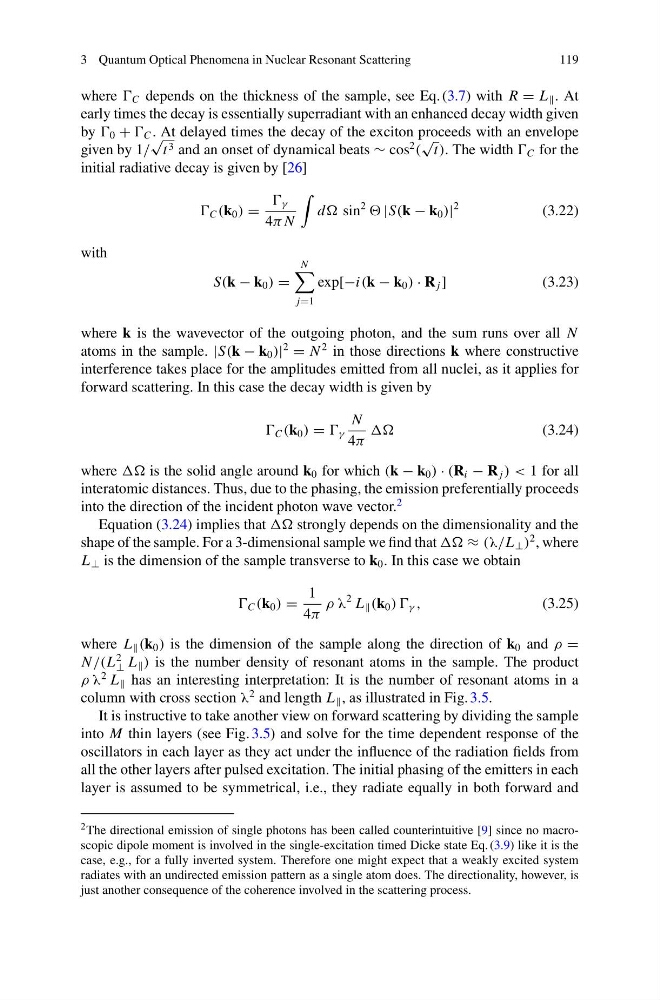
where C depends on the thickness of the sample, see Eq. (3.7) with R = L . At
early times the decay is essentially superradiant with an enhanced decay width given
by 0 + C . At delayed times the decay of the exciton proceeds with an envelope
given by 1/
√
t 3 and an onset of dynamical beats ∼ cos
2
(
√
t). The width C for the
initial radiative decay is given by [26]
C (k 0 ) =
γ
4π N
d sin
2
|S(k − k 0 )|
2
(3.22)
with
S(k − k 0 ) =
N
j=1
exp[−i(k − k 0 ) · R j ]
(3.23)
where k is the wavevector of the outgoing photon, and the sum runs over all N
atoms in the sample. |S(k − k 0 )|
2
= N
2 in those directions k where constructive
interference takes place for the amplitudes emitted from all nuclei, as it applies for
forward scattering. In this case the decay width is given by
C (k 0 ) = γ
N
4π
(3.24)
where is the solid angle around k 0 for which (k − k 0 ) · (R i − R j ) < 1 for all
interatomic distances. Thus, due to the phasing, the emission preferentially proceeds
into the direction of the incident photon wave vector.
2
Equation (3.24) implies that strongly depends on the dimensionality and the
shape of the sample. For a 3-dimensional sample we find that ≈ (λ/L ⊥ )
2 , where
L ⊥ is the dimension of the sample transverse to k 0 . In this case we obtain
C (k 0 ) =
1
4π
ρ λ
2 L (k 0 ) ) γ ,
(3.25)
where L (k 0 ) is the dimension of the sample along the direction of k 0 and ρ =
N /(L
2
⊥ L ) is the number density of resonant atoms in the sample. The product
ρ λ
2 L has an interesting interpretation: It is the number of resonant atoms in a
column with cross section λ
2 and length L , as illustrated in Fig. 3.5.
It is instructive to take another view on forward scattering by dividing the sample
into M thin layers (see Fig. 3.5) and solve for the time dependent response of the
oscillators in each layer as they act under the influence of the radiation fields from
all the other layers after pulsed excitation. The initial phasing of the emitters in each
layer is assumed to be symmetrical, i.e., they radiate equally in both forward and
2 The directional emission of single photons has been called counterintuitive [9] since no macroscopic dipole moment is involved in the single-excitation timed Dicke state Eq. (3.9) like it is the
case, e.g., for a fully inverted system. Therefore one might expect that a weakly excited system
radiates with an undirected emission pattern as a single atom does. The directionality, however, is
just another consequence of the coherence involved in the scattering process.
119
where C depends on the thickness of the sample, see Eq. (3.7) with R = L . At
early times the decay is essentially superradiant with an enhanced decay width given
by 0 + C . At delayed times the decay of the exciton proceeds with an envelope
given by 1/
√
t 3 and an onset of dynamical beats ∼ cos
2
(
√
t). The width C for the
initial radiative decay is given by [26]
C (k 0 ) =
γ
4π N
d sin
2
|S(k − k 0 )|
2
(3.22)
with
S(k − k 0 ) =
N
j=1
exp[−i(k − k 0 ) · R j ]
(3.23)
where k is the wavevector of the outgoing photon, and the sum runs over all N
atoms in the sample. |S(k − k 0 )|
2
= N
2 in those directions k where constructive
interference takes place for the amplitudes emitted from all nuclei, as it applies for
forward scattering. In this case the decay width is given by
C (k 0 ) = γ
N
4π
(3.24)
where is the solid angle around k 0 for which (k − k 0 ) · (R i − R j ) < 1 for all
interatomic distances. Thus, due to the phasing, the emission preferentially proceeds
into the direction of the incident photon wave vector.
2
Equation (3.24) implies that strongly depends on the dimensionality and the
shape of the sample. For a 3-dimensional sample we find that ≈ (λ/L ⊥ )
2 , where
L ⊥ is the dimension of the sample transverse to k 0 . In this case we obtain
C (k 0 ) =
1
4π
ρ λ
2 L (k 0 ) ) γ ,
(3.25)
where L (k 0 ) is the dimension of the sample along the direction of k 0 and ρ =
N /(L
2
⊥ L ) is the number density of resonant atoms in the sample. The product
ρ λ
2 L has an interesting interpretation: It is the number of resonant atoms in a
column with cross section λ
2 and length L , as illustrated in Fig. 3.5.
It is instructive to take another view on forward scattering by dividing the sample
into M thin layers (see Fig. 3.5) and solve for the time dependent response of the
oscillators in each layer as they act under the influence of the radiation fields from
all the other layers after pulsed excitation. The initial phasing of the emitters in each
layer is assumed to be symmetrical, i.e., they radiate equally in both forward and
2 The directional emission of single photons has been called counterintuitive [9] since no macroscopic dipole moment is involved in the single-excitation timed Dicke state Eq. (3.9) like it is the
case, e.g., for a fully inverted system. Therefore one might expect that a weakly excited system
radiates with an undirected emission pattern as a single atom does. The directionality, however, is
just another consequence of the coherence involved in the scattering process.