

114
R. Röhlsberger and J. Evers
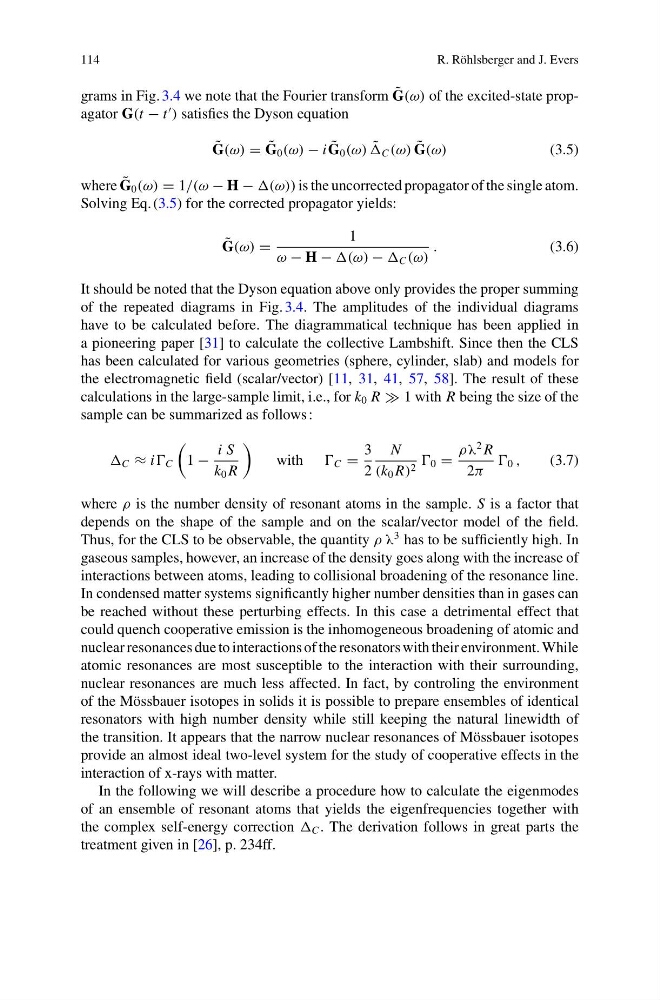
grams in Fig. 3.4 we note that the Fourier transform ˜
G(ω) of the excited-state propagator G(t − t
) satisfies the Dyson equation
˜
G(ω) = ˜
G 0 (ω) − i ˜
G 0 (ω) ˜
C (ω) ˜
G(ω)
(3.5)
where ˜
G 0 (ω) = 1/(ω − H − (ω)) is the uncorrected propagator of the single atom.
Solving Eq. (3.5) for the corrected propagator yields:
˜
G(ω) =
1
ω − H − (ω) − C (ω)
.
(3.6)
It should be noted that the Dyson equation above only provides the proper summing
of the repeated diagrams in Fig. 3.4. The amplitudes of the individual diagrams
have to be calculated before. The diagrammatical technique has been applied in
a pioneering paper [31] to calculate the collective Lambshift. Since then the CLS
has been calculated for various geometries (sphere, cylinder, slab) and models for
the electromagnetic field (scalar/vector) [11, 31, 41, 57, 58]. The result of these
calculations in the large-sample limit, i.e., for k 0 R 1 with R being the size of the
sample can be summarized as follows :
C ≈ i C
1 −
i S
k 0 R
with C =
3
2
N
(k 0 R) 2 0 =
ρλ
2 R
2π
0 ,
(3.7)
where ρ is the number density of resonant atoms in the sample. S is a factor that
depends on the shape of the sample and on the scalar/vector model of the field.
Thus, for the CLS to be observable, the quantity ρ λ
3 has to be sufficiently high. In
gaseous samples, however, an increase of the density goes along with the increase of
interactions between atoms, leading to collisional broadening of the resonance line.
In condensed matter systems significantly higher number densities than in gases can
be reached without these perturbing effects. In this case a detrimental effect that
could quench cooperative emission is the inhomogeneous broadening of atomic and
nuclear resonances due to interactions of the resonators with their environment. While
atomic resonances are most susceptible to the interaction with their surrounding,
nuclear resonances are much less affected. In fact, by controling the environment
of the Mössbauer isotopes in solids it is possible to prepare ensembles of identical
resonators with high number density while still keeping the natural linewidth of
the transition. It appears that the narrow nuclear resonances of Mössbauer isotopes
provide an almost ideal two-level system for the study of cooperative effects in the
interaction of x-rays with matter.
In the following we will describe a procedure how to calculate the eigenmodes
of an ensemble of resonant atoms that yields the eigenfrequencies together with
the complex self-energy correction C . The derivation follows in great parts the
treatment given in [26], p. 234ff.
R. Röhlsberger and J. Evers
grams in Fig. 3.4 we note that the Fourier transform ˜
G(ω) of the excited-state propagator G(t − t
) satisfies the Dyson equation
˜
G(ω) = ˜
G 0 (ω) − i ˜
G 0 (ω) ˜
C (ω) ˜
G(ω)
(3.5)
where ˜
G 0 (ω) = 1/(ω − H − (ω)) is the uncorrected propagator of the single atom.
Solving Eq. (3.5) for the corrected propagator yields:
˜
G(ω) =
1
ω − H − (ω) − C (ω)
.
(3.6)
It should be noted that the Dyson equation above only provides the proper summing
of the repeated diagrams in Fig. 3.4. The amplitudes of the individual diagrams
have to be calculated before. The diagrammatical technique has been applied in
a pioneering paper [31] to calculate the collective Lambshift. Since then the CLS
has been calculated for various geometries (sphere, cylinder, slab) and models for
the electromagnetic field (scalar/vector) [11, 31, 41, 57, 58]. The result of these
calculations in the large-sample limit, i.e., for k 0 R 1 with R being the size of the
sample can be summarized as follows :
C ≈ i C
1 −
i S
k 0 R
with C =
3
2
N
(k 0 R) 2 0 =
ρλ
2 R
2π
0 ,
(3.7)
where ρ is the number density of resonant atoms in the sample. S is a factor that
depends on the shape of the sample and on the scalar/vector model of the field.
Thus, for the CLS to be observable, the quantity ρ λ
3 has to be sufficiently high. In
gaseous samples, however, an increase of the density goes along with the increase of
interactions between atoms, leading to collisional broadening of the resonance line.
In condensed matter systems significantly higher number densities than in gases can
be reached without these perturbing effects. In this case a detrimental effect that
could quench cooperative emission is the inhomogeneous broadening of atomic and
nuclear resonances due to interactions of the resonators with their environment. While
atomic resonances are most susceptible to the interaction with their surrounding,
nuclear resonances are much less affected. In fact, by controling the environment
of the Mössbauer isotopes in solids it is possible to prepare ensembles of identical
resonators with high number density while still keeping the natural linewidth of
the transition. It appears that the narrow nuclear resonances of Mössbauer isotopes
provide an almost ideal two-level system for the study of cooperative effects in the
interaction of x-rays with matter.
In the following we will describe a procedure how to calculate the eigenmodes
of an ensemble of resonant atoms that yields the eigenfrequencies together with
the complex self-energy correction C . The derivation follows in great parts the
treatment given in [26], p. 234ff.