

112
R. Röhlsberger and J. Evers
was demonstrated first by Gerdau et al. in 1985 for nuclear Bragg diffraction [51]
and by Hastings et al. in [52] for nuclear resonant forward scattering. Since then
the technique became an established method at many synchrotron radiation sources
around the world with a multitude of applications in various fields of the natural sciences [6, 53, 54]. The most widely used isotope in this field is
57 Fe with a transition
energy of E 0 = 14.4125 keV, a natural linewidth of 0 = 4.7 neV, corresponding
to a lifetime of τ 0 = 141 ns. Beamlines at present-day 3rd generation synchrotron
radiation sources like ESRF, APS, SPring8 and PETRA III deliver a spectral flux of
about 10
5 photons/s/ 0 . The radiation comes typically in pulses with a duration of a
few 10 ps, so that excitation and subsequent emission can be treated as independent
processes.
Before discussing cooperative effects in the resonant interaction of many identical
nuclei with a common radiation field, it is instructive to discuss first the scattering
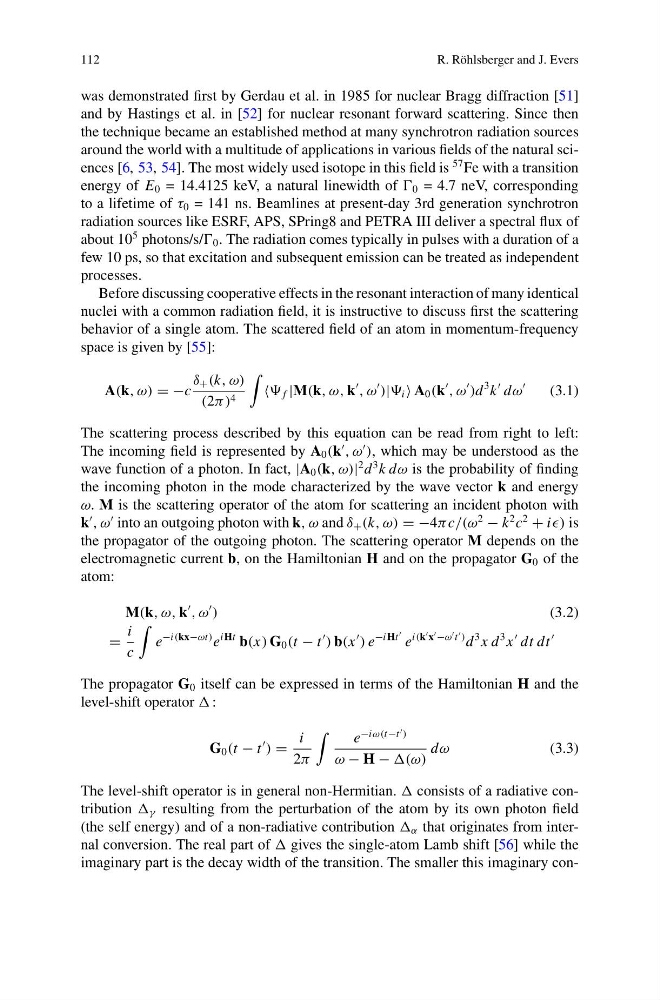
behavior of a single atom. The scattered field of an atom in momentum-frequency
space is given by [55]:
A(k, ω) = −c
δ + (k, ω)
(2π) 4
f |M(k, ω, k
, ω
)| i A 0 (k
, ω
)d
3 k
dω
(3.1)
The scattering process described by this equation can be read from right to left:
The incoming field is represented by A 0 (k
, ω
), which may be understood as the
wave function of a photon. In fact, |A 0 (k, ω)|
2 d
3 k dω is the probability of finding
the incoming photon in the mode characterized by the wave vector k and energy
ω. M is the scattering operator of the atom for scattering an incident photon with
k
, ω
into an outgoing photon with k, ω and δ + (k, ω) = −4π c/(ω
2
− k
2 c
2
+ i) is
the propagator of the outgoing photon. The scattering operator M depends on the
electromagnetic current b, on the Hamiltonian H and on the propagator G 0 of the
atom:
M(k, ω, k
, ω
)
(3.2)
=
i
c
e
−i(kx−ωt) e
iHt b(x) G 0 (t − t
) b(x
) e
−iHt
e
i(k
x
−ω
t
) d
3 x d
3 x
dt dt
The propagator G 0 itself can be expressed in terms of the Hamiltonian H and the
level-shift operator :
G 0 (t − t
) =
i
2π
e
−iω(t−t
)
ω − H − (ω)
dω
(3.3)
The level-shift operator is in general non-Hermitian. consists of a radiative contribution γ resulting from the perturbation of the atom by its own photon field
(the self energy) and of a non-radiative contribution α that originates from internal conversion. The real part of gives the single-atom Lamb shift [56] while the
imaginary part is the decay width of the transition. The smaller this imaginary con-
R. Röhlsberger and J. Evers
was demonstrated first by Gerdau et al. in 1985 for nuclear Bragg diffraction [51]
and by Hastings et al. in [52] for nuclear resonant forward scattering. Since then
the technique became an established method at many synchrotron radiation sources
around the world with a multitude of applications in various fields of the natural sciences [6, 53, 54]. The most widely used isotope in this field is
57 Fe with a transition
energy of E 0 = 14.4125 keV, a natural linewidth of 0 = 4.7 neV, corresponding
to a lifetime of τ 0 = 141 ns. Beamlines at present-day 3rd generation synchrotron
radiation sources like ESRF, APS, SPring8 and PETRA III deliver a spectral flux of
about 10
5 photons/s/ 0 . The radiation comes typically in pulses with a duration of a
few 10 ps, so that excitation and subsequent emission can be treated as independent
processes.
Before discussing cooperative effects in the resonant interaction of many identical
nuclei with a common radiation field, it is instructive to discuss first the scattering
behavior of a single atom. The scattered field of an atom in momentum-frequency
space is given by [55]:
A(k, ω) = −c
δ + (k, ω)
(2π) 4
f |M(k, ω, k
, ω
)| i A 0 (k
, ω
)d
3 k
dω
(3.1)
The scattering process described by this equation can be read from right to left:
The incoming field is represented by A 0 (k
, ω
), which may be understood as the
wave function of a photon. In fact, |A 0 (k, ω)|
2 d
3 k dω is the probability of finding
the incoming photon in the mode characterized by the wave vector k and energy
ω. M is the scattering operator of the atom for scattering an incident photon with
k
, ω
into an outgoing photon with k, ω and δ + (k, ω) = −4π c/(ω
2
− k
2 c
2
+ i) is
the propagator of the outgoing photon. The scattering operator M depends on the
electromagnetic current b, on the Hamiltonian H and on the propagator G 0 of the
atom:
M(k, ω, k
, ω
)
(3.2)
=
i
c
e
−i(kx−ωt) e
iHt b(x) G 0 (t − t
) b(x
) e
−iHt
e
i(k
x
−ω
t
) d
3 x d
3 x
dt dt
The propagator G 0 itself can be expressed in terms of the Hamiltonian H and the
level-shift operator :
G 0 (t − t
) =
i
2π
e
−iω(t−t
)
ω − H − (ω)
dω
(3.3)
The level-shift operator is in general non-Hermitian. consists of a radiative contribution γ resulting from the perturbation of the atom by its own photon field
(the self energy) and of a non-radiative contribution α that originates from internal conversion. The real part of gives the single-atom Lamb shift [56] while the
imaginary part is the decay width of the transition. The smaller this imaginary con-