

92
M. Seto et al.
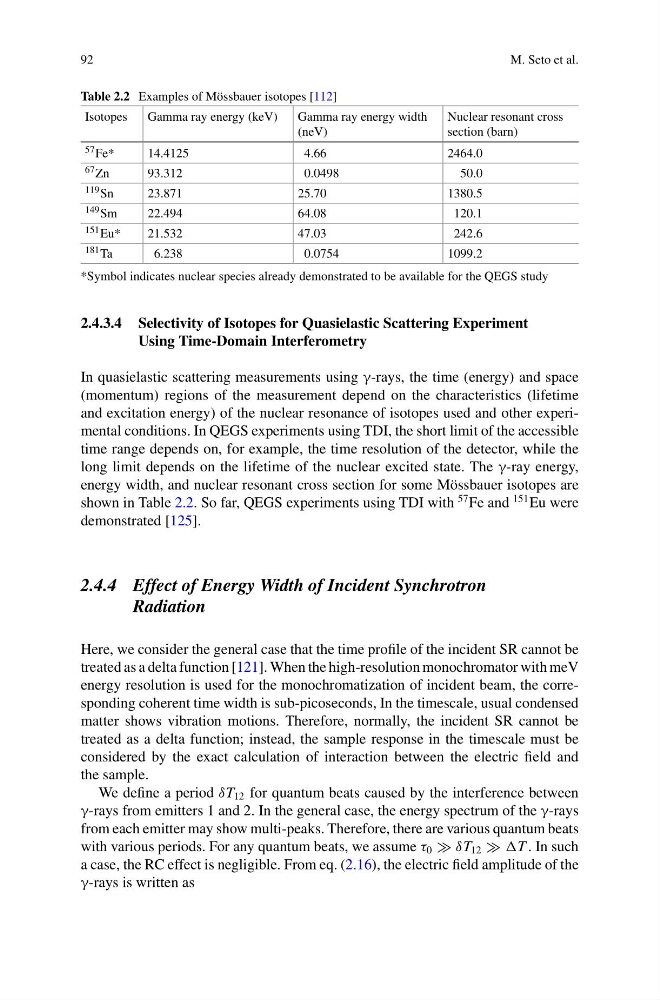
Table 2.2 Examples of Mössbauer isotopes [112]
Isotopes
Gamma ray energy (keV)
Gamma ray energy width
(neV)
Nuclear resonant cross
section (barn)
57 Fe*
14.4125
4.66
2464.0
67 Zn
93.312
0.0498
50.0
119 Sn
23.871
25.70
1380.5
149 Sm
22.494
64.08
120.1
151 Eu*
21.532
47.03
242.6
181 Ta
6.238
0.0754
1099.2
*Symbol indicates nuclear species already demonstrated to be available for the QEGS study
2.4.3.4 Selectivity of Isotopes for Quasielastic Scattering Experiment
Using Time-Domain Interferometry
In quasielastic scattering measurements using γ-rays, the time (energy) and space
(momentum) regions of the measurement depend on the characteristics (lifetime
and excitation energy) of the nuclear resonance of isotopes used and other experimental conditions. In QEGS experiments using TDI, the short limit of the accessible
time range depends on, for example, the time resolution of the detector, while the
long limit depends on the lifetime of the nuclear excited state. The γ-ray energy,
energy width, and nuclear resonant cross section for some Mössbauer isotopes are
shown in Table 2.2. So far, QEGS experiments using TDI with
57 Fe and
151 Eu were
demonstrated [125].
2.4.4 Effect of Energy Width of Incident Synchrotron
Radiation
Here, we consider the general case that the time profile of the incident SR cannot be
treated as a delta function [121]. When the high-resolution monochromator with meV
energy resolution is used for the monochromatization of incident beam, the corresponding coherent time width is sub-picoseconds, In the timescale, usual condensed
matter shows vibration motions. Therefore, normally, the incident SR cannot be
treated as a delta function; instead, the sample response in the timescale must be
considered by the exact calculation of interaction between the electric field and
the sample.
We define a period δT 12 for quantum beats caused by the interference between
γ-rays from emitters 1 and 2. In the general case, the energy spectrum of the γ-rays
from each emitter may show multi-peaks. Therefore, there are various quantum beats
with various periods. For any quantum beats, we assume τ 0 δT 12 T . In such
a case, the RC effect is negligible. From eq. (2.16), the electric field amplitude of the
γ-rays is written as
M. Seto et al.
Table 2.2 Examples of Mössbauer isotopes [112]
Isotopes
Gamma ray energy (keV)
Gamma ray energy width
(neV)
Nuclear resonant cross
section (barn)
57 Fe*
14.4125
4.66
2464.0
67 Zn
93.312
0.0498
50.0
119 Sn
23.871
25.70
1380.5
149 Sm
22.494
64.08
120.1
151 Eu*
21.532
47.03
242.6
181 Ta
6.238
0.0754
1099.2
*Symbol indicates nuclear species already demonstrated to be available for the QEGS study
2.4.3.4 Selectivity of Isotopes for Quasielastic Scattering Experiment
Using Time-Domain Interferometry
In quasielastic scattering measurements using γ-rays, the time (energy) and space
(momentum) regions of the measurement depend on the characteristics (lifetime
and excitation energy) of the nuclear resonance of isotopes used and other experimental conditions. In QEGS experiments using TDI, the short limit of the accessible
time range depends on, for example, the time resolution of the detector, while the
long limit depends on the lifetime of the nuclear excited state. The γ-ray energy,
energy width, and nuclear resonant cross section for some Mössbauer isotopes are
shown in Table 2.2. So far, QEGS experiments using TDI with
57 Fe and
151 Eu were
demonstrated [125].
2.4.4 Effect of Energy Width of Incident Synchrotron
Radiation
Here, we consider the general case that the time profile of the incident SR cannot be
treated as a delta function [121]. When the high-resolution monochromator with meV
energy resolution is used for the monochromatization of incident beam, the corresponding coherent time width is sub-picoseconds, In the timescale, usual condensed
matter shows vibration motions. Therefore, normally, the incident SR cannot be
treated as a delta function; instead, the sample response in the timescale must be
considered by the exact calculation of interaction between the electric field and
the sample.
We define a period δT 12 for quantum beats caused by the interference between
γ-rays from emitters 1 and 2. In the general case, the energy spectrum of the γ-rays
from each emitter may show multi-peaks. Therefore, there are various quantum beats
with various periods. For any quantum beats, we assume τ 0 δT 12 T . In such
a case, the RC effect is negligible. From eq. (2.16), the electric field amplitude of the
γ-rays is written as