

2 Synchrotron-Radiation-Based Energy-Domain Mössbauer …
83
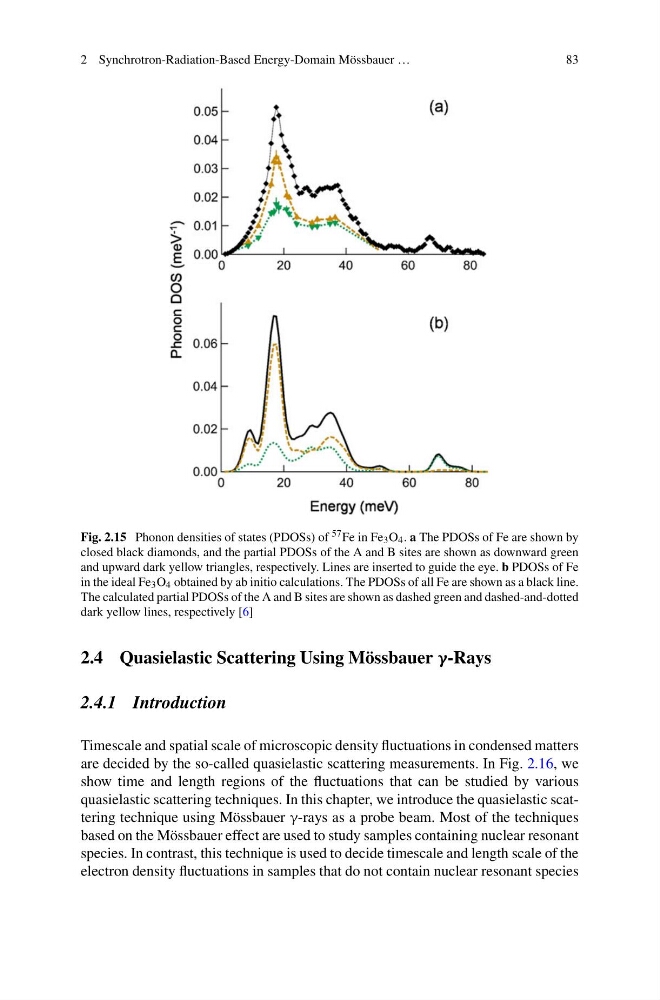
Fig. 2.15 Phonon densities of states (PDOSs) of 57 Fe in Fe 3 O 4 . a The PDOSs of Fe are shown by
closed black diamonds, and the partial PDOSs of the A and B sites are shown as downward green
and upward dark yellow triangles, respectively. Lines are inserted to guide the eye. b PDOSs of Fe
in the ideal Fe 3 O 4 obtained by ab initio calculations. The PDOSs of all Fe are shown as a black line.
The calculated partial PDOSs of the A and B sites are shown as dashed green and dashed-and-dotted
dark yellow lines, respectively [6]
2.4 Quasielastic Scattering Using Mössbauer γ-Rays
2.4.1 Introduction
Timescale and spatial scale of microscopic density fluctuations in condensed matters
are decided by the so-called quasielastic scattering measurements. In Fig. 2.16, we
show time and length regions of the fluctuations that can be studied by various
quasielastic scattering techniques. In this chapter, we introduce the quasielastic scattering technique using Mössbauer γ-rays as a probe beam. Most of the techniques
based on the Mössbauer effect are used to study samples containing nuclear resonant
species. In contrast, this technique is used to decide timescale and length scale of the
electron density fluctuations in samples that do not contain nuclear resonant species
83
Fig. 2.15 Phonon densities of states (PDOSs) of 57 Fe in Fe 3 O 4 . a The PDOSs of Fe are shown by
closed black diamonds, and the partial PDOSs of the A and B sites are shown as downward green
and upward dark yellow triangles, respectively. Lines are inserted to guide the eye. b PDOSs of Fe
in the ideal Fe 3 O 4 obtained by ab initio calculations. The PDOSs of all Fe are shown as a black line.
The calculated partial PDOSs of the A and B sites are shown as dashed green and dashed-and-dotted
dark yellow lines, respectively [6]
2.4 Quasielastic Scattering Using Mössbauer γ-Rays
2.4.1 Introduction
Timescale and spatial scale of microscopic density fluctuations in condensed matters
are decided by the so-called quasielastic scattering measurements. In Fig. 2.16, we
show time and length regions of the fluctuations that can be studied by various
quasielastic scattering techniques. In this chapter, we introduce the quasielastic scattering technique using Mössbauer γ-rays as a probe beam. Most of the techniques
based on the Mössbauer effect are used to study samples containing nuclear resonant
species. In contrast, this technique is used to decide timescale and length scale of the
electron density fluctuations in samples that do not contain nuclear resonant species