

64
M. Seto et al.
Table 2.1 List of standard
references for some isotopes
Nuclides Energy reference
Nuclide Energy reference
40 K
KCl
125 Te
Mg 3 TeO 6
61 Ni
Ni 0.86 V 0.14
149 Sm
Sm 2 O 3 or SmB 6
73 Ge
Li 2 GeO 3 or GeO 2
151 Eu
EuF 3
119 Sn
CaSnO 3
174 Yb
YbB 12
it. This limitation is quite mild because the incident SR is hard X-rays. Consequently, we can arrange any environmental cells, such as a low-temperature cryostat,
high-pressure cell, and gas chamber. Conversely, the limitation of the scatterer is a
little complicated. The scattering from the scatterer should be efficiently detected
by the detector. This limits the shape of the scatterer, as described. Nevertheless,
thin film samples are sometimes good as the scatterer. As for the energy reference
substance, it should be a chemical compound showing no hyperfine splitting in their
resonant nuclear levels. Table 2.1 shows the chemical compounds used as suitable
energy references. Some of them show small hyperfine splitting, which is not as
large as the natural line width of the nuclear resonance and is not a big problem in
actual use. In addition, when we perform the SR-based Mössbauer spectroscopy with
isotopes whose resonant energy is high, typically above 40 keV, both the transmitter
and scatterer should be cooled down to obtain a reasonable recoilless fraction. For
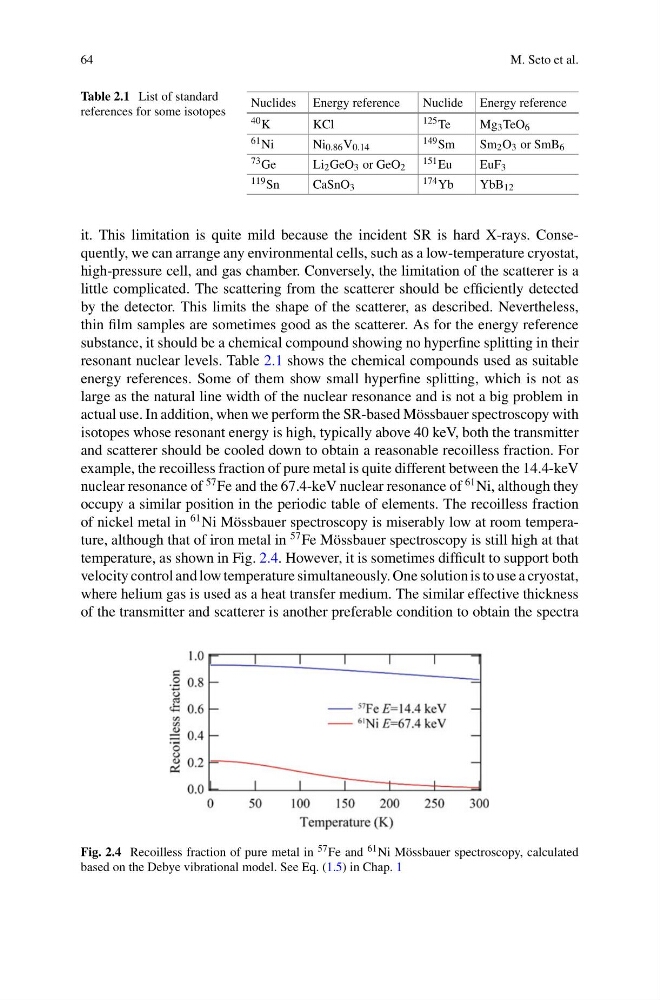
example, the recoilless fraction of pure metal is quite different between the 14.4-keV
nuclear resonance of
57 Fe and the 67.4-keV nuclear resonance of
61 Ni, although they
occupy a similar position in the periodic table of elements. The recoilless fraction
of nickel metal in
61 Ni Mössbauer spectroscopy is miserably low at room temperature, although that of iron metal in
57 Fe Mössbauer spectroscopy is still high at that
temperature, as shown in Fig. 2.4. However, it is sometimes difficult to support both
velocity control and low temperature simultaneously. One solution is to use a cryostat,
where helium gas is used as a heat transfer medium. The similar effective thickness
of the transmitter and scatterer is another preferable condition to obtain the spectra
Fig. 2.4 Recoilless fraction of pure metal in 57 Fe and 61 Ni Mössbauer spectroscopy, calculated
based on the Debye vibrational model. See Eq. (1.5) in Chap. 1
M. Seto et al.
Table 2.1 List of standard
references for some isotopes
Nuclides Energy reference
Nuclide Energy reference
40 K
KCl
125 Te
Mg 3 TeO 6
61 Ni
Ni 0.86 V 0.14
149 Sm
Sm 2 O 3 or SmB 6
73 Ge
Li 2 GeO 3 or GeO 2
151 Eu
EuF 3
119 Sn
CaSnO 3
174 Yb
YbB 12
it. This limitation is quite mild because the incident SR is hard X-rays. Consequently, we can arrange any environmental cells, such as a low-temperature cryostat,
high-pressure cell, and gas chamber. Conversely, the limitation of the scatterer is a
little complicated. The scattering from the scatterer should be efficiently detected
by the detector. This limits the shape of the scatterer, as described. Nevertheless,
thin film samples are sometimes good as the scatterer. As for the energy reference
substance, it should be a chemical compound showing no hyperfine splitting in their
resonant nuclear levels. Table 2.1 shows the chemical compounds used as suitable
energy references. Some of them show small hyperfine splitting, which is not as
large as the natural line width of the nuclear resonance and is not a big problem in
actual use. In addition, when we perform the SR-based Mössbauer spectroscopy with
isotopes whose resonant energy is high, typically above 40 keV, both the transmitter
and scatterer should be cooled down to obtain a reasonable recoilless fraction. For
example, the recoilless fraction of pure metal is quite different between the 14.4-keV
nuclear resonance of
57 Fe and the 67.4-keV nuclear resonance of
61 Ni, although they
occupy a similar position in the periodic table of elements. The recoilless fraction
of nickel metal in
61 Ni Mössbauer spectroscopy is miserably low at room temperature, although that of iron metal in
57 Fe Mössbauer spectroscopy is still high at that
temperature, as shown in Fig. 2.4. However, it is sometimes difficult to support both
velocity control and low temperature simultaneously. One solution is to use a cryostat,
where helium gas is used as a heat transfer medium. The similar effective thickness
of the transmitter and scatterer is another preferable condition to obtain the spectra
Fig. 2.4 Recoilless fraction of pure metal in 57 Fe and 61 Ni Mössbauer spectroscopy, calculated
based on the Debye vibrational model. See Eq. (1.5) in Chap. 1