

1 Historical Developments and Future Perspectives …
47
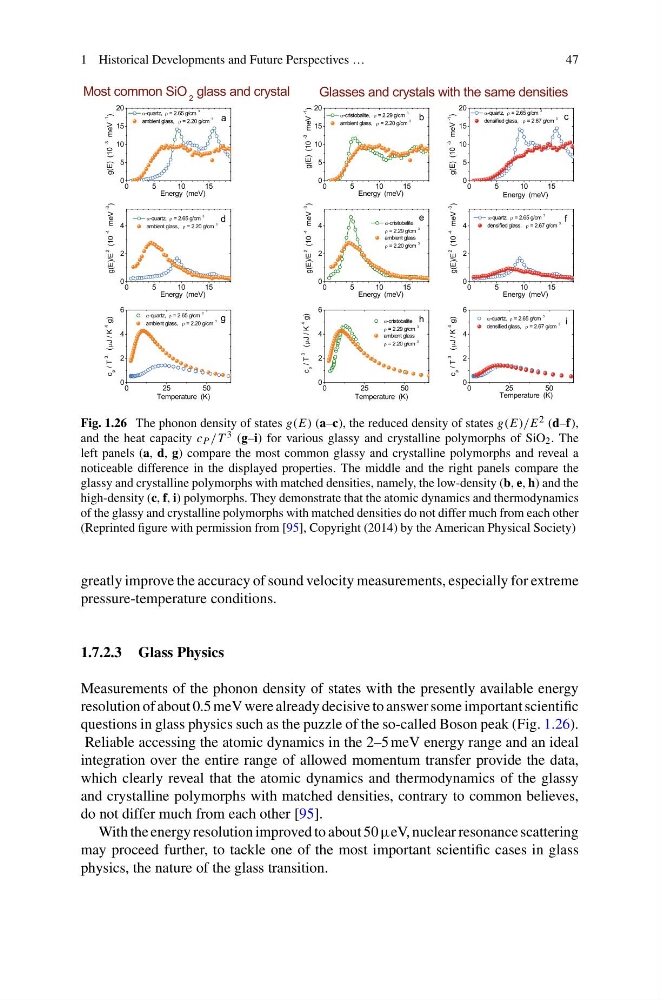
Fig. 1.26 The phonon density of states g(E) (a–c), the reduced density of states g(E)/E 2 (d–f),
and the heat capacity c P /T 3 (g–i) for various glassy and crystalline polymorphs of SiO 2 . The
left panels (a, d, g) compare the most common glassy and crystalline polymorphs and reveal a
noticeable difference in the displayed properties. The middle and the right panels compare the
glassy and crystalline polymorphs with matched densities, namely, the low-density (b, e, h) and the
high-density (c, f, i) polymorphs. They demonstrate that the atomic dynamics and thermodynamics
of the glassy and crystalline polymorphs with matched densities do not differ much from each other
(Reprinted figure with permission from [95], Copyright (2014) by the American Physical Society)
greatly improve the accuracy of sound velocity measurements, especially for extreme
pressure-temperature conditions.
1.7.2.3 Glass Physics
Measurements of the phonon density of states with the presently available energy
resolution of about 0.5 meV were already decisive to answer some important scientific
questions in glass physics such as the puzzle of the so-called Boson peak (Fig. 1.26).
Reliable accessing the atomic dynamics in the 2–5 meV energy range and an ideal
integration over the entire range of allowed momentum transfer provide the data,
which clearly reveal that the atomic dynamics and thermodynamics of the glassy
and crystalline polymorphs with matched densities, contrary to common believes,
do not differ much from each other [95].
With the energy resolution improved to about 50 μeV, nuclear resonance scattering
may proceed further, to tackle one of the most important scientific cases in glass
physics, the nature of the glass transition.
47
Fig. 1.26 The phonon density of states g(E) (a–c), the reduced density of states g(E)/E 2 (d–f),
and the heat capacity c P /T 3 (g–i) for various glassy and crystalline polymorphs of SiO 2 . The
left panels (a, d, g) compare the most common glassy and crystalline polymorphs and reveal a
noticeable difference in the displayed properties. The middle and the right panels compare the
glassy and crystalline polymorphs with matched densities, namely, the low-density (b, e, h) and the
high-density (c, f, i) polymorphs. They demonstrate that the atomic dynamics and thermodynamics
of the glassy and crystalline polymorphs with matched densities do not differ much from each other
(Reprinted figure with permission from [95], Copyright (2014) by the American Physical Society)
greatly improve the accuracy of sound velocity measurements, especially for extreme
pressure-temperature conditions.
1.7.2.3 Glass Physics
Measurements of the phonon density of states with the presently available energy
resolution of about 0.5 meV were already decisive to answer some important scientific
questions in glass physics such as the puzzle of the so-called Boson peak (Fig. 1.26).
Reliable accessing the atomic dynamics in the 2–5 meV energy range and an ideal
integration over the entire range of allowed momentum transfer provide the data,
which clearly reveal that the atomic dynamics and thermodynamics of the glassy
and crystalline polymorphs with matched densities, contrary to common believes,
do not differ much from each other [95].
With the energy resolution improved to about 50 μeV, nuclear resonance scattering
may proceed further, to tackle one of the most important scientific cases in glass
physics, the nature of the glass transition.