

1 Historical Developments and Future Perspectives …
45
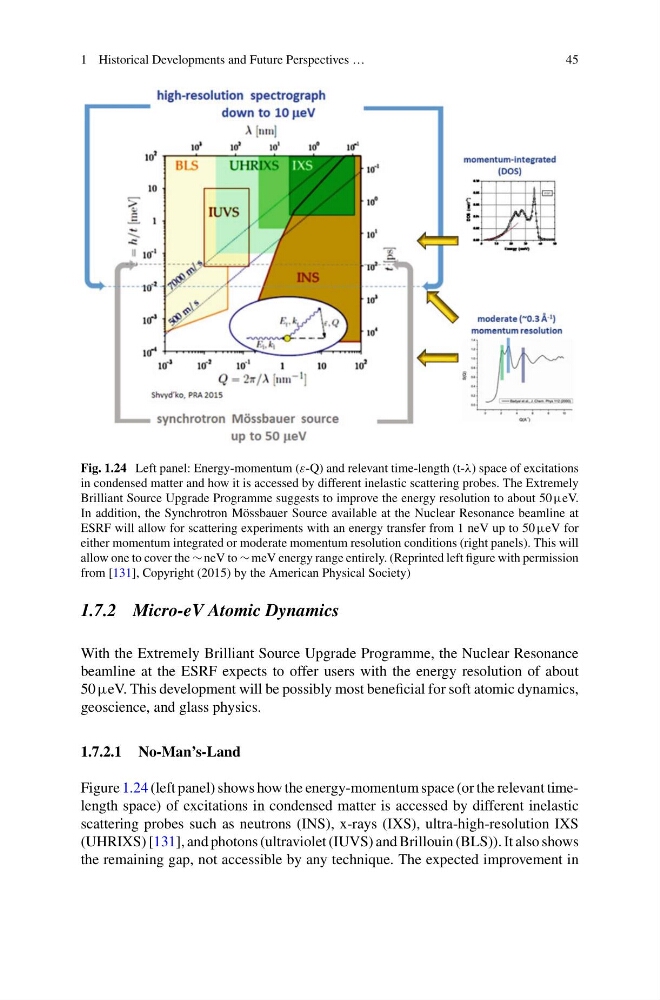
Fig. 1.24 Left panel: Energy-momentum (ε-Q) and relevant time-length (t-λ) space of excitations
in condensed matter and how it is accessed by different inelastic scattering probes. The Extremely
Brilliant Source Upgrade Programme suggests to improve the energy resolution to about 50 μeV.
In addition, the Synchrotron Mössbauer Source available at the Nuclear Resonance beamline at
ESRF will allow for scattering experiments with an energy transfer from 1 neV up to 50 μeV for
either momentum integrated or moderate momentum resolution conditions (right panels). This will
allow one to cover the ∼ neV to ∼ meV energy range entirely. (Reprinted left figure with permission
from [131], Copyright (2015) by the American Physical Society)
1.7.2 Micro-eV Atomic Dynamics
With the Extremely Brilliant Source Upgrade Programme, the Nuclear Resonance
beamline at the ESRF expects to offer users with the energy resolution of about
50 μeV. This development will be possibly most beneficial for soft atomic dynamics,
geoscience, and glass physics.
1.7.2.1 No-Man’s-Land
Figure 1.24 (left panel) shows how the energy-momentum space (or the relevant timelength space) of excitations in condensed matter is accessed by different inelastic
scattering probes such as neutrons (INS), x-rays (IXS), ultra-high-resolution IXS
(UHRIXS) [131], and photons (ultraviolet (IUVS) and Brillouin (BLS)). It also shows
the remaining gap, not accessible by any technique. The expected improvement in
45
Fig. 1.24 Left panel: Energy-momentum (ε-Q) and relevant time-length (t-λ) space of excitations
in condensed matter and how it is accessed by different inelastic scattering probes. The Extremely
Brilliant Source Upgrade Programme suggests to improve the energy resolution to about 50 μeV.
In addition, the Synchrotron Mössbauer Source available at the Nuclear Resonance beamline at
ESRF will allow for scattering experiments with an energy transfer from 1 neV up to 50 μeV for
either momentum integrated or moderate momentum resolution conditions (right panels). This will
allow one to cover the ∼ neV to ∼ meV energy range entirely. (Reprinted left figure with permission
from [131], Copyright (2015) by the American Physical Society)
1.7.2 Micro-eV Atomic Dynamics
With the Extremely Brilliant Source Upgrade Programme, the Nuclear Resonance
beamline at the ESRF expects to offer users with the energy resolution of about
50 μeV. This development will be possibly most beneficial for soft atomic dynamics,
geoscience, and glass physics.
1.7.2.1 No-Man’s-Land
Figure 1.24 (left panel) shows how the energy-momentum space (or the relevant timelength space) of excitations in condensed matter is accessed by different inelastic
scattering probes such as neutrons (INS), x-rays (IXS), ultra-high-resolution IXS
(UHRIXS) [131], and photons (ultraviolet (IUVS) and Brillouin (BLS)). It also shows
the remaining gap, not accessible by any technique. The expected improvement in