

484
Y. Yoshida
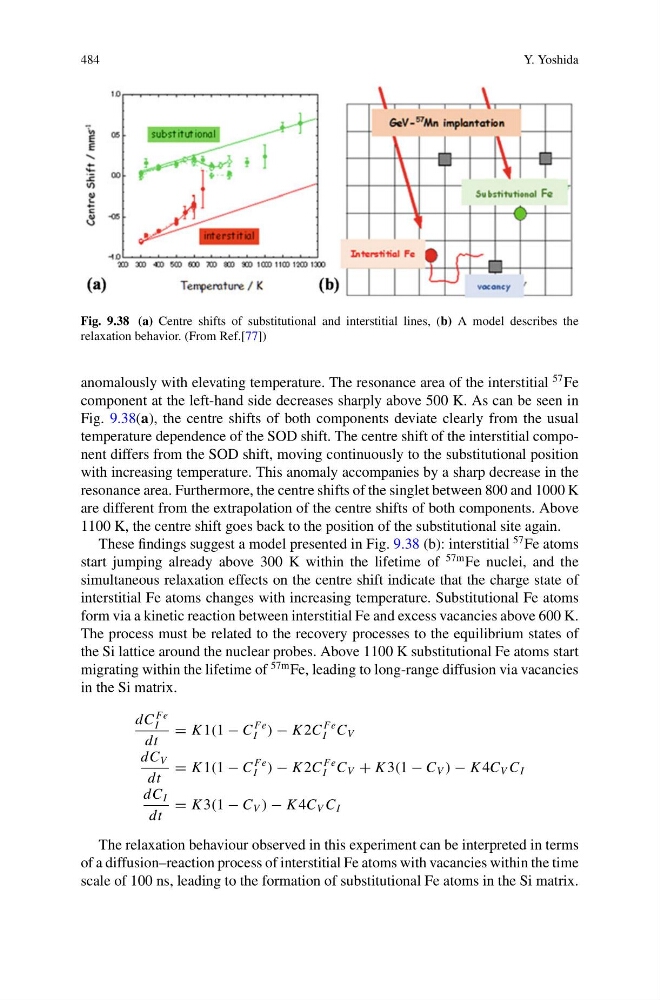
Fig. 9.38 (a) Centre shifts of substitutional and interstitial lines, (b) A model describes the
relaxation behavior. (From Ref.[77])
anomalously with elevating temperature. The resonance area of the interstitial
57 Fe
component at the left-hand side decreases sharply above 500 K. As can be seen in
Fig. 9.38(a), the centre shifts of both components deviate clearly from the usual
temperature dependence of the SOD shift. The centre shift of the interstitial component differs from the SOD shift, moving continuously to the substitutional position
with increasing temperature. This anomaly accompanies by a sharp decrease in the
resonance area. Furthermore, the centre shifts of the singlet between 800 and 1000 K
are different from the extrapolation of the centre shifts of both components. Above
1100 K, the centre shift goes back to the position of the substitutional site again.
These findings suggest a model presented in Fig. 9.38 (b): interstitial
57 Fe atoms
start jumping already above 300 K within the lifetime of
57m Fe nuclei, and the
simultaneous relaxation effects on the centre shift indicate that the charge state of
interstitial Fe atoms changes with increasing temperature. Substitutional Fe atoms
form via a kinetic reaction between interstitial Fe and excess vacancies above 600 K.
The process must be related to the recovery processes to the equilibrium states of
the Si lattice around the nuclear probes. Above 1100 K substitutional Fe atoms start
migrating within the lifetime of
57m Fe, leading to long-range diffusion via vacancies
in the Si matrix.
dC
Fe
I
dt
= K 1(1 − C
Fe
I ) − K 2C
Fe
I C V
dC V
dt
= K 1(1 − C
Fe
I ) − K 2C
Fe
I C V + K 3(1 − C V ) − K 4C V C I
dC I
dt
= K 3(1 − C V ) − K 4C V C I
The relaxation behaviour observed in this experiment can be interpreted in terms
of a diffusion–reaction process of interstitial Fe atoms with vacancies within the time
scale of 100 ns, leading to the formation of substitutional Fe atoms in the Si matrix.
Y. Yoshida
Fig. 9.38 (a) Centre shifts of substitutional and interstitial lines, (b) A model describes the
relaxation behavior. (From Ref.[77])
anomalously with elevating temperature. The resonance area of the interstitial
57 Fe
component at the left-hand side decreases sharply above 500 K. As can be seen in
Fig. 9.38(a), the centre shifts of both components deviate clearly from the usual
temperature dependence of the SOD shift. The centre shift of the interstitial component differs from the SOD shift, moving continuously to the substitutional position
with increasing temperature. This anomaly accompanies by a sharp decrease in the
resonance area. Furthermore, the centre shifts of the singlet between 800 and 1000 K
are different from the extrapolation of the centre shifts of both components. Above
1100 K, the centre shift goes back to the position of the substitutional site again.
These findings suggest a model presented in Fig. 9.38 (b): interstitial
57 Fe atoms
start jumping already above 300 K within the lifetime of
57m Fe nuclei, and the
simultaneous relaxation effects on the centre shift indicate that the charge state of
interstitial Fe atoms changes with increasing temperature. Substitutional Fe atoms
form via a kinetic reaction between interstitial Fe and excess vacancies above 600 K.
The process must be related to the recovery processes to the equilibrium states of
the Si lattice around the nuclear probes. Above 1100 K substitutional Fe atoms start
migrating within the lifetime of
57m Fe, leading to long-range diffusion via vacancies
in the Si matrix.
dC
Fe
I
dt
= K 1(1 − C
Fe
I ) − K 2C
Fe
I C V
dC V
dt
= K 1(1 − C
Fe
I ) − K 2C
Fe
I C V + K 3(1 − C V ) − K 4C V C I
dC I
dt
= K 3(1 − C V ) − K 4C V C I
The relaxation behaviour observed in this experiment can be interpreted in terms
of a diffusion–reaction process of interstitial Fe atoms with vacancies within the time
scale of 100 ns, leading to the formation of substitutional Fe atoms in the Si matrix.