

480
Y. Yoshida
Fig. 9.34 In beam
Mössbauer spectra at 500 K
at different measuring
directions from [100] (0°) to
[110] (45°). The angular
resolution was 5° at the
detector distance 0.11 m.
The deuteron beam current
was 75 nA. Reprinted figure
from [42] with permission,
©Trans Tech Publications,
Ltd. Reproduced with
permission. All right
reserved
-8
-6
-4
-2
0
2
4
6
8
100
200
14
o
0
o
100
200
100
200
22
o
Velocity (mm/s)
Normalized counts
100
200
32
o
100
200
45
o
in Fig. 9.33 with those obtained in a conventional laboratory experiment on pure Fe
in ultra-high-vacuum (open symbols). None of the spectra of Fig. 9.32 show wellresolved satellite lines. At first glance, the spectra appear to be very similar to those
of pure α-Fe. The temperature dependence of the fit parameters is, however, quite
different, as may be seen in Fig. 9.33: (a) The area A decreases much faster than
expected from a Debye model with the Debye temperature of α-Fe, D = 470 K.
(b) The hyperfine fields B hf are lower than those of α-Fe. (c) Above 550 K, the
centre shift δ starts deviating from the second-order Doppler shift corresponding to
substitutional Fe. (d) The full width at half maximum stays at a constant of about
0.40 mms
−1 .
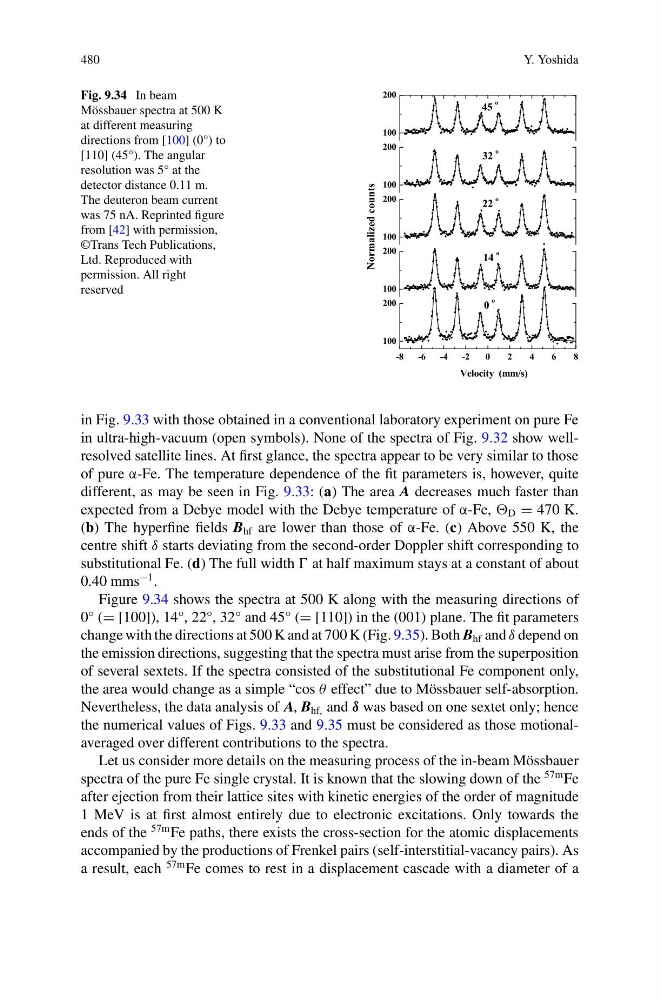
Figure 9.34 shows the spectra at 500 K along with the measuring directions of
0° (= [100]), 14°, 22°, 32° and 45° (= [110]) in the (001) plane. The fit parameters
change with the directions at 500 K and at 700 K (Fig. 9.35). Both B hf and δ depend on
the emission directions, suggesting that the spectra must arise from the superposition
of several sextets. If the spectra consisted of the substitutional Fe component only,
the area would change as a simple “cos θ effect” due to Mössbauer self-absorption.
Nevertheless, the data analysis of A, B hf, and δ was based on one sextet only; hence
the numerical values of Figs. 9.33 and 9.35 must be considered as those motionalaveraged over different contributions to the spectra.
Let us consider more details on the measuring process of the in-beam Mössbauer
spectra of the pure Fe single crystal. It is known that the slowing down of the
57m Fe
after ejection from their lattice sites with kinetic energies of the order of magnitude
1 MeV is at first almost entirely due to electronic excitations. Only towards the
ends of the
57m Fe paths, there exists the cross-section for the atomic displacements
accompanied by the productions of Frenkel pairs (self-interstitial-vacancy pairs). As
a result, each
57m Fe comes to rest in a displacement cascade with a diameter of a
Y. Yoshida
Fig. 9.34 In beam
Mössbauer spectra at 500 K
at different measuring
directions from [100] (0°) to
[110] (45°). The angular
resolution was 5° at the
detector distance 0.11 m.
The deuteron beam current
was 75 nA. Reprinted figure
from [42] with permission,
©Trans Tech Publications,
Ltd. Reproduced with
permission. All right
reserved
-8
-6
-4
-2
0
2
4
6
8
100
200
14
o
0
o
100
200
100
200
22
o
Velocity (mm/s)
Normalized counts
100
200
32
o
100
200
45
o
in Fig. 9.33 with those obtained in a conventional laboratory experiment on pure Fe
in ultra-high-vacuum (open symbols). None of the spectra of Fig. 9.32 show wellresolved satellite lines. At first glance, the spectra appear to be very similar to those
of pure α-Fe. The temperature dependence of the fit parameters is, however, quite
different, as may be seen in Fig. 9.33: (a) The area A decreases much faster than
expected from a Debye model with the Debye temperature of α-Fe, D = 470 K.
(b) The hyperfine fields B hf are lower than those of α-Fe. (c) Above 550 K, the
centre shift δ starts deviating from the second-order Doppler shift corresponding to
substitutional Fe. (d) The full width at half maximum stays at a constant of about
0.40 mms
−1 .
Figure 9.34 shows the spectra at 500 K along with the measuring directions of
0° (= [100]), 14°, 22°, 32° and 45° (= [110]) in the (001) plane. The fit parameters
change with the directions at 500 K and at 700 K (Fig. 9.35). Both B hf and δ depend on
the emission directions, suggesting that the spectra must arise from the superposition
of several sextets. If the spectra consisted of the substitutional Fe component only,
the area would change as a simple “cos θ effect” due to Mössbauer self-absorption.
Nevertheless, the data analysis of A, B hf, and δ was based on one sextet only; hence
the numerical values of Figs. 9.33 and 9.35 must be considered as those motionalaveraged over different contributions to the spectra.
Let us consider more details on the measuring process of the in-beam Mössbauer
spectra of the pure Fe single crystal. It is known that the slowing down of the
57m Fe
after ejection from their lattice sites with kinetic energies of the order of magnitude
1 MeV is at first almost entirely due to electronic excitations. Only towards the
ends of the
57m Fe paths, there exists the cross-section for the atomic displacements
accompanied by the productions of Frenkel pairs (self-interstitial-vacancy pairs). As
a result, each
57m Fe comes to rest in a displacement cascade with a diameter of a