

9 Mössbauer Spectroscopic Studies on Atomic Diffusion in Materials
477
(a)
(b)
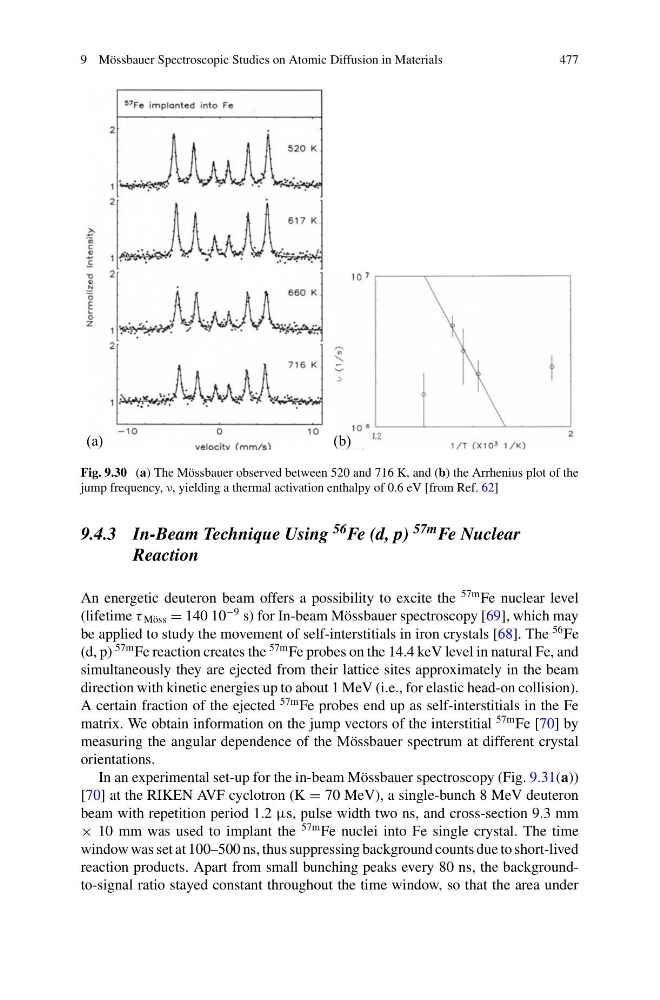
Fig. 9.30 (a) The Mössbauer observed between 520 and 716 K, and (b) the Arrhenius plot of the
jump frequency, ν, yielding a thermal activation enthalpy of 0.6 eV [from Ref. 62]
9.4.3 In-Beam Technique Using 56 Fe (d, p) 57m Fe Nuclear
Reaction
An energetic deuteron beam offers a possibility to excite the
57m Fe nuclear level
(lifetime τ Möss = 140 10
−9 s) for In-beam Mössbauer spectroscopy [69], which may
be applied to study the movement of self-interstitials in iron crystals [68]. The
56 Fe
(d, p)
57m Fe reaction creates the
57m Fe probes on the 14.4 keV level in natural Fe, and
simultaneously they are ejected from their lattice sites approximately in the beam
direction with kinetic energies up to about 1 MeV (i.e., for elastic head-on collision).
A certain fraction of the ejected
57m Fe probes end up as self-interstitials in the Fe
matrix. We obtain information on the jump vectors of the interstitial
57m Fe [70] by
measuring the angular dependence of the Mössbauer spectrum at different crystal
orientations.
In an experimental set-up for the in-beam Mössbauer spectroscopy (Fig. 9.31(a))
[70] at the RIKEN AVF cyclotron (K = 70 MeV), a single-bunch 8 MeV deuteron
beam with repetition period 1.2 μs, pulse width two ns, and cross-section 9.3 mm
× 10 mm was used to implant the
57m Fe nuclei into Fe single crystal. The time
window was set at 100–500 ns, thus suppressing background counts due to short-lived
reaction products. Apart from small bunching peaks every 80 ns, the backgroundto-signal ratio stayed constant throughout the time window, so that the area under
477
(a)
(b)
Fig. 9.30 (a) The Mössbauer observed between 520 and 716 K, and (b) the Arrhenius plot of the
jump frequency, ν, yielding a thermal activation enthalpy of 0.6 eV [from Ref. 62]
9.4.3 In-Beam Technique Using 56 Fe (d, p) 57m Fe Nuclear
Reaction
An energetic deuteron beam offers a possibility to excite the
57m Fe nuclear level
(lifetime τ Möss = 140 10
−9 s) for In-beam Mössbauer spectroscopy [69], which may
be applied to study the movement of self-interstitials in iron crystals [68]. The
56 Fe
(d, p)
57m Fe reaction creates the
57m Fe probes on the 14.4 keV level in natural Fe, and
simultaneously they are ejected from their lattice sites approximately in the beam
direction with kinetic energies up to about 1 MeV (i.e., for elastic head-on collision).
A certain fraction of the ejected
57m Fe probes end up as self-interstitials in the Fe
matrix. We obtain information on the jump vectors of the interstitial
57m Fe [70] by
measuring the angular dependence of the Mössbauer spectrum at different crystal
orientations.
In an experimental set-up for the in-beam Mössbauer spectroscopy (Fig. 9.31(a))
[70] at the RIKEN AVF cyclotron (K = 70 MeV), a single-bunch 8 MeV deuteron
beam with repetition period 1.2 μs, pulse width two ns, and cross-section 9.3 mm
× 10 mm was used to implant the
57m Fe nuclei into Fe single crystal. The time
window was set at 100–500 ns, thus suppressing background counts due to short-lived
reaction products. Apart from small bunching peaks every 80 ns, the backgroundto-signal ratio stayed constant throughout the time window, so that the area under