

9 Mössbauer Spectroscopic Studies on Atomic Diffusion in Materials
461
ferromagnetic component from Martensitic phase. Both phases contained the supersaturated interstitial carbon atoms. Therefore, the two components changed during
the isochronal annealing due to the clustering and precipitation processes of carbon,
as is seen in other spectra in Fig. 9.14(b)–(d).
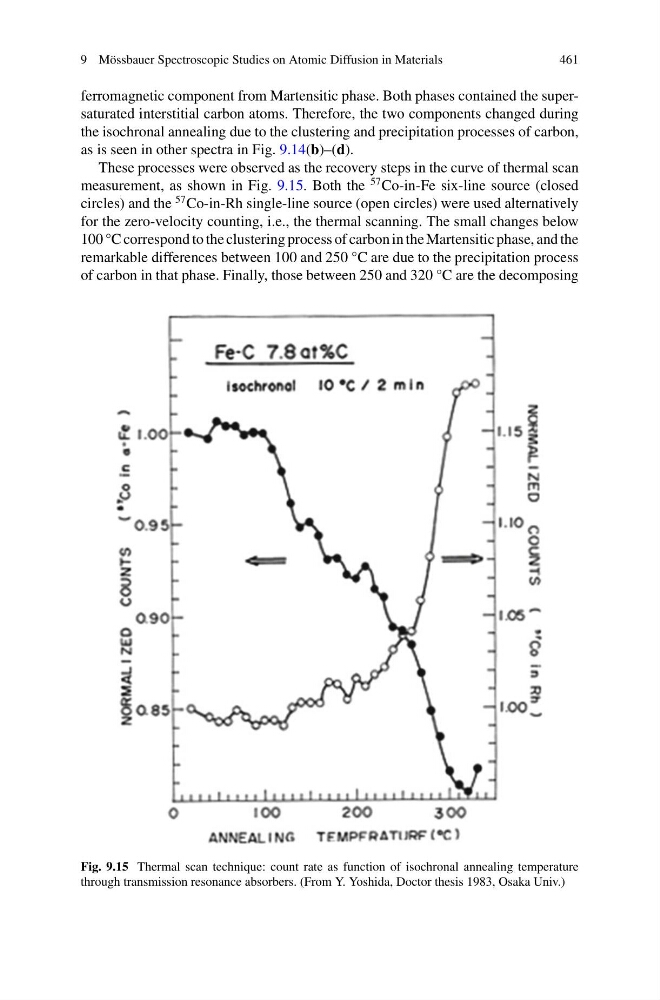
These processes were observed as the recovery steps in the curve of thermal scan
measurement, as shown in Fig. 9.15. Both the
57 Co-in-Fe six-line source (closed
circles) and the
57 Co-in-Rh single-line source (open circles) were used alternatively
for the zero-velocity counting, i.e., the thermal scanning. The small changes below
100 °C correspond to the clustering process of carbon in the Martensitic phase, and the
remarkable differences between 100 and 250 °C are due to the precipitation process
of carbon in that phase. Finally, those between 250 and 320 °C are the decomposing
Fig. 9.15 Thermal scan technique: count rate as function of isochronal annealing temperature
through transmission resonance absorbers. (From Y. Yoshida, Doctor thesis 1983, Osaka Univ.)
461
ferromagnetic component from Martensitic phase. Both phases contained the supersaturated interstitial carbon atoms. Therefore, the two components changed during
the isochronal annealing due to the clustering and precipitation processes of carbon,
as is seen in other spectra in Fig. 9.14(b)–(d).
These processes were observed as the recovery steps in the curve of thermal scan
measurement, as shown in Fig. 9.15. Both the
57 Co-in-Fe six-line source (closed
circles) and the
57 Co-in-Rh single-line source (open circles) were used alternatively
for the zero-velocity counting, i.e., the thermal scanning. The small changes below
100 °C correspond to the clustering process of carbon in the Martensitic phase, and the
remarkable differences between 100 and 250 °C are due to the precipitation process
of carbon in that phase. Finally, those between 250 and 320 °C are the decomposing
Fig. 9.15 Thermal scan technique: count rate as function of isochronal annealing temperature
through transmission resonance absorbers. (From Y. Yoshida, Doctor thesis 1983, Osaka Univ.)