

1 Historical Developments and Future Perspectives …
31
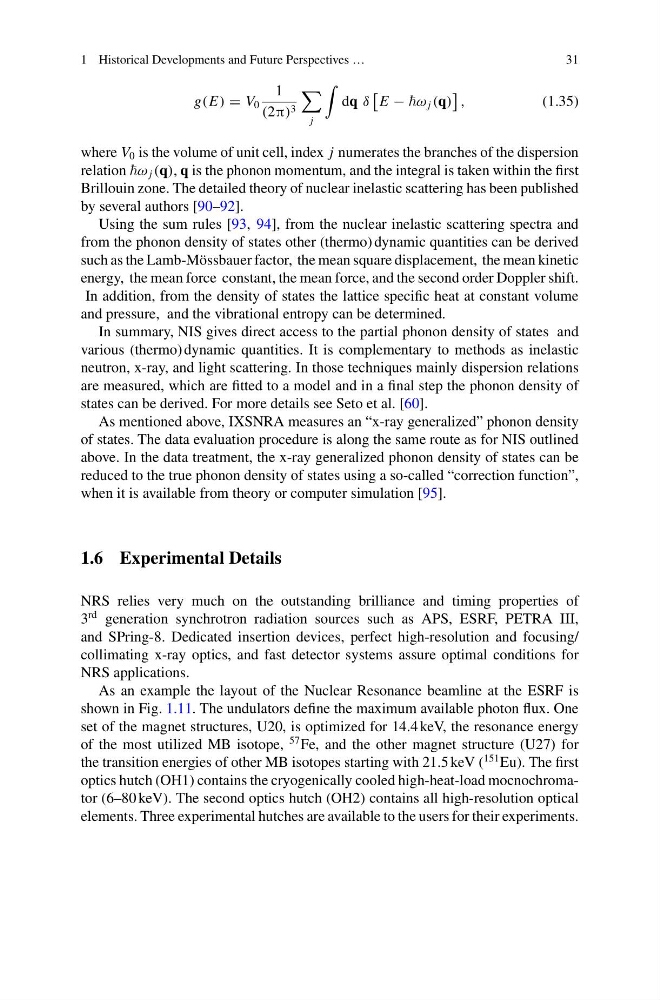
g(E) = V 0
1
(2π) 3
j
dq δ
E − ω j (q)
,
(1.35)
where V 0 is the volume of unit cell, index j numerates the branches of the dispersion
relation ω j (q), q is the phonon momentum, and the integral is taken within the first
Brillouin zone. The detailed theory of nuclear inelastic scattering has been published
by several authors [90–92].
Using the sum rules [93, 94], from the nuclear inelastic scattering spectra and
from the phonon density of states other (thermo) dynamic quantities can be derived
such as the Lamb-Mössbauer factor, the mean square displacement, the mean kinetic
energy, the mean force constant, the mean force, and the second order Doppler shift.
In addition, from the density of states the lattice specific heat at constant volume
and pressure, and the vibrational entropy can be determined.
In summary, NIS gives direct access to the partial phonon density of states and
various (thermo) dynamic quantities. It is complementary to methods as inelastic
neutron, x-ray, and light scattering. In those techniques mainly dispersion relations
are measured, which are fitted to a model and in a final step the phonon density of
states can be derived. For more details see Seto et al. [60].
As mentioned above, IXSNRA measures an “x-ray generalized” phonon density
of states. The data evaluation procedure is along the same route as for NIS outlined
above. In the data treatment, the x-ray generalized phonon density of states can be
reduced to the true phonon density of states using a so-called “correction function”,
when it is available from theory or computer simulation [95].
1.6 Experimental Details
NRS relies very much on the outstanding brilliance and timing properties of
3
rd generation synchrotron radiation sources such as APS, ESRF, PETRA III,
and SPring-8. Dedicated insertion devices, perfect high-resolution and focusing/
collimating x-ray optics, and fast detector systems assure optimal conditions for
NRS applications.
As an example the layout of the Nuclear Resonance beamline at the ESRF is
shown in Fig. 1.11. The undulators define the maximum available photon flux. One
set of the magnet structures, U20, is optimized for 14.4 keV, the resonance energy
of the most utilized MB isotope,
57 Fe, and the other magnet structure (U27) for
the transition energies of other MB isotopes starting with 21.5 keV (
151 Eu). The first
optics hutch (OH1) contains the cryogenically cooled high-heat-load mocnochromator (6–80 keV). The second optics hutch (OH2) contains all high-resolution optical
elements. Three experimental hutches are available to the users for their experiments.
31
g(E) = V 0
1
(2π) 3
j
dq δ
E − ω j (q)
,
(1.35)
where V 0 is the volume of unit cell, index j numerates the branches of the dispersion
relation ω j (q), q is the phonon momentum, and the integral is taken within the first
Brillouin zone. The detailed theory of nuclear inelastic scattering has been published
by several authors [90–92].
Using the sum rules [93, 94], from the nuclear inelastic scattering spectra and
from the phonon density of states other (thermo) dynamic quantities can be derived
such as the Lamb-Mössbauer factor, the mean square displacement, the mean kinetic
energy, the mean force constant, the mean force, and the second order Doppler shift.
In addition, from the density of states the lattice specific heat at constant volume
and pressure, and the vibrational entropy can be determined.
In summary, NIS gives direct access to the partial phonon density of states and
various (thermo) dynamic quantities. It is complementary to methods as inelastic
neutron, x-ray, and light scattering. In those techniques mainly dispersion relations
are measured, which are fitted to a model and in a final step the phonon density of
states can be derived. For more details see Seto et al. [60].
As mentioned above, IXSNRA measures an “x-ray generalized” phonon density
of states. The data evaluation procedure is along the same route as for NIS outlined
above. In the data treatment, the x-ray generalized phonon density of states can be
reduced to the true phonon density of states using a so-called “correction function”,
when it is available from theory or computer simulation [95].
1.6 Experimental Details
NRS relies very much on the outstanding brilliance and timing properties of
3
rd generation synchrotron radiation sources such as APS, ESRF, PETRA III,
and SPring-8. Dedicated insertion devices, perfect high-resolution and focusing/
collimating x-ray optics, and fast detector systems assure optimal conditions for
NRS applications.
As an example the layout of the Nuclear Resonance beamline at the ESRF is
shown in Fig. 1.11. The undulators define the maximum available photon flux. One
set of the magnet structures, U20, is optimized for 14.4 keV, the resonance energy
of the most utilized MB isotope,
57 Fe, and the other magnet structure (U27) for
the transition energies of other MB isotopes starting with 21.5 keV (
151 Eu). The first
optics hutch (OH1) contains the cryogenically cooled high-heat-load mocnochromator (6–80 keV). The second optics hutch (OH2) contains all high-resolution optical
elements. Three experimental hutches are available to the users for their experiments.