

458
Y. Yoshida
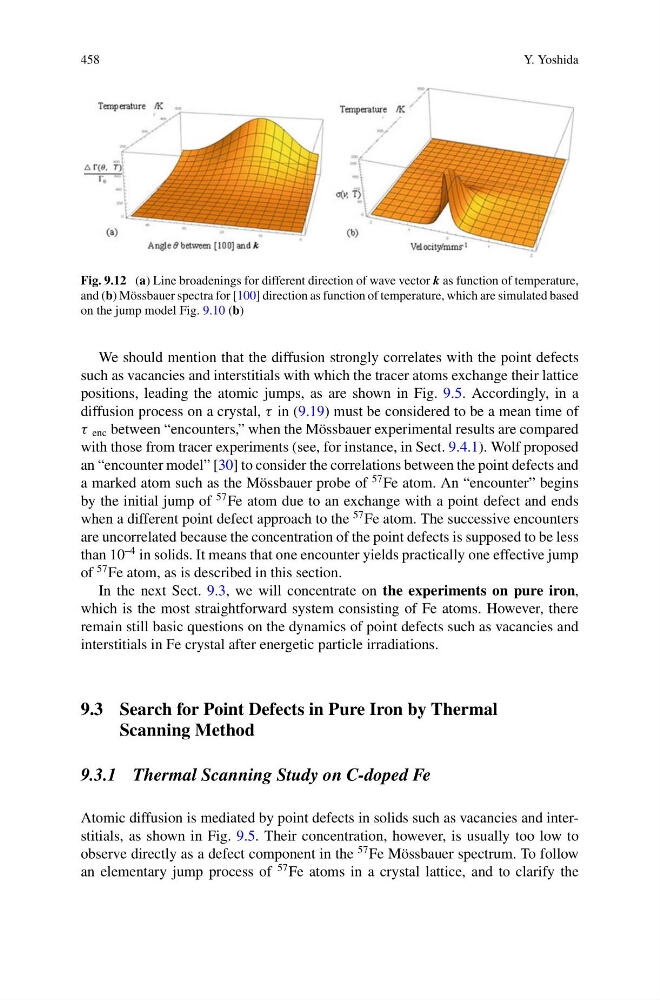
Fig. 9.12 (a) Line broadenings for different direction of wave vector k as function of temperature,
and (b) Mössbauer spectra for [100] direction as function of temperature, which are simulated based
on the jump model Fig. 9.10 (b)
We should mention that the diffusion strongly correlates with the point defects
such as vacancies and interstitials with which the tracer atoms exchange their lattice
positions, leading the atomic jumps, as are shown in Fig. 9.5. Accordingly, in a
diffusion process on a crystal, τ in (9.19) must be considered to be a mean time of
τ enc between “encounters,” when the Mössbauer experimental results are compared
with those from tracer experiments (see, for instance, in Sect. 9.4.1). Wolf proposed
an “encounter model” [30] to consider the correlations between the point defects and
a marked atom such as the Mössbauer probe of
57 Fe atom. An “encounter” begins
by the initial jump of
57 Fe atom due to an exchange with a point defect and ends
when a different point defect approach to the
57 Fe atom. The successive encounters
are uncorrelated because the concentration of the point defects is supposed to be less
than 10
–4 in solids. It means that one encounter yields practically one effective jump
of
57 Fe atom, as is described in this section.
In the next Sect. 9.3, we will concentrate on the experiments on pure iron,
which is the most straightforward system consisting of Fe atoms. However, there
remain still basic questions on the dynamics of point defects such as vacancies and
interstitials in Fe crystal after energetic particle irradiations.
9.3 Search for Point Defects in Pure Iron by Thermal
Scanning Method
9.3.1 Thermal Scanning Study on C-doped Fe
Atomic diffusion is mediated by point defects in solids such as vacancies and interstitials, as shown in Fig. 9.5. Their concentration, however, is usually too low to
observe directly as a defect component in the
57 Fe Mössbauer spectrum. To follow
an elementary jump process of
57 Fe atoms in a crystal lattice, and to clarify the
Y. Yoshida
Fig. 9.12 (a) Line broadenings for different direction of wave vector k as function of temperature,
and (b) Mössbauer spectra for [100] direction as function of temperature, which are simulated based
on the jump model Fig. 9.10 (b)
We should mention that the diffusion strongly correlates with the point defects
such as vacancies and interstitials with which the tracer atoms exchange their lattice
positions, leading the atomic jumps, as are shown in Fig. 9.5. Accordingly, in a
diffusion process on a crystal, τ in (9.19) must be considered to be a mean time of
τ enc between “encounters,” when the Mössbauer experimental results are compared
with those from tracer experiments (see, for instance, in Sect. 9.4.1). Wolf proposed
an “encounter model” [30] to consider the correlations between the point defects and
a marked atom such as the Mössbauer probe of
57 Fe atom. An “encounter” begins
by the initial jump of
57 Fe atom due to an exchange with a point defect and ends
when a different point defect approach to the
57 Fe atom. The successive encounters
are uncorrelated because the concentration of the point defects is supposed to be less
than 10
–4 in solids. It means that one encounter yields practically one effective jump
of
57 Fe atom, as is described in this section.
In the next Sect. 9.3, we will concentrate on the experiments on pure iron,
which is the most straightforward system consisting of Fe atoms. However, there
remain still basic questions on the dynamics of point defects such as vacancies and
interstitials in Fe crystal after energetic particle irradiations.
9.3 Search for Point Defects in Pure Iron by Thermal
Scanning Method
9.3.1 Thermal Scanning Study on C-doped Fe
Atomic diffusion is mediated by point defects in solids such as vacancies and interstitials, as shown in Fig. 9.5. Their concentration, however, is usually too low to
observe directly as a defect component in the
57 Fe Mössbauer spectrum. To follow
an elementary jump process of
57 Fe atoms in a crystal lattice, and to clarify the