

450
Y. Yoshida
elements such as H, C. One would get an idea of how fast the atoms can move in
metallic systems on the right perpendicular axis in Fig. 9.4, i.e., the diffusion length
after annealing for one hour.
As we will see in Sect. 9.2.3, one can detect the atomic diffusion as a line broadening of the Mössbauer spectrum for the diffusivities of
57 Fe atoms in pure Fe from
D = 10
–15 to 10
–11 m
2 /s as is indicated by red zone in Fig. 9.4. We expect such a
high diffusivity only at high temperatures close to the melting point. To achieve an
in-situ observation of the atomic jumps by Mössbauer spectroscopy, therefore, one
has to develop an experimental set-up accessible for measuring a spectrum with a
line broadening , between 0.01 and 30 mms
−1 , yielding us a challenging task to
attack the experimental conditions.
In Sect. 9.4, the readers will find a series of challenges in how we observed the
line broadenings in pure iron as well as in silicon crystals. In the next subsection,
we explain the basics of
57 Fe Mössbauer spectroscopy, which will be necessary to
understand the contents described in the later sections.
9.2.2 Hyperfine Interactions of 57 Fe Nuclei and Mössbauer
Experimental Set-Up
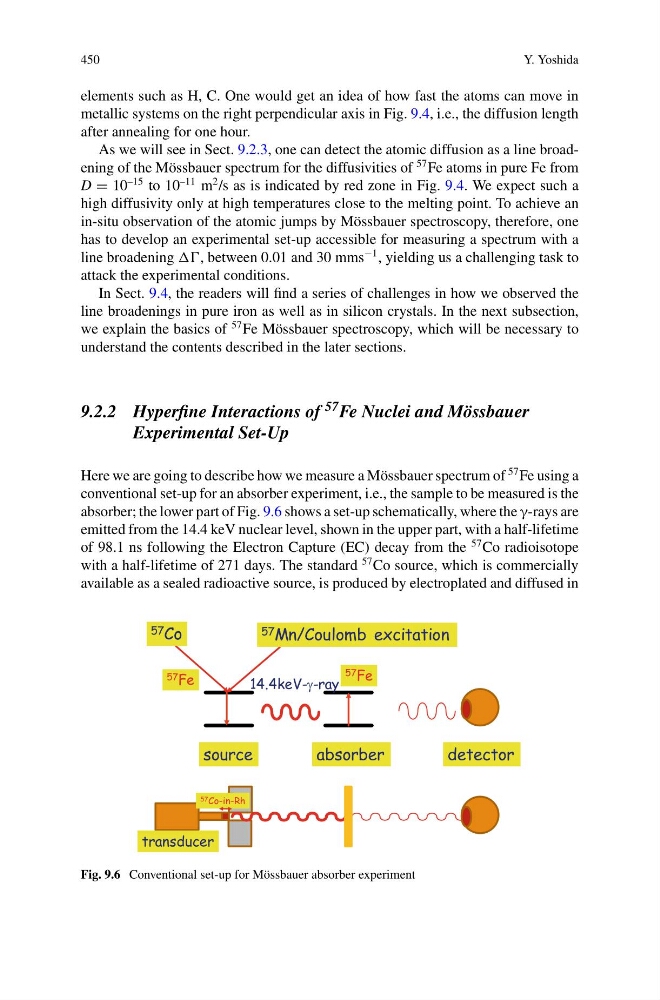
Here we are going to describe how we measure a Mössbauer spectrum of
57 Fe using a
conventional set-up for an absorber experiment, i.e., the sample to be measured is the
absorber; the lower part of Fig. 9.6 shows a set-up schematically, where the γ-rays are
emitted from the 14.4 keV nuclear level, shown in the upper part, with a half-lifetime
of 98.1 ns following the Electron Capture (EC) decay from the
57 Co radioisotope
with a half-lifetime of 271 days. The standard
57 Co source, which is commercially
available as a sealed radioactive source, is produced by electroplated and diffused in
Fig. 9.6 Conventional set-up for Mössbauer absorber experiment
Y. Yoshida
elements such as H, C. One would get an idea of how fast the atoms can move in
metallic systems on the right perpendicular axis in Fig. 9.4, i.e., the diffusion length
after annealing for one hour.
As we will see in Sect. 9.2.3, one can detect the atomic diffusion as a line broadening of the Mössbauer spectrum for the diffusivities of
57 Fe atoms in pure Fe from
D = 10
–15 to 10
–11 m
2 /s as is indicated by red zone in Fig. 9.4. We expect such a
high diffusivity only at high temperatures close to the melting point. To achieve an
in-situ observation of the atomic jumps by Mössbauer spectroscopy, therefore, one
has to develop an experimental set-up accessible for measuring a spectrum with a
line broadening , between 0.01 and 30 mms
−1 , yielding us a challenging task to
attack the experimental conditions.
In Sect. 9.4, the readers will find a series of challenges in how we observed the
line broadenings in pure iron as well as in silicon crystals. In the next subsection,
we explain the basics of
57 Fe Mössbauer spectroscopy, which will be necessary to
understand the contents described in the later sections.
9.2.2 Hyperfine Interactions of 57 Fe Nuclei and Mössbauer
Experimental Set-Up
Here we are going to describe how we measure a Mössbauer spectrum of
57 Fe using a
conventional set-up for an absorber experiment, i.e., the sample to be measured is the
absorber; the lower part of Fig. 9.6 shows a set-up schematically, where the γ-rays are
emitted from the 14.4 keV nuclear level, shown in the upper part, with a half-lifetime
of 98.1 ns following the Electron Capture (EC) decay from the
57 Co radioisotope
with a half-lifetime of 271 days. The standard
57 Co source, which is commercially
available as a sealed radioactive source, is produced by electroplated and diffused in
Fig. 9.6 Conventional set-up for Mössbauer absorber experiment