

8 Mössbauer Spectroscopy in External Magnetic Fields
417
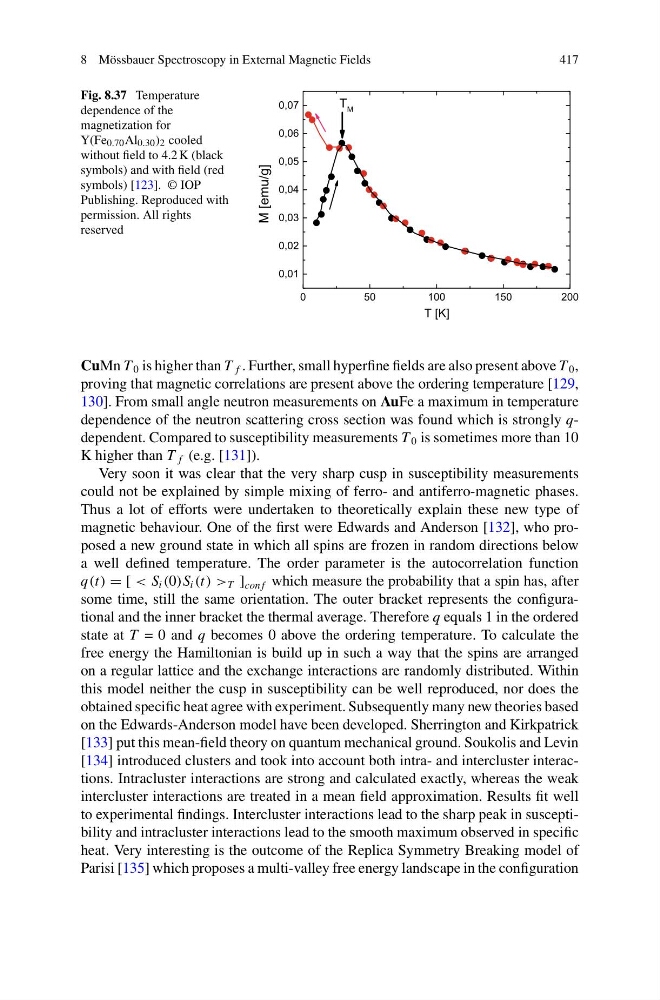
Fig. 8.37 Temperature
dependence of the
magnetization for
Y(Fe 0.70 Al 0.30 ) 2 cooled
without field to 4.2 K (black
symbols) and with field (red
symbols) [123]. © IOP
Publishing. Reproduced with
permission. All rights
reserved
CuMn T 0 is higher than T f . Further, small hyperfine fields are also present above T 0 ,
proving that magnetic correlations are present above the ordering temperature [129,
130]. From small angle neutron measurements on AuFe a maximum in temperature
dependence of the neutron scattering cross section was found which is strongly qdependent. Compared to susceptibility measurements T 0 is sometimes more than 10
K higher than T f (e.g. [131]).
Very soon it was clear that the very sharp cusp in susceptibility measurements
could not be explained by simple mixing of ferro- and antiferro-magnetic phases.
Thus a lot of efforts were undertaken to theoretically explain these new type of
magnetic behaviour. One of the first were Edwards and Anderson [132], who proposed a new ground state in which all spins are frozen in random directions below
a well defined temperature. The order parameter is the autocorrelation function
q(t) = [ < S i (0)S i (t) > T ] con f which measure the probability that a spin has, after
some time, still the same orientation. The outer bracket represents the configurational and the inner bracket the thermal average. Therefore q equals 1 in the ordered
state at T = 0 and q becomes 0 above the ordering temperature. To calculate the
free energy the Hamiltonian is build up in such a way that the spins are arranged
on a regular lattice and the exchange interactions are randomly distributed. Within
this model neither the cusp in susceptibility can be well reproduced, nor does the
obtained specific heat agree with experiment. Subsequently many new theories based
on the Edwards-Anderson model have been developed. Sherrington and Kirkpatrick
[133] put this mean-field theory on quantum mechanical ground. Soukolis and Levin
[134] introduced clusters and took into account both intra- and intercluster interactions. Intracluster interactions are strong and calculated exactly, whereas the weak
intercluster interactions are treated in a mean field approximation. Results fit well
to experimental findings. Intercluster interactions lead to the sharp peak in susceptibility and intracluster interactions lead to the smooth maximum observed in specific
heat. Very interesting is the outcome of the Replica Symmetry Breaking model of
Parisi [135] which proposes a multi-valley free energy landscape in the configuration
417
Fig. 8.37 Temperature
dependence of the
magnetization for
Y(Fe 0.70 Al 0.30 ) 2 cooled
without field to 4.2 K (black
symbols) and with field (red
symbols) [123]. © IOP
Publishing. Reproduced with
permission. All rights
reserved
CuMn T 0 is higher than T f . Further, small hyperfine fields are also present above T 0 ,
proving that magnetic correlations are present above the ordering temperature [129,
130]. From small angle neutron measurements on AuFe a maximum in temperature
dependence of the neutron scattering cross section was found which is strongly qdependent. Compared to susceptibility measurements T 0 is sometimes more than 10
K higher than T f (e.g. [131]).
Very soon it was clear that the very sharp cusp in susceptibility measurements
could not be explained by simple mixing of ferro- and antiferro-magnetic phases.
Thus a lot of efforts were undertaken to theoretically explain these new type of
magnetic behaviour. One of the first were Edwards and Anderson [132], who proposed a new ground state in which all spins are frozen in random directions below
a well defined temperature. The order parameter is the autocorrelation function
q(t) = [ < S i (0)S i (t) > T ] con f which measure the probability that a spin has, after
some time, still the same orientation. The outer bracket represents the configurational and the inner bracket the thermal average. Therefore q equals 1 in the ordered
state at T = 0 and q becomes 0 above the ordering temperature. To calculate the
free energy the Hamiltonian is build up in such a way that the spins are arranged
on a regular lattice and the exchange interactions are randomly distributed. Within
this model neither the cusp in susceptibility can be well reproduced, nor does the
obtained specific heat agree with experiment. Subsequently many new theories based
on the Edwards-Anderson model have been developed. Sherrington and Kirkpatrick
[133] put this mean-field theory on quantum mechanical ground. Soukolis and Levin
[134] introduced clusters and took into account both intra- and intercluster interactions. Intracluster interactions are strong and calculated exactly, whereas the weak
intercluster interactions are treated in a mean field approximation. Results fit well
to experimental findings. Intercluster interactions lead to the sharp peak in susceptibility and intracluster interactions lead to the smooth maximum observed in specific
heat. Very interesting is the outcome of the Replica Symmetry Breaking model of
Parisi [135] which proposes a multi-valley free energy landscape in the configuration