

8 Mössbauer Spectroscopy in External Magnetic Fields
415
Fig. 8.35 Induced hyperfine fields for divalent (left) and monovalent (right) Fe-Sb skutterutides
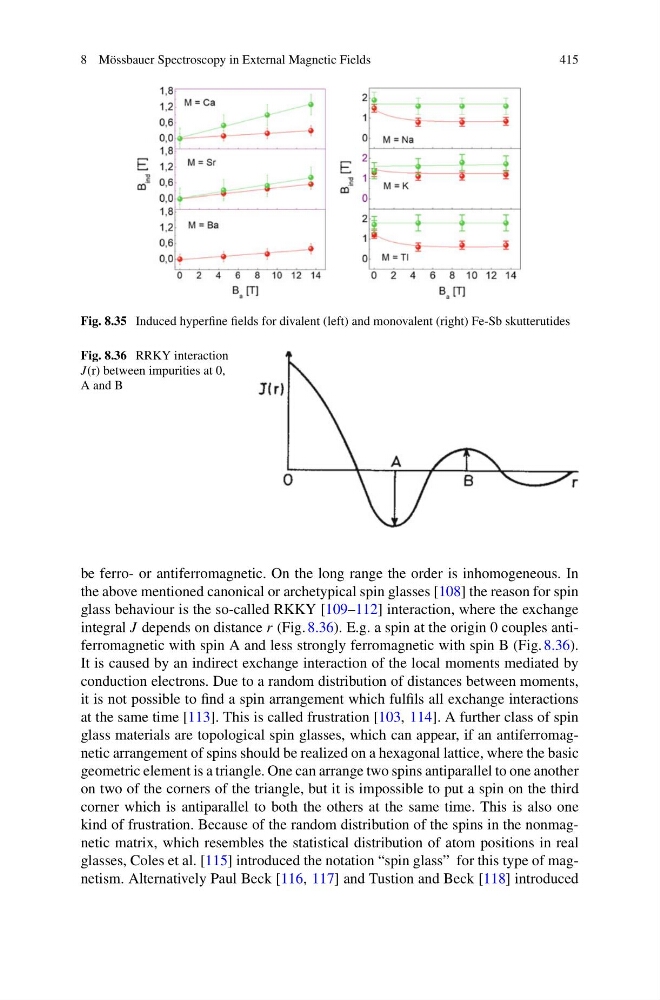
Fig. 8.36 RRKY interaction
J(r) between impurities at 0,
A and B
be ferro- or antiferromagnetic. On the long range the order is inhomogeneous. In
the above mentioned canonical or archetypical spin glasses [108] the reason for spin
glass behaviour is the so-called RKKY [109–112] interaction, where the exchange
integral J depends on distance r (Fig. 8.36). E.g. a spin at the origin 0 couples antiferromagnetic with spin A and less strongly ferromagnetic with spin B (Fig. 8.36).
It is caused by an indirect exchange interaction of the local moments mediated by
conduction electrons. Due to a random distribution of distances between moments,
it is not possible to find a spin arrangement which fulfils all exchange interactions
at the same time [113]. This is called frustration [103, 114]. A further class of spin
glass materials are topological spin glasses, which can appear, if an antiferromagnetic arrangement of spins should be realized on a hexagonal lattice, where the basic
geometric element is a triangle. One can arrange two spins antiparallel to one another
on two of the corners of the triangle, but it is impossible to put a spin on the third
corner which is antiparallel to both the others at the same time. This is also one
kind of frustration. Because of the random distribution of the spins in the nonmagnetic matrix, which resembles the statistical distribution of atom positions in real
glasses, Coles et al. [115] introduced the notation “spin glass” for this type of magnetism. Alternatively Paul Beck [116, 117] and Tustion and Beck [118] introduced
415
Fig. 8.35 Induced hyperfine fields for divalent (left) and monovalent (right) Fe-Sb skutterutides
Fig. 8.36 RRKY interaction
J(r) between impurities at 0,
A and B
be ferro- or antiferromagnetic. On the long range the order is inhomogeneous. In
the above mentioned canonical or archetypical spin glasses [108] the reason for spin
glass behaviour is the so-called RKKY [109–112] interaction, where the exchange
integral J depends on distance r (Fig. 8.36). E.g. a spin at the origin 0 couples antiferromagnetic with spin A and less strongly ferromagnetic with spin B (Fig. 8.36).
It is caused by an indirect exchange interaction of the local moments mediated by
conduction electrons. Due to a random distribution of distances between moments,
it is not possible to find a spin arrangement which fulfils all exchange interactions
at the same time [113]. This is called frustration [103, 114]. A further class of spin
glass materials are topological spin glasses, which can appear, if an antiferromagnetic arrangement of spins should be realized on a hexagonal lattice, where the basic
geometric element is a triangle. One can arrange two spins antiparallel to one another
on two of the corners of the triangle, but it is impossible to put a spin on the third
corner which is antiparallel to both the others at the same time. This is also one
kind of frustration. Because of the random distribution of the spins in the nonmagnetic matrix, which resembles the statistical distribution of atom positions in real
glasses, Coles et al. [115] introduced the notation “spin glass” for this type of magnetism. Alternatively Paul Beck [116, 117] and Tustion and Beck [118] introduced