

408
M. Reissner
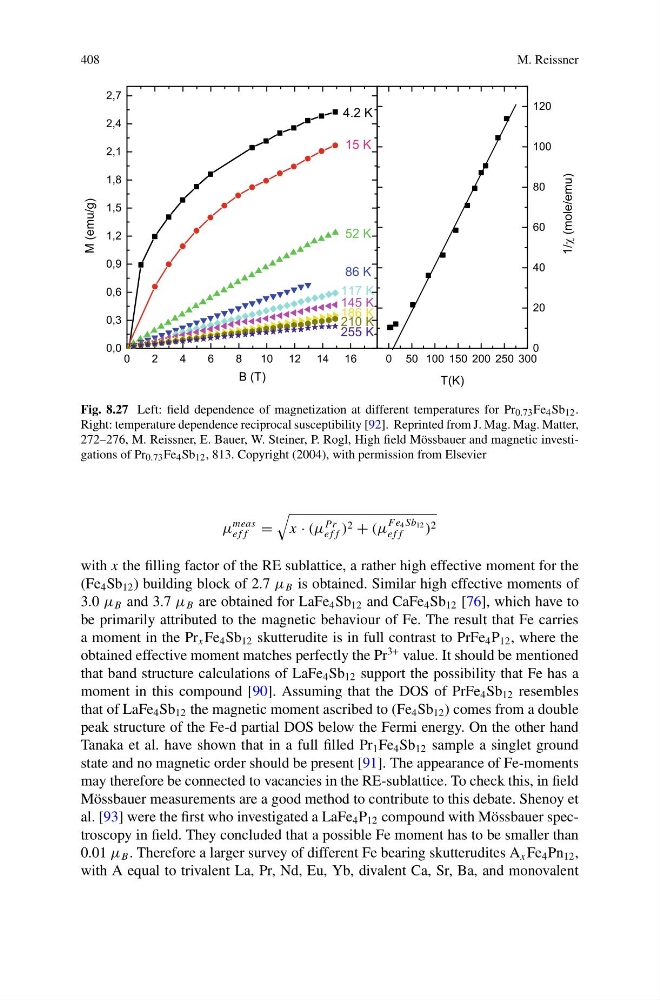
Fig. 8.27 Left: field dependence of magnetization at different temperatures for Pr 0.73 Fe 4 Sb 12 .
Right: temperature dependence reciprocal susceptibility [92]. Reprinted from J. Mag. Mag. Matter,
272–276, M. Reissner, E. Bauer, W. Steiner, P. Rogl, High field Mössbauer and magnetic investigations of Pr 0.73 Fe 4 Sb 12 , 813. Copyright (2004), with permission from Elsevier
μ
meas
e f f =
x · (μ
Pr
e f f ) 2 + (μ
Fe 4 Sb 12
e f f
) 2
with x the filling factor of the RE sublattice, a rather high effective moment for the
(Fe 4 Sb 12 ) building block of 2.7 μ B is obtained. Similar high effective moments of
3.0 μ B and 3.7 μ B are obtained for LaFe 4 Sb 12 and CaFe 4 Sb 12 [76], which have to
be primarily attributed to the magnetic behaviour of Fe. The result that Fe carries
a moment in the Pr x Fe 4 Sb 12 skutterudite is in full contrast to PrFe 4 P 12 , where the
obtained effective moment matches perfectly the Pr
3+ value. It should be mentioned
that band structure calculations of LaFe 4 Sb 12 support the possibility that Fe has a
moment in this compound [90]. Assuming that the DOS of PrFe 4 Sb 12 resembles
that of LaFe 4 Sb 12 the magnetic moment ascribed to (Fe 4 Sb 12 ) comes from a double
peak structure of the Fe-d partial DOS below the Fermi energy. On the other hand
Tanaka et al. have shown that in a full filled Pr 1 Fe 4 Sb 12 sample a singlet ground
state and no magnetic order should be present [91]. The appearance of Fe-moments
may therefore be connected to vacancies in the RE-sublattice. To check this, in field
Mössbauer measurements are a good method to contribute to this debate. Shenoy et
al. [93] were the first who investigated a LaFe 4 P 12 compound with Mössbauer spectroscopy in field. They concluded that a possible Fe moment has to be smaller than
0.01 μ B . Therefore a larger survey of different Fe bearing skutterudites A x Fe 4 Pn 12 ,
with A equal to trivalent La, Pr, Nd, Eu, Yb, divalent Ca, Sr, Ba, and monovalent
M. Reissner
Fig. 8.27 Left: field dependence of magnetization at different temperatures for Pr 0.73 Fe 4 Sb 12 .
Right: temperature dependence reciprocal susceptibility [92]. Reprinted from J. Mag. Mag. Matter,
272–276, M. Reissner, E. Bauer, W. Steiner, P. Rogl, High field Mössbauer and magnetic investigations of Pr 0.73 Fe 4 Sb 12 , 813. Copyright (2004), with permission from Elsevier
μ
meas
e f f =
x · (μ
Pr
e f f ) 2 + (μ
Fe 4 Sb 12
e f f
) 2
with x the filling factor of the RE sublattice, a rather high effective moment for the
(Fe 4 Sb 12 ) building block of 2.7 μ B is obtained. Similar high effective moments of
3.0 μ B and 3.7 μ B are obtained for LaFe 4 Sb 12 and CaFe 4 Sb 12 [76], which have to
be primarily attributed to the magnetic behaviour of Fe. The result that Fe carries
a moment in the Pr x Fe 4 Sb 12 skutterudite is in full contrast to PrFe 4 P 12 , where the
obtained effective moment matches perfectly the Pr
3+ value. It should be mentioned
that band structure calculations of LaFe 4 Sb 12 support the possibility that Fe has a
moment in this compound [90]. Assuming that the DOS of PrFe 4 Sb 12 resembles
that of LaFe 4 Sb 12 the magnetic moment ascribed to (Fe 4 Sb 12 ) comes from a double
peak structure of the Fe-d partial DOS below the Fermi energy. On the other hand
Tanaka et al. have shown that in a full filled Pr 1 Fe 4 Sb 12 sample a singlet ground
state and no magnetic order should be present [91]. The appearance of Fe-moments
may therefore be connected to vacancies in the RE-sublattice. To check this, in field
Mössbauer measurements are a good method to contribute to this debate. Shenoy et
al. [93] were the first who investigated a LaFe 4 P 12 compound with Mössbauer spectroscopy in field. They concluded that a possible Fe moment has to be smaller than
0.01 μ B . Therefore a larger survey of different Fe bearing skutterudites A x Fe 4 Pn 12 ,
with A equal to trivalent La, Pr, Nd, Eu, Yb, divalent Ca, Sr, Ba, and monovalent