

402
M. Reissner
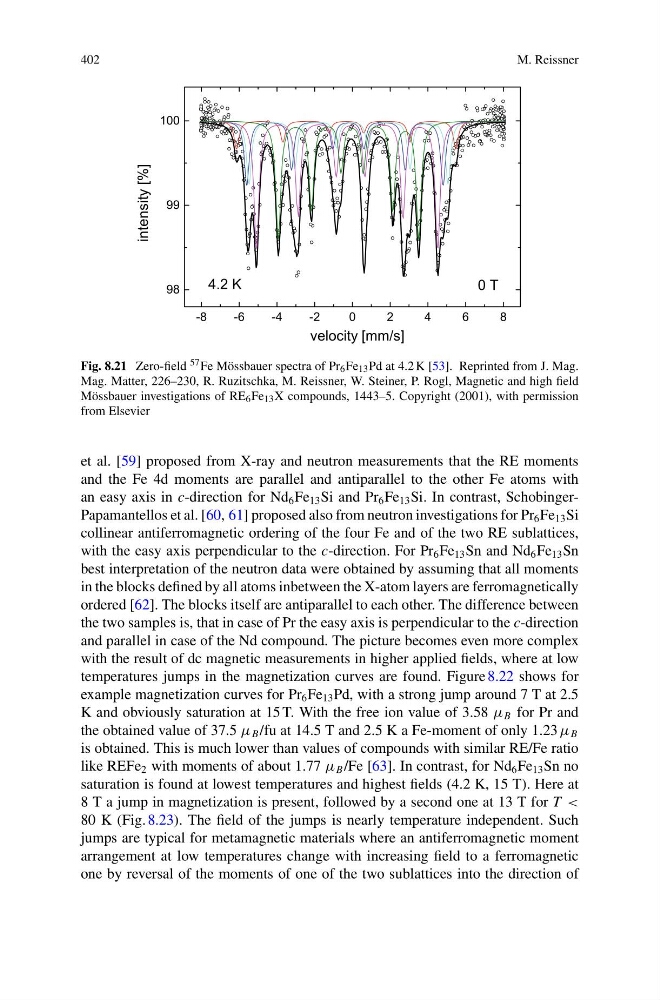
Fig. 8.21 Zero-field 57 Fe Mössbauer spectra of Pr 6 Fe 13 Pd at 4.2 K [53]. Reprinted from J. Mag.
Mag. Matter, 226–230, R. Ruzitschka, M. Reissner, W. Steiner, P. Rogl, Magnetic and high field
Mössbauer investigations of RE 6 Fe 13 X compounds, 1443–5. Copyright (2001), with permission
from Elsevier
et al. [59] proposed from X-ray and neutron measurements that the RE moments
and the Fe 4d moments are parallel and antiparallel to the other Fe atoms with
an easy axis in c-direction for Nd 6 Fe 13 Si and Pr 6 Fe 13 Si. In contrast, SchobingerPapamantellos et al. [60, 61] proposed also from neutron investigations for Pr 6 Fe 13 Si
collinear antiferromagnetic ordering of the four Fe and of the two RE sublattices,
with the easy axis perpendicular to the c-direction. For Pr 6 Fe 13 Sn and Nd 6 Fe 13 Sn
best interpretation of the neutron data were obtained by assuming that all moments
in the blocks defined by all atoms inbetween the X-atom layers are ferromagnetically
ordered [62]. The blocks itself are antiparallel to each other. The difference between
the two samples is, that in case of Pr the easy axis is perpendicular to the c-direction
and parallel in case of the Nd compound. The picture becomes even more complex
with the result of dc magnetic measurements in higher applied fields, where at low
temperatures jumps in the magnetization curves are found. Figure 8.22 shows for
example magnetization curves for Pr 6 Fe 13 Pd, with a strong jump around 7 T at 2.5
K and obviously saturation at 15 T. With the free ion value of 3.58 μ B for Pr and
the obtained value of 37.5 μ B /fu at 14.5 T and 2.5 K a Fe-moment of only 1.23 μ B
is obtained. This is much lower than values of compounds with similar RE/Fe ratio
like REFe 2 with moments of about 1.77 μ B /Fe [63]. In contrast, for Nd 6 Fe 13 Sn no
saturation is found at lowest temperatures and highest fields (4.2 K, 15 T). Here at
8 T a jump in magnetization is present, followed by a second one at 13 T for T <
80 K (Fig. 8.23). The field of the jumps is nearly temperature independent. Such
jumps are typical for metamagnetic materials where an antiferromagnetic moment
arrangement at low temperatures change with increasing field to a ferromagnetic
one by reversal of the moments of one of the two sublattices into the direction of
M. Reissner
Fig. 8.21 Zero-field 57 Fe Mössbauer spectra of Pr 6 Fe 13 Pd at 4.2 K [53]. Reprinted from J. Mag.
Mag. Matter, 226–230, R. Ruzitschka, M. Reissner, W. Steiner, P. Rogl, Magnetic and high field
Mössbauer investigations of RE 6 Fe 13 X compounds, 1443–5. Copyright (2001), with permission
from Elsevier
et al. [59] proposed from X-ray and neutron measurements that the RE moments
and the Fe 4d moments are parallel and antiparallel to the other Fe atoms with
an easy axis in c-direction for Nd 6 Fe 13 Si and Pr 6 Fe 13 Si. In contrast, SchobingerPapamantellos et al. [60, 61] proposed also from neutron investigations for Pr 6 Fe 13 Si
collinear antiferromagnetic ordering of the four Fe and of the two RE sublattices,
with the easy axis perpendicular to the c-direction. For Pr 6 Fe 13 Sn and Nd 6 Fe 13 Sn
best interpretation of the neutron data were obtained by assuming that all moments
in the blocks defined by all atoms inbetween the X-atom layers are ferromagnetically
ordered [62]. The blocks itself are antiparallel to each other. The difference between
the two samples is, that in case of Pr the easy axis is perpendicular to the c-direction
and parallel in case of the Nd compound. The picture becomes even more complex
with the result of dc magnetic measurements in higher applied fields, where at low
temperatures jumps in the magnetization curves are found. Figure 8.22 shows for
example magnetization curves for Pr 6 Fe 13 Pd, with a strong jump around 7 T at 2.5
K and obviously saturation at 15 T. With the free ion value of 3.58 μ B for Pr and
the obtained value of 37.5 μ B /fu at 14.5 T and 2.5 K a Fe-moment of only 1.23 μ B
is obtained. This is much lower than values of compounds with similar RE/Fe ratio
like REFe 2 with moments of about 1.77 μ B /Fe [63]. In contrast, for Nd 6 Fe 13 Sn no
saturation is found at lowest temperatures and highest fields (4.2 K, 15 T). Here at
8 T a jump in magnetization is present, followed by a second one at 13 T for T <
80 K (Fig. 8.23). The field of the jumps is nearly temperature independent. Such
jumps are typical for metamagnetic materials where an antiferromagnetic moment
arrangement at low temperatures change with increasing field to a ferromagnetic
one by reversal of the moments of one of the two sublattices into the direction of