

8 Mössbauer Spectroscopy in External Magnetic Fields
387
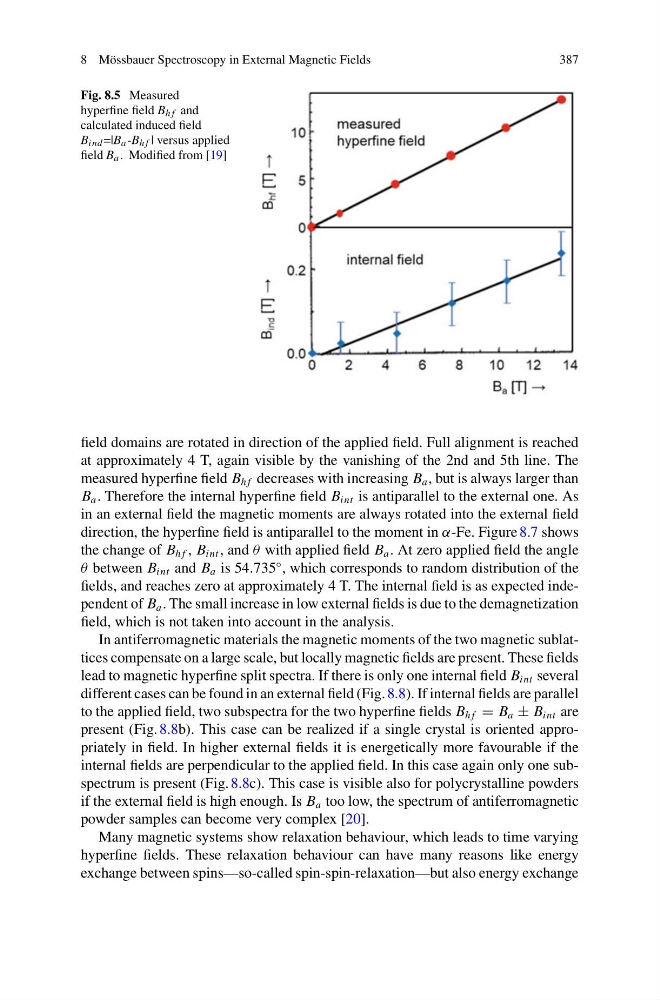
Fig. 8.5 Measured
hyperfine field B h f and
calculated induced field
B ind =|B a -B h f | versus applied
field B a . Modified from [19]
field domains are rotated in direction of the applied field. Full alignment is reached
at approximately 4 T, again visible by the vanishing of the 2nd and 5th line. The
measured hyperfine field B h f decreases with increasing B a , but is always larger than
B a . Therefore the internal hyperfine field B int is antiparallel to the external one. As
in an external field the magnetic moments are always rotated into the external field
direction, the hyperfine field is antiparallel to the moment in α-Fe. Figure 8.7 shows
the change of B h f , B int , and θ with applied field B a . At zero applied field the angle
θ between B int and B a is 54.735
◦ , which corresponds to random distribution of the
fields, and reaches zero at approximately 4 T. The internal field is as expected independent of B a . The small increase in low external fields is due to the demagnetization
field, which is not taken into account in the analysis.
In antiferromagnetic materials the magnetic moments of the two magnetic sublattices compensate on a large scale, but locally magnetic fields are present. These fields
lead to magnetic hyperfine split spectra. If there is only one internal field B int several
different cases can be found in an external field (Fig. 8.8). If internal fields are parallel
to the applied field, two subspectra for the two hyperfine fields B h f = B a ± B int are
present (Fig. 8.8b). This case can be realized if a single crystal is oriented appropriately in field. In higher external fields it is energetically more favourable if the
internal fields are perpendicular to the applied field. In this case again only one subspectrum is present (Fig. 8.8c). This case is visible also for polycrystalline powders
if the external field is high enough. Is B a too low, the spectrum of antiferromagnetic
powder samples can become very complex [20].
Many magnetic systems show relaxation behaviour, which leads to time varying
hyperfine fields. These relaxation behaviour can have many reasons like energy
exchange between spins—so-called spin-spin-relaxation—but also energy exchange
387
Fig. 8.5 Measured
hyperfine field B h f and
calculated induced field
B ind =|B a -B h f | versus applied
field B a . Modified from [19]
field domains are rotated in direction of the applied field. Full alignment is reached
at approximately 4 T, again visible by the vanishing of the 2nd and 5th line. The
measured hyperfine field B h f decreases with increasing B a , but is always larger than
B a . Therefore the internal hyperfine field B int is antiparallel to the external one. As
in an external field the magnetic moments are always rotated into the external field
direction, the hyperfine field is antiparallel to the moment in α-Fe. Figure 8.7 shows
the change of B h f , B int , and θ with applied field B a . At zero applied field the angle
θ between B int and B a is 54.735
◦ , which corresponds to random distribution of the
fields, and reaches zero at approximately 4 T. The internal field is as expected independent of B a . The small increase in low external fields is due to the demagnetization
field, which is not taken into account in the analysis.
In antiferromagnetic materials the magnetic moments of the two magnetic sublattices compensate on a large scale, but locally magnetic fields are present. These fields
lead to magnetic hyperfine split spectra. If there is only one internal field B int several
different cases can be found in an external field (Fig. 8.8). If internal fields are parallel
to the applied field, two subspectra for the two hyperfine fields B h f = B a ± B int are
present (Fig. 8.8b). This case can be realized if a single crystal is oriented appropriately in field. In higher external fields it is energetically more favourable if the
internal fields are perpendicular to the applied field. In this case again only one subspectrum is present (Fig. 8.8c). This case is visible also for polycrystalline powders
if the external field is high enough. Is B a too low, the spectrum of antiferromagnetic
powder samples can become very complex [20].
Many magnetic systems show relaxation behaviour, which leads to time varying
hyperfine fields. These relaxation behaviour can have many reasons like energy
exchange between spins—so-called spin-spin-relaxation—but also energy exchange