

7 Application of Mössbauer Spectroscopy to Li-Ion and Na-Ion …
365
The mechanism is more complex for delithiation. The operando
119 Sn Mössbauer
spectra obtained for the first delithiation of CoSn 2 [67] and nanostructured MnSn 2
based electrodes [130] show the same trends as FeSn 2 . During the delithiation, the
single Mössbauer peak of Li 7 Sn 2 is broadened and transformed into a broadened
doublet with increasing average isomer shift. This trend is typical of Li 7 Sn 2 dealloying process. This suggests the formation of poorly crystallized Li x Sn nanoparticles with intermediate compositions as described in Sect. 7.6.1 for FeSn 2 , or of more
complex Li-Co-Sn and Li-Mn-Sn metastable ternary phases [130]. It is difficult to
have a more reliable interpretation of the spectra since they do not show any resolved
structures and the isomer shifts of the Sn based intermetallics and Li x Sn phases are
all in the same range from 1.8 to 2.5 mm s
−1 . The variations of the average isomer
shift can be related to changes in the composition of the Li-Sn based species but it is
impossible to identify well-defined phases as the Li x Sn crystalline references, which
suggests the coexistence of metastable phases with possible different compositions,
sizes and crystallinities, depending on the stage of delithiation.
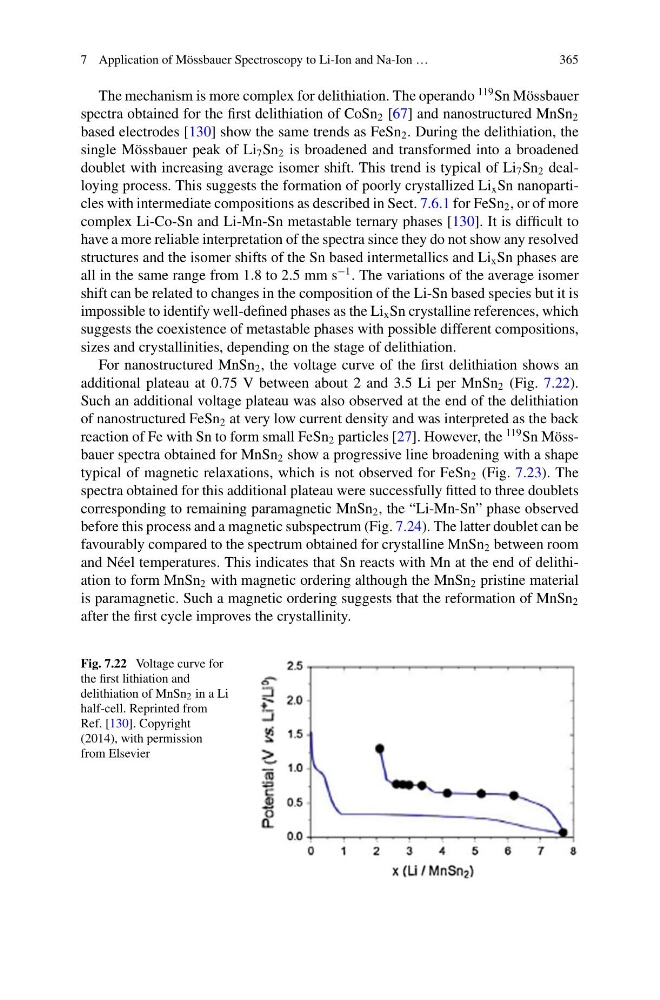
For nanostructured MnSn 2 , the voltage curve of the first delithiation shows an
additional plateau at 0.75 V between about 2 and 3.5 Li per MnSn 2 (Fig. 7.22).
Such an additional voltage plateau was also observed at the end of the delithiation
of nanostructured FeSn 2 at very low current density and was interpreted as the back
reaction of Fe with Sn to form small FeSn 2 particles [27]. However, the
119 Sn Mössbauer spectra obtained for MnSn 2 show a progressive line broadening with a shape
typical of magnetic relaxations, which is not observed for FeSn 2 (Fig. 7.23). The
spectra obtained for this additional plateau were successfully fitted to three doublets
corresponding to remaining paramagnetic MnSn 2 , the “Li-Mn-Sn” phase observed
before this process and a magnetic subspectrum (Fig. 7.24). The latter doublet can be
favourably compared to the spectrum obtained for crystalline MnSn 2 between room
and Néel temperatures. This indicates that Sn reacts with Mn at the end of delithiation to form MnSn 2 with magnetic ordering although the MnSn 2 pristine material
is paramagnetic. Such a magnetic ordering suggests that the reformation of MnSn 2
after the first cycle improves the crystallinity.
Fig. 7.22 Voltage curve for
the first lithiation and
delithiation of MnSn 2 in a Li
half-cell. Reprinted from
Ref. [130]. Copyright
(2014), with permission
from Elsevier
365
The mechanism is more complex for delithiation. The operando
119 Sn Mössbauer
spectra obtained for the first delithiation of CoSn 2 [67] and nanostructured MnSn 2
based electrodes [130] show the same trends as FeSn 2 . During the delithiation, the
single Mössbauer peak of Li 7 Sn 2 is broadened and transformed into a broadened
doublet with increasing average isomer shift. This trend is typical of Li 7 Sn 2 dealloying process. This suggests the formation of poorly crystallized Li x Sn nanoparticles with intermediate compositions as described in Sect. 7.6.1 for FeSn 2 , or of more
complex Li-Co-Sn and Li-Mn-Sn metastable ternary phases [130]. It is difficult to
have a more reliable interpretation of the spectra since they do not show any resolved
structures and the isomer shifts of the Sn based intermetallics and Li x Sn phases are
all in the same range from 1.8 to 2.5 mm s
−1 . The variations of the average isomer
shift can be related to changes in the composition of the Li-Sn based species but it is
impossible to identify well-defined phases as the Li x Sn crystalline references, which
suggests the coexistence of metastable phases with possible different compositions,
sizes and crystallinities, depending on the stage of delithiation.
For nanostructured MnSn 2 , the voltage curve of the first delithiation shows an
additional plateau at 0.75 V between about 2 and 3.5 Li per MnSn 2 (Fig. 7.22).
Such an additional voltage plateau was also observed at the end of the delithiation
of nanostructured FeSn 2 at very low current density and was interpreted as the back
reaction of Fe with Sn to form small FeSn 2 particles [27]. However, the
119 Sn Mössbauer spectra obtained for MnSn 2 show a progressive line broadening with a shape
typical of magnetic relaxations, which is not observed for FeSn 2 (Fig. 7.23). The
spectra obtained for this additional plateau were successfully fitted to three doublets
corresponding to remaining paramagnetic MnSn 2 , the “Li-Mn-Sn” phase observed
before this process and a magnetic subspectrum (Fig. 7.24). The latter doublet can be
favourably compared to the spectrum obtained for crystalline MnSn 2 between room
and Néel temperatures. This indicates that Sn reacts with Mn at the end of delithiation to form MnSn 2 with magnetic ordering although the MnSn 2 pristine material
is paramagnetic. Such a magnetic ordering suggests that the reformation of MnSn 2
after the first cycle improves the crystallinity.
Fig. 7.22 Voltage curve for
the first lithiation and
delithiation of MnSn 2 in a Li
half-cell. Reprinted from
Ref. [130]. Copyright
(2014), with permission
from Elsevier