

7 Application of Mössbauer Spectroscopy to Li-Ion and Na-Ion …
355
existence of tin oxides as impurities. The spectra recorded for the insertion of 0.5, 1
and 3.4 Li per Sn were fitted to two doublets with Mössbauer parameters similar to
those of Li 2 Sn 5 , LiSn and Li 7 Sn 2 , respectively, although some small differences could
be tentatively attributed to variations in the composition of the electrochemically
formed Li x Sn phases.
7.5.4 Si as Negative Electrode Material for Li-Ion Batteries
The electrochemical alloying reactions of Li with Si were studied by in situ
119 Sn
Mössbauer spectroscopy for amorphous a-Si y Sn 1-y (y = 0.87, 0.93) powdered
samples obtained by magnetron sputtering [101]. The voltage profiles of the two
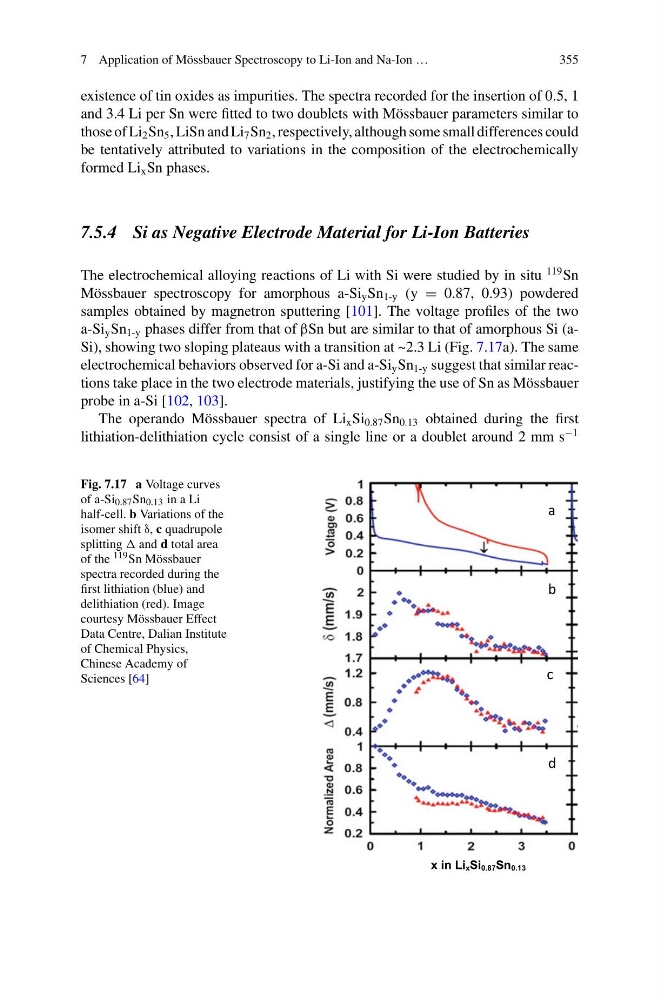
a-Si y Sn 1-y phases differ from that of βSn but are similar to that of amorphous Si (aSi), showing two sloping plateaus with a transition at ~2.3 Li (Fig. 7.17a). The same
electrochemical behaviors observed for a-Si and a-Si y Sn 1-y suggest that similar reactions take place in the two electrode materials, justifying the use of Sn as Mössbauer
probe in a-Si [102, 103].
The operando Mössbauer spectra of Li x Si 0.87 Sn 0.13 obtained during the first
lithiation-delithiation cycle consist of a single line or a doublet around 2 mm s
−1
Fig. 7.17 a Voltage curves
of a-Si 0.87 Sn 0.13 in a Li
half-cell. b Variations of the
isomer shift δ, c quadrupole
splitting and d total area
of the 119 Sn Mössbauer
spectra recorded during the
first lithiation (blue) and
delithiation (red). Image
courtesy Mössbauer Effect
Data Centre, Dalian Institute
of Chemical Physics,
Chinese Academy of
Sciences [64]
x in Li x Si 0.87 Sn 0.13
a
b
d
c
355
existence of tin oxides as impurities. The spectra recorded for the insertion of 0.5, 1
and 3.4 Li per Sn were fitted to two doublets with Mössbauer parameters similar to
those of Li 2 Sn 5 , LiSn and Li 7 Sn 2 , respectively, although some small differences could
be tentatively attributed to variations in the composition of the electrochemically
formed Li x Sn phases.
7.5.4 Si as Negative Electrode Material for Li-Ion Batteries
The electrochemical alloying reactions of Li with Si were studied by in situ
119 Sn
Mössbauer spectroscopy for amorphous a-Si y Sn 1-y (y = 0.87, 0.93) powdered
samples obtained by magnetron sputtering [101]. The voltage profiles of the two
a-Si y Sn 1-y phases differ from that of βSn but are similar to that of amorphous Si (aSi), showing two sloping plateaus with a transition at ~2.3 Li (Fig. 7.17a). The same
electrochemical behaviors observed for a-Si and a-Si y Sn 1-y suggest that similar reactions take place in the two electrode materials, justifying the use of Sn as Mössbauer
probe in a-Si [102, 103].
The operando Mössbauer spectra of Li x Si 0.87 Sn 0.13 obtained during the first
lithiation-delithiation cycle consist of a single line or a doublet around 2 mm s
−1
Fig. 7.17 a Voltage curves
of a-Si 0.87 Sn 0.13 in a Li
half-cell. b Variations of the
isomer shift δ, c quadrupole
splitting and d total area
of the 119 Sn Mössbauer
spectra recorded during the
first lithiation (blue) and
delithiation (red). Image
courtesy Mössbauer Effect
Data Centre, Dalian Institute
of Chemical Physics,
Chinese Academy of
Sciences [64]
x in Li x Si 0.87 Sn 0.13
a
b
d
c