

7 Application of Mössbauer Spectroscopy to Li-Ion and Na-Ion …
331
shifts corresponding to different iron oxidation and spin states. Other Mössbauer
parameters, such as the quadrupole splitting or the hyperfine magnetic field, should
be considered to resolve any ambiguity.
The isomer shift depends on the valence electron configuration of the Mössbauer
atom and can be used to investigate changes in the type of ligand, oxidation state,
chemical bonding, coordination number and bond lengths arising from electrochemical reactions in Li-ion or Na-ion batteries. A common situation is the reversible
change of Fe oxidation state in Fe
2+ cathode materials such as LiFePO 4 following
the reaction
LiFe
2+ PO 4 = Fe
3+ PO 4 + Li
+
+ e
−
(7.6)
The values of the
57 Fe Mössbauer isomer shift relative to α-Fe at room temperature
are very different for LiFe
2+ PO 4 (δ = 1.2 mm s
−1 ) and Fe
3+ PO 4 : (δ = 0.6 mm s
−1 ).
Equation (7.6) indicates that the delithiation of LiFePO 4 leads to the decrease of
the Fe 3d electron population and, through the shielding effect, to the increase of
ρ(0). The negative sign of α in Eq. (7.4) for
57 Fe explains the observed decrease
of the isomer shift from LiFePO 4 to FePO 4 . In this example, the two Fe oxidation
states can be easily distinguished by only considering the values of the isomer shift
because ferrous and ferric ions in LiFePO 4 and FePO 4 , respectively, have both high
spin states. Another example is the reduction of Sn(IV) into Sn(0) during the first
lithiation of SnO 2 following the conversion reaction
Sn(IV)O 2 + 4Li
+
+ 4e
−
→ βSn(0) + 2Li 2 O
(7.7)
The
119 Sn Mössbauer isomer shifts relative to BaSnO 3 of SnO 2 and βSn at
room temperature are 0 mm s
−1 and 2.55 mm s
−1 , respectively. They can be easily
distinguished by
119 Sn Mössbauer spectroscopy.
7.3.3 Quadrupole Splitting
The quadrupole splitting originates from the interaction between the nuclear
quadrupole moment and the electric field gradient (EFG) at the nucleus created by
the anisotropic charge distribution surrounding the nucleus. The nuclear quadrupole
moment exists for a nuclear spin state I > 1/2 and measures the deviation of the
nuclear charge distribution from spherical symmetry. Both the EFG and the nuclear
quadrupole moment operator ˆ
Q are second rank tensors and the Hamiltonian H QI
resulting from quadrupole interactions is expressed as the product of these two
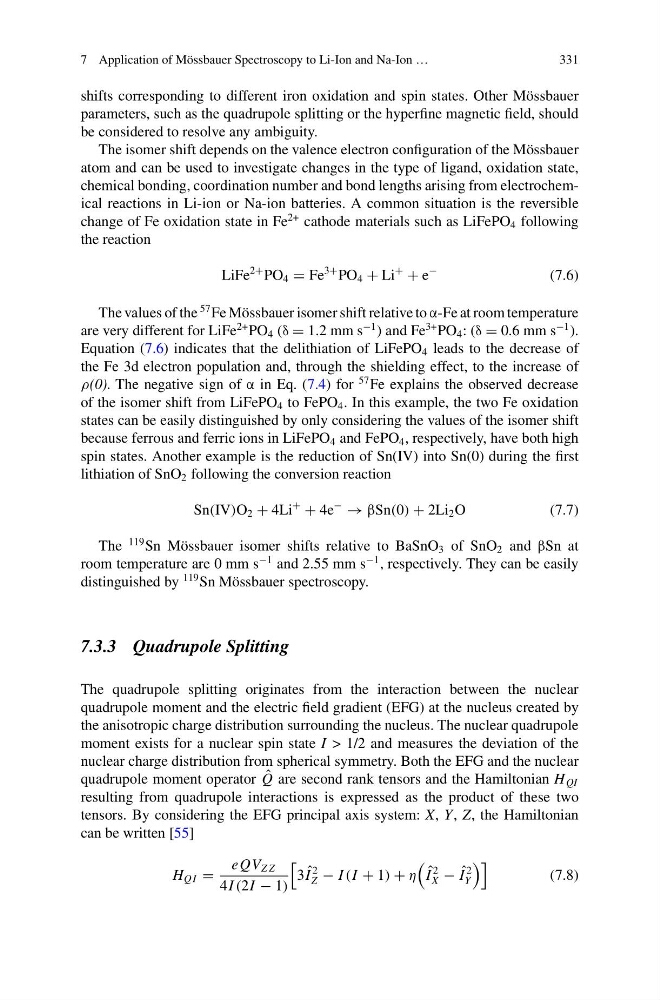
tensors. By considering the EFG principal axis system: X, Y, Z, the Hamiltonian
can be written [55]
H Q I =
eQV Z Z
4I (2I − 1)
3 ˆ
I
2
Z − I (I + 1) + η
ˆ
I
2
X − ˆ
I
2
Y
(7.8)
331
shifts corresponding to different iron oxidation and spin states. Other Mössbauer
parameters, such as the quadrupole splitting or the hyperfine magnetic field, should
be considered to resolve any ambiguity.
The isomer shift depends on the valence electron configuration of the Mössbauer
atom and can be used to investigate changes in the type of ligand, oxidation state,
chemical bonding, coordination number and bond lengths arising from electrochemical reactions in Li-ion or Na-ion batteries. A common situation is the reversible
change of Fe oxidation state in Fe
2+ cathode materials such as LiFePO 4 following
the reaction
LiFe
2+ PO 4 = Fe
3+ PO 4 + Li
+
+ e
−
(7.6)
The values of the
57 Fe Mössbauer isomer shift relative to α-Fe at room temperature
are very different for LiFe
2+ PO 4 (δ = 1.2 mm s
−1 ) and Fe
3+ PO 4 : (δ = 0.6 mm s
−1 ).
Equation (7.6) indicates that the delithiation of LiFePO 4 leads to the decrease of
the Fe 3d electron population and, through the shielding effect, to the increase of
ρ(0). The negative sign of α in Eq. (7.4) for
57 Fe explains the observed decrease
of the isomer shift from LiFePO 4 to FePO 4 . In this example, the two Fe oxidation
states can be easily distinguished by only considering the values of the isomer shift
because ferrous and ferric ions in LiFePO 4 and FePO 4 , respectively, have both high
spin states. Another example is the reduction of Sn(IV) into Sn(0) during the first
lithiation of SnO 2 following the conversion reaction
Sn(IV)O 2 + 4Li
+
+ 4e
−
→ βSn(0) + 2Li 2 O
(7.7)
The
119 Sn Mössbauer isomer shifts relative to BaSnO 3 of SnO 2 and βSn at
room temperature are 0 mm s
−1 and 2.55 mm s
−1 , respectively. They can be easily
distinguished by
119 Sn Mössbauer spectroscopy.
7.3.3 Quadrupole Splitting
The quadrupole splitting originates from the interaction between the nuclear
quadrupole moment and the electric field gradient (EFG) at the nucleus created by
the anisotropic charge distribution surrounding the nucleus. The nuclear quadrupole
moment exists for a nuclear spin state I > 1/2 and measures the deviation of the
nuclear charge distribution from spherical symmetry. Both the EFG and the nuclear
quadrupole moment operator ˆ
Q are second rank tensors and the Hamiltonian H QI
resulting from quadrupole interactions is expressed as the product of these two
tensors. By considering the EFG principal axis system: X, Y, Z, the Hamiltonian
can be written [55]
H Q I =
eQV Z Z
4I (2I − 1)
3 ˆ
I
2
Z − I (I + 1) + η
ˆ
I
2
X − ˆ
I
2
Y
(7.8)