

328
P.-E. Lippens
The standard application of in-lab Mössbauer spectroscopy is restricted to a small
number of isotopes.
57 Fe and
119 Sn are by far the most commonly used isotopes,
but others like
121 Sb [29] or
99 Ru [30] have also been considered to study electrode materials. For other chemical elements, synchrotron radiation based Mössbauer
spectroscopy [43] or atomic substitution with a Mössbauer isotope should be envisaged. In some cases, the low concentration of Mössbauer atoms requires long-term
experiments that are not always compatible with operando measurements.
Information about samples under investigation are mainly obtained from the analysis of the shape of the Mössbauer spectra that are usually not a single Lorentzian line
(see Sect. 7.3.6). Electric and magnetic interactions between the Mössbauer nuclei
and their local environment lead to the shift and splitting of the nuclear states, which
affects the number and energy of the recoil-free nuclear transitions. These interactions are at the origin of three main Mössbauer parameters that can be, in principle,
obtained from the Mössbauer spectra: isomer shift, quadrupole splitting and hyperfine magnetic field. These parameters and the recoil-free fraction are described in
the following subsections.
7.3.2 Isomer Shift
The hyperfine interactions between the nuclear charge density and the Coulomb
potential due to the electron density are localized within the nucleus. The atomic
nucleus has a small and finite size and can be non-spherical, leading to monopole
and quadrupole electric interactions that are related to the average size of the nucleus
considered as a sphere and the deviation from the non-spherical shape of the nucleus,
respectively. The monopole and quadrupole interactions are at the origin of the isomer
shift and quadrupole splitting, respectively. For the determination of the isomer shift,
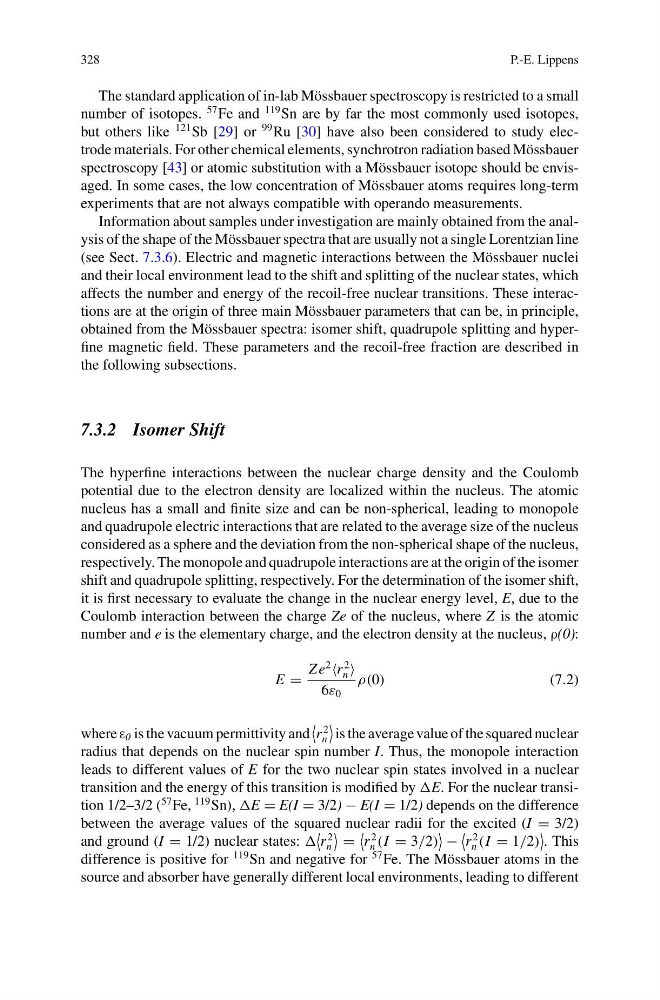
it is first necessary to evaluate the change in the nuclear energy level, E, due to the
Coulomb interaction between the charge Ze of the nucleus, where Z is the atomic
number and e is the elementary charge, and the electron density at the nucleus, ρ(0):
E =
Ze
2
r
2
n
6ε 0
ρ(0)
(7.2)
where ε 0 is the vacuum permittivity and
r
2
n
is the average value of the squared nuclear
radius that depends on the nuclear spin number I. Thus, the monopole interaction
leads to different values of E for the two nuclear spin states involved in a nuclear
transition and the energy of this transition is modified by E. For the nuclear transition 1/2–3/2 (
57 Fe,
119 Sn), E = E(I = 3/2) − E(I = 1/2) depends on the difference
between the average values of the squared nuclear radii for the excited (I = 3/2)
and ground (I = 1/2) nuclear states:
r
2
n
=
r
2
n (I = 3/2)
−
r
2
n (I = 1/2)
. This
difference is positive for
119 Sn and negative for
57 Fe. The Mössbauer atoms in the
source and absorber have generally different local environments, leading to different
P.-E. Lippens
The standard application of in-lab Mössbauer spectroscopy is restricted to a small
number of isotopes.
57 Fe and
119 Sn are by far the most commonly used isotopes,
but others like
121 Sb [29] or
99 Ru [30] have also been considered to study electrode materials. For other chemical elements, synchrotron radiation based Mössbauer
spectroscopy [43] or atomic substitution with a Mössbauer isotope should be envisaged. In some cases, the low concentration of Mössbauer atoms requires long-term
experiments that are not always compatible with operando measurements.
Information about samples under investigation are mainly obtained from the analysis of the shape of the Mössbauer spectra that are usually not a single Lorentzian line
(see Sect. 7.3.6). Electric and magnetic interactions between the Mössbauer nuclei
and their local environment lead to the shift and splitting of the nuclear states, which
affects the number and energy of the recoil-free nuclear transitions. These interactions are at the origin of three main Mössbauer parameters that can be, in principle,
obtained from the Mössbauer spectra: isomer shift, quadrupole splitting and hyperfine magnetic field. These parameters and the recoil-free fraction are described in
the following subsections.
7.3.2 Isomer Shift
The hyperfine interactions between the nuclear charge density and the Coulomb
potential due to the electron density are localized within the nucleus. The atomic
nucleus has a small and finite size and can be non-spherical, leading to monopole
and quadrupole electric interactions that are related to the average size of the nucleus
considered as a sphere and the deviation from the non-spherical shape of the nucleus,
respectively. The monopole and quadrupole interactions are at the origin of the isomer
shift and quadrupole splitting, respectively. For the determination of the isomer shift,
it is first necessary to evaluate the change in the nuclear energy level, E, due to the
Coulomb interaction between the charge Ze of the nucleus, where Z is the atomic
number and e is the elementary charge, and the electron density at the nucleus, ρ(0):
E =
Ze
2
r
2
n
6ε 0
ρ(0)
(7.2)
where ε 0 is the vacuum permittivity and
r
2
n
is the average value of the squared nuclear
radius that depends on the nuclear spin number I. Thus, the monopole interaction
leads to different values of E for the two nuclear spin states involved in a nuclear
transition and the energy of this transition is modified by E. For the nuclear transition 1/2–3/2 (
57 Fe,
119 Sn), E = E(I = 3/2) − E(I = 1/2) depends on the difference
between the average values of the squared nuclear radii for the excited (I = 3/2)
and ground (I = 1/2) nuclear states:
r
2
n
=
r
2
n (I = 3/2)
−
r
2
n (I = 1/2)
. This
difference is positive for
119 Sn and negative for
57 Fe. The Mössbauer atoms in the
source and absorber have generally different local environments, leading to different