

18
R. Rüffer and A. I. Chumakov
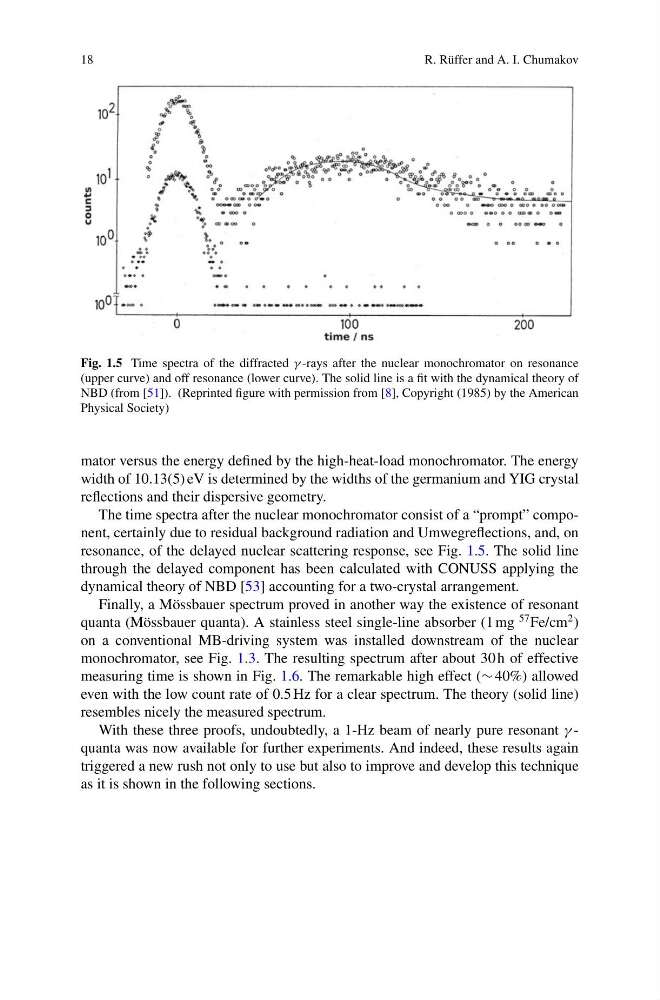
Fig. 1.5 Time spectra of the diffracted γ -rays after the nuclear monochromator on resonance
(upper curve) and off resonance (lower curve). The solid line is a fit with the dynamical theory of
NBD (from [51]). (Reprinted figure with permission from [8], Copyright (1985) by the American
Physical Society)
mator versus the energy defined by the high-heat-load monochromator. The energy
width of 10.13(5) eV is determined by the widths of the germanium and YIG crystal
reflections and their dispersive geometry.
The time spectra after the nuclear monochromator consist of a “prompt” component, certainly due to residual background radiation and Umwegreflections, and, on
resonance, of the delayed nuclear scattering response, see Fig. 1.5. The solid line
through the delayed component has been calculated with CONUSS applying the
dynamical theory of NBD [53] accounting for a two-crystal arrangement.
Finally, a Mössbauer spectrum proved in another way the existence of resonant
quanta (Mössbauer quanta). A stainless steel single-line absorber (1 mg
57 Fe/cm
2 )
on a conventional MB-driving system was installed downstream of the nuclear
monochromator, see Fig. 1.3. The resulting spectrum after about 30 h of effective
measuring time is shown in Fig. 1.6. The remarkable high effect (∼ 40%) allowed
even with the low count rate of 0.5 Hz for a clear spectrum. The theory (solid line)
resembles nicely the measured spectrum.
With these three proofs, undoubtedly, a 1-Hz beam of nearly pure resonant γ -
quanta was now available for further experiments. And indeed, these results again
triggered a new rush not only to use but also to improve and develop this technique
as it is shown in the following sections.
R. Rüffer and A. I. Chumakov
Fig. 1.5 Time spectra of the diffracted γ -rays after the nuclear monochromator on resonance
(upper curve) and off resonance (lower curve). The solid line is a fit with the dynamical theory of
NBD (from [51]). (Reprinted figure with permission from [8], Copyright (1985) by the American
Physical Society)
mator versus the energy defined by the high-heat-load monochromator. The energy
width of 10.13(5) eV is determined by the widths of the germanium and YIG crystal
reflections and their dispersive geometry.
The time spectra after the nuclear monochromator consist of a “prompt” component, certainly due to residual background radiation and Umwegreflections, and, on
resonance, of the delayed nuclear scattering response, see Fig. 1.5. The solid line
through the delayed component has been calculated with CONUSS applying the
dynamical theory of NBD [53] accounting for a two-crystal arrangement.
Finally, a Mössbauer spectrum proved in another way the existence of resonant
quanta (Mössbauer quanta). A stainless steel single-line absorber (1 mg
57 Fe/cm
2 )
on a conventional MB-driving system was installed downstream of the nuclear
monochromator, see Fig. 1.3. The resulting spectrum after about 30 h of effective
measuring time is shown in Fig. 1.6. The remarkable high effect (∼ 40%) allowed
even with the low count rate of 0.5 Hz for a clear spectrum. The theory (solid line)
resembles nicely the measured spectrum.
With these three proofs, undoubtedly, a 1-Hz beam of nearly pure resonant γ -
quanta was now available for further experiments. And indeed, these results again
triggered a new rush not only to use but also to improve and develop this technique
as it is shown in the following sections.