

6 Molecular Magnetism of Metal Complexes and Light-Induced …
305
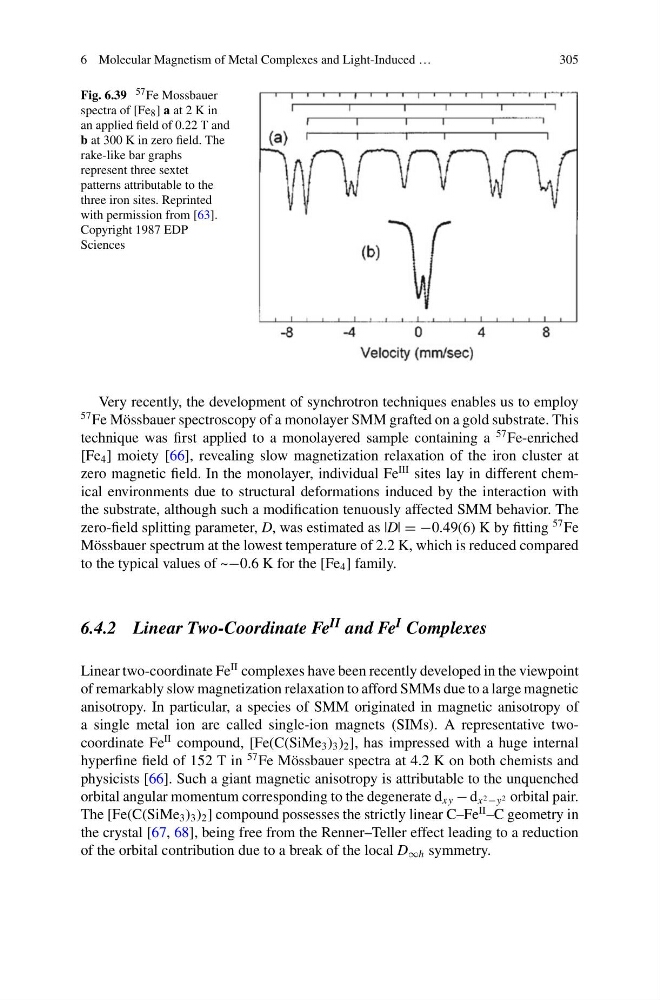
Fig. 6.39 57 Fe Mossbauer
spectra of [Fe 8 ] a at 2 K in
an applied field of 0.22 T and
b at 300 K in zero field. The
rake-like bar graphs
represent three sextet
patterns attributable to the
three iron sites. Reprinted
with permission from [63].
Copyright 1987 EDP
Sciences
Very recently, the development of synchrotron techniques enables us to employ
57 Fe Mössbauer spectroscopy of a monolayer SMM grafted on a gold substrate. This
technique was first applied to a monolayered sample containing a
57 Fe-enriched
[Fe 4 ] moiety [66], revealing slow magnetization relaxation of the iron cluster at
zero magnetic field. In the monolayer, individual Fe
III sites lay in different chemical environments due to structural deformations induced by the interaction with
the substrate, although such a modification tenuously affected SMM behavior. The
zero-field splitting parameter, D, was estimated as |D| = −0.49(6) K by fitting
57 Fe
Mössbauer spectrum at the lowest temperature of 2.2 K, which is reduced compared
to the typical values of ~−0.6 K for the [Fe 4 ] family.
6.4.2 Linear Two-Coordinate Fe II and Fe I Complexes
Linear two-coordinate Fe
II complexes have been recently developed in the viewpoint
of remarkably slow magnetization relaxation to afford SMMs due to a large magnetic
anisotropy. In particular, a species of SMM originated in magnetic anisotropy of
a single metal ion are called single-ion magnets (SIMs). A representative twocoordinate Fe
II compound, [Fe(C(SiMe 3 ) 3 ) 2 ], has impressed with a huge internal
hyperfine field of 152 T in
57 Fe Mössbauer spectra at 4.2 K on both chemists and
physicists [66]. Such a giant magnetic anisotropy is attributable to the unquenched
orbital angular momentum corresponding to the degenerate d xy − d x 2 −y 2 orbital pair.
The [Fe(C(SiMe 3 ) 3 ) 2 ] compound possesses the strictly linear C–Fe
II –C geometry in
the crystal [67, 68], being free from the Renner–Teller effect leading to a reduction
of the orbital contribution due to a break of the local D ∞h symmetry.
305
Fig. 6.39 57 Fe Mossbauer
spectra of [Fe 8 ] a at 2 K in
an applied field of 0.22 T and
b at 300 K in zero field. The
rake-like bar graphs
represent three sextet
patterns attributable to the
three iron sites. Reprinted
with permission from [63].
Copyright 1987 EDP
Sciences
Very recently, the development of synchrotron techniques enables us to employ
57 Fe Mössbauer spectroscopy of a monolayer SMM grafted on a gold substrate. This
technique was first applied to a monolayered sample containing a
57 Fe-enriched
[Fe 4 ] moiety [66], revealing slow magnetization relaxation of the iron cluster at
zero magnetic field. In the monolayer, individual Fe
III sites lay in different chemical environments due to structural deformations induced by the interaction with
the substrate, although such a modification tenuously affected SMM behavior. The
zero-field splitting parameter, D, was estimated as |D| = −0.49(6) K by fitting
57 Fe
Mössbauer spectrum at the lowest temperature of 2.2 K, which is reduced compared
to the typical values of ~−0.6 K for the [Fe 4 ] family.
6.4.2 Linear Two-Coordinate Fe II and Fe I Complexes
Linear two-coordinate Fe
II complexes have been recently developed in the viewpoint
of remarkably slow magnetization relaxation to afford SMMs due to a large magnetic
anisotropy. In particular, a species of SMM originated in magnetic anisotropy of
a single metal ion are called single-ion magnets (SIMs). A representative twocoordinate Fe
II compound, [Fe(C(SiMe 3 ) 3 ) 2 ], has impressed with a huge internal
hyperfine field of 152 T in
57 Fe Mössbauer spectra at 4.2 K on both chemists and
physicists [66]. Such a giant magnetic anisotropy is attributable to the unquenched
orbital angular momentum corresponding to the degenerate d xy − d x 2 −y 2 orbital pair.
The [Fe(C(SiMe 3 ) 3 ) 2 ] compound possesses the strictly linear C–Fe
II –C geometry in
the crystal [67, 68], being free from the Renner–Teller effect leading to a reduction
of the orbital contribution due to a break of the local D ∞h symmetry.