

276
N. Kojima and A. Okazawa
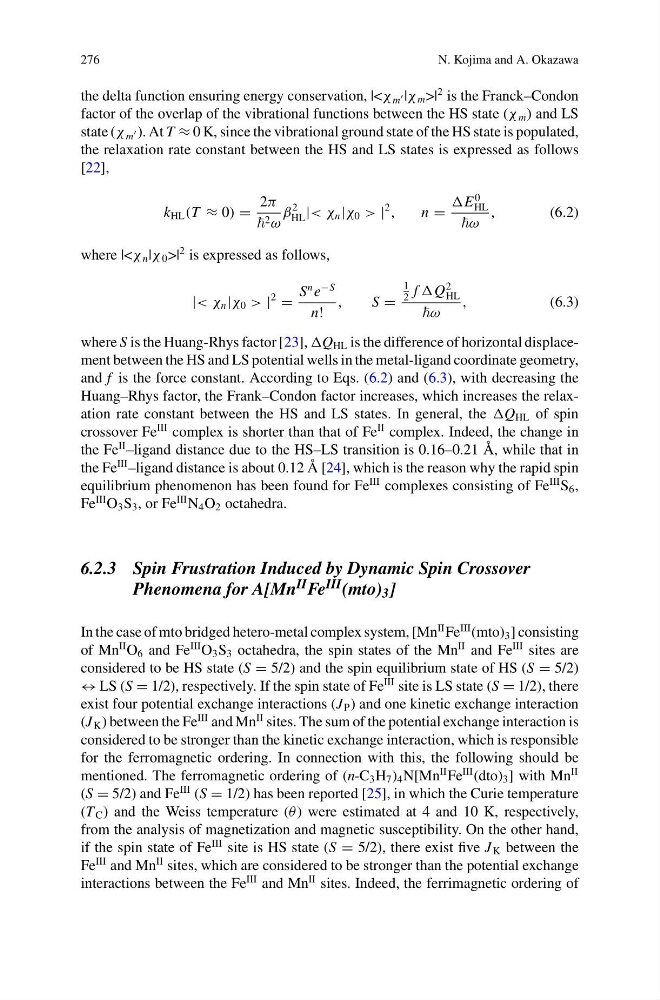
the delta function ensuring energy conservation, |<χ m |χ m >|
2 is the Franck–Condon
factor of the overlap of the vibrational functions between the HS state (χ m ) and LS
state (χ m ). At T ≈ 0 K, since the vibrational ground state of the HS state is populated,
the relaxation rate constant between the HS and LS states is expressed as follows
[22],
k HL (T ≈ 0) =
2π
2 ω
β
2
HL |< χ n |χ 0 > |
2
,
n =
E
0
HL
ω
,
(6.2)
where |<χ n |χ 0 >|
2 is expressed as follows,
|< χ n |χ 0 > |
2
=
S
n e
−S
n!
,
S =
1
2
f Q
2
HL
ω
,
(6.3)
where S is the Huang-Rhys factor [23], Q HL is the difference of horizontal displacement between the HS and LS potential wells in the metal-ligand coordinate geometry,
and f is the force constant. According to Eqs. (6.2) and (6.3), with decreasing the
Huang–Rhys factor, the Frank–Condon factor increases, which increases the relaxation rate constant between the HS and LS states. In general, the Q HL of spin
crossover Fe
III complex is shorter than that of Fe
II complex. Indeed, the change in
the Fe
II –ligand distance due to the HS–LS transition is 0.16–0.21 Å, while that in
the Fe
III –ligand distance is about 0.12 Å [24], which is the reason why the rapid spin
equilibrium phenomenon has been found for Fe
III complexes consisting of Fe
III S 6 ,
Fe
III O 3 S 3 , or Fe
III N 4 O 2 octahedra.
6.2.3 Spin Frustration Induced by Dynamic Spin Crossover
Phenomena for A[Mn II Fe III (mto) 3 ]
In the case of mto bridged hetero-metal complex system, [Mn
II Fe
III (mto) 3 ] consisting
of Mn
II O 6 and Fe
III O 3 S 3 octahedra, the spin states of the Mn
II and Fe
III sites are
considered to be HS state (S = 5/2) and the spin equilibrium state of HS (S = 5/2)
↔ LS (S = 1/2), respectively. If the spin state of Fe
III site is LS state (S = 1/2), there
exist four potential exchange interactions (J P ) and one kinetic exchange interaction
(J K ) between the Fe
III and Mn
II sites. The sum of the potential exchange interaction is
considered to be stronger than the kinetic exchange interaction, which is responsible
for the ferromagnetic ordering. In connection with this, the following should be
mentioned. The ferromagnetic ordering of (n-C 3 H 7 ) 4 N[Mn
II Fe
III (dto) 3 ] with Mn
II
(S = 5/2) and Fe
III (S = 1/2) has been reported [25], in which the Curie temperature
(T C ) and the Weiss temperature (θ ) were estimated at 4 and 10 K, respectively,
from the analysis of magnetization and magnetic susceptibility. On the other hand,
if the spin state of Fe
III site is HS state (S = 5/2), there exist five J K between the
Fe
III and Mn
II sites, which are considered to be stronger than the potential exchange
interactions between the Fe
III and Mn
II sites. Indeed, the ferrimagnetic ordering of
N. Kojima and A. Okazawa
the delta function ensuring energy conservation, |<χ m |χ m >|
2 is the Franck–Condon
factor of the overlap of the vibrational functions between the HS state (χ m ) and LS
state (χ m ). At T ≈ 0 K, since the vibrational ground state of the HS state is populated,
the relaxation rate constant between the HS and LS states is expressed as follows
[22],
k HL (T ≈ 0) =
2π
2 ω
β
2
HL |< χ n |χ 0 > |
2
,
n =
E
0
HL
ω
,
(6.2)
where |<χ n |χ 0 >|
2 is expressed as follows,
|< χ n |χ 0 > |
2
=
S
n e
−S
n!
,
S =
1
2
f Q
2
HL
ω
,
(6.3)
where S is the Huang-Rhys factor [23], Q HL is the difference of horizontal displacement between the HS and LS potential wells in the metal-ligand coordinate geometry,
and f is the force constant. According to Eqs. (6.2) and (6.3), with decreasing the
Huang–Rhys factor, the Frank–Condon factor increases, which increases the relaxation rate constant between the HS and LS states. In general, the Q HL of spin
crossover Fe
III complex is shorter than that of Fe
II complex. Indeed, the change in
the Fe
II –ligand distance due to the HS–LS transition is 0.16–0.21 Å, while that in
the Fe
III –ligand distance is about 0.12 Å [24], which is the reason why the rapid spin
equilibrium phenomenon has been found for Fe
III complexes consisting of Fe
III S 6 ,
Fe
III O 3 S 3 , or Fe
III N 4 O 2 octahedra.
6.2.3 Spin Frustration Induced by Dynamic Spin Crossover
Phenomena for A[Mn II Fe III (mto) 3 ]
In the case of mto bridged hetero-metal complex system, [Mn
II Fe
III (mto) 3 ] consisting
of Mn
II O 6 and Fe
III O 3 S 3 octahedra, the spin states of the Mn
II and Fe
III sites are
considered to be HS state (S = 5/2) and the spin equilibrium state of HS (S = 5/2)
↔ LS (S = 1/2), respectively. If the spin state of Fe
III site is LS state (S = 1/2), there
exist four potential exchange interactions (J P ) and one kinetic exchange interaction
(J K ) between the Fe
III and Mn
II sites. The sum of the potential exchange interaction is
considered to be stronger than the kinetic exchange interaction, which is responsible
for the ferromagnetic ordering. In connection with this, the following should be
mentioned. The ferromagnetic ordering of (n-C 3 H 7 ) 4 N[Mn
II Fe
III (dto) 3 ] with Mn
II
(S = 5/2) and Fe
III (S = 1/2) has been reported [25], in which the Curie temperature
(T C ) and the Weiss temperature (θ ) were estimated at 4 and 10 K, respectively,
from the analysis of magnetization and magnetic susceptibility. On the other hand,
if the spin state of Fe
III site is HS state (S = 5/2), there exist five J K between the
Fe
III and Mn
II sites, which are considered to be stronger than the potential exchange
interactions between the Fe
III and Mn
II sites. Indeed, the ferrimagnetic ordering of