

8
R. Rüffer and A. I. Chumakov
(iii) the polarization is along the direction of acceleration.
The for us interesting situation is the case where the velocity v, close to the velocity
of light, is perpendicular to the acceleration ˙
v of the emitting charge, i.e., relativistic
charged particles in a transverse magnetic field in a circular particle accelerator: here
the relativistic contraction of the emitted radiation is around the direction of maximum emission of the “antenna”, while in the case where velocity v and acceleration
˙
v are parallel (e.g. in a linear accelerator) the emitted radiation in forward direction
would be zero.
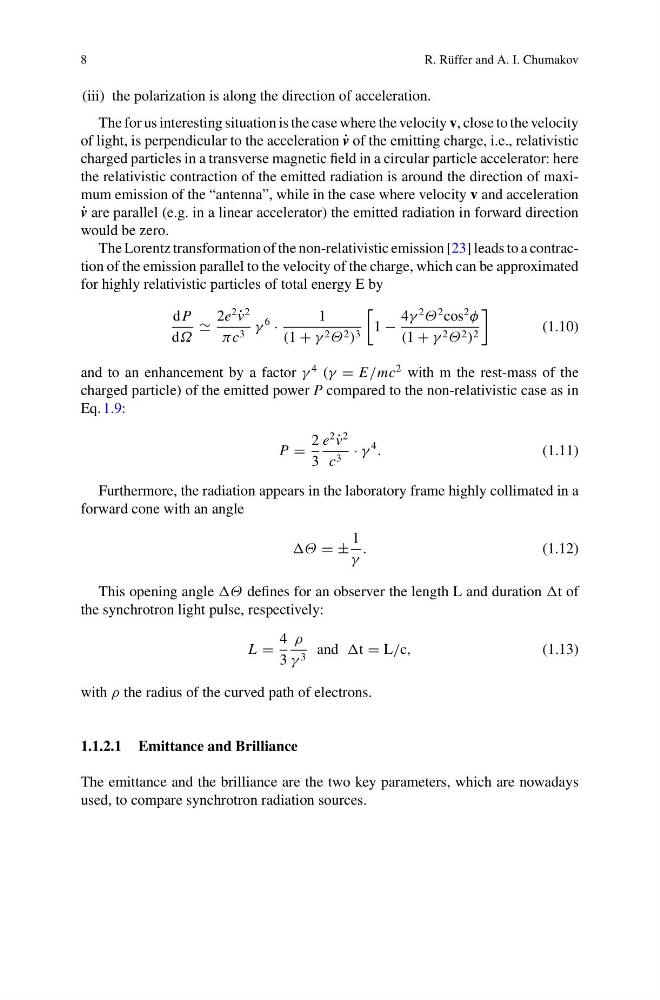
The Lorentz transformation of the non-relativistic emission [23] leads to a contraction of the emission parallel to the velocity of the charge, which can be approximated
for highly relativistic particles of total energy E by
d P
dΩ
2e
2
˙
v
2
π c 3 γ
6
·
1
(1 + γ 2 Θ 2 ) 3
1 −
4γ
2
Θ
2 cos
2
φ
(1 + γ 2 Θ 2 ) 2
(1.10)
and to an enhancement by a factor γ
4 (γ = E/mc
2 with m the rest-mass of the
charged particle) of the emitted power P compared to the non-relativistic case as in
Eq. 1.9:
P =
2
3
e
2
˙
v
2
c 3 · γ
4
.
(1.11)
Furthermore, the radiation appears in the laboratory frame highly collimated in a
forward cone with an angle
Θ = ±
1
γ
.
(1.12)
This opening angle Θ defines for an observer the length L and duration t of
the synchrotron light pulse, respectively:
L =
4
3
ρ
γ 3 and t = L/c,
(1.13)
with ρ the radius of the curved path of electrons.
1.1.2.1 Emittance and Brilliance
The emittance and the brilliance are the two key parameters, which are nowadays
used, to compare synchrotron radiation sources.
R. Rüffer and A. I. Chumakov
(iii) the polarization is along the direction of acceleration.
The for us interesting situation is the case where the velocity v, close to the velocity
of light, is perpendicular to the acceleration ˙
v of the emitting charge, i.e., relativistic
charged particles in a transverse magnetic field in a circular particle accelerator: here
the relativistic contraction of the emitted radiation is around the direction of maximum emission of the “antenna”, while in the case where velocity v and acceleration
˙
v are parallel (e.g. in a linear accelerator) the emitted radiation in forward direction
would be zero.
The Lorentz transformation of the non-relativistic emission [23] leads to a contraction of the emission parallel to the velocity of the charge, which can be approximated
for highly relativistic particles of total energy E by
d P
dΩ
2e
2
˙
v
2
π c 3 γ
6
·
1
(1 + γ 2 Θ 2 ) 3
1 −
4γ
2
Θ
2 cos
2
φ
(1 + γ 2 Θ 2 ) 2
(1.10)
and to an enhancement by a factor γ
4 (γ = E/mc
2 with m the rest-mass of the
charged particle) of the emitted power P compared to the non-relativistic case as in
Eq. 1.9:
P =
2
3
e
2
˙
v
2
c 3 · γ
4
.
(1.11)
Furthermore, the radiation appears in the laboratory frame highly collimated in a
forward cone with an angle
Θ = ±
1
γ
.
(1.12)
This opening angle Θ defines for an observer the length L and duration t of
the synchrotron light pulse, respectively:
L =
4
3
ρ
γ 3 and t = L/c,
(1.13)
with ρ the radius of the curved path of electrons.
1.1.2.1 Emittance and Brilliance
The emittance and the brilliance are the two key parameters, which are nowadays
used, to compare synchrotron radiation sources.