

5 Mössbauer Spectroscopy with High Spatial Resolution …
225
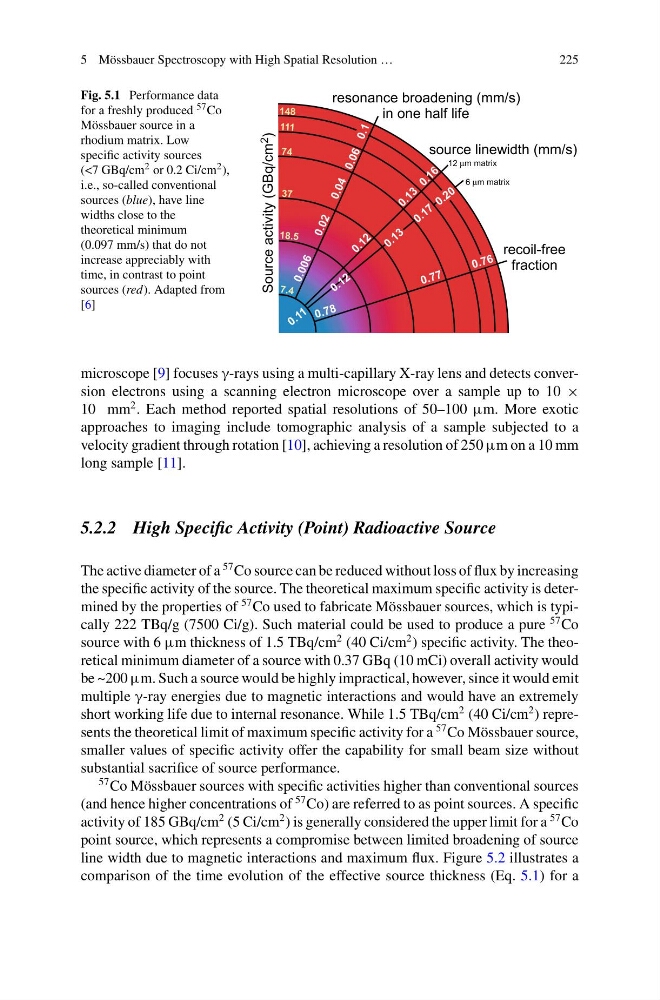
Fig. 5.1 Performance data
for a freshly produced 57 Co
Mössbauer source in a
rhodium matrix. Low
specific activity sources
(<7 GBq/cm 2 or 0.2 Ci/cm 2 ),
i.e., so-called conventional
sources (blue), have line
widths close to the
theoretical minimum
(0.097 mm/s) that do not
increase appreciably with
time, in contrast to point
sources (red). Adapted from
[6]
μ
μ
microscope [9] focuses γ-rays using a multi-capillary X-ray lens and detects conversion electrons using a scanning electron microscope over a sample up to 10 ×
10 mm
2 . Each method reported spatial resolutions of 50–100 μm. More exotic
approaches to imaging include tomographic analysis of a sample subjected to a
velocity gradient through rotation [10], achieving a resolution of 250 μm on a 10 mm
long sample [11].
5.2.2 High Specific Activity (Point) Radioactive Source
The active diameter of a
57 Co source can be reduced without loss of flux by increasing
the specific activity of the source. The theoretical maximum specific activity is determined by the properties of
57 Co used to fabricate Mössbauer sources, which is typically 222 TBq/g (7500 Ci/g). Such material could be used to produce a pure
57 Co
source with 6 μm thickness of 1.5 TBq/cm
2 (40 Ci/cm
2 ) specific activity. The theoretical minimum diameter of a source with 0.37 GBq (10 mCi) overall activity would
be ~200 μm. Such a source would be highly impractical, however, since it would emit
multiple γ-ray energies due to magnetic interactions and would have an extremely
short working life due to internal resonance. While 1.5 TBq/cm
2 (40 Ci/cm
2 ) represents the theoretical limit of maximum specific activity for a
57 Co Mössbauer source,
smaller values of specific activity offer the capability for small beam size without
substantial sacrifice of source performance.
57 Co Mössbauer sources with specific activities higher than conventional sources
(and hence higher concentrations of
57 Co) are referred to as point sources. A specific
activity of 185 GBq/cm
2 (5 Ci/cm
2 ) is generally considered the upper limit for a
57 Co
point source, which represents a compromise between limited broadening of source
line width due to magnetic interactions and maximum flux. Figure 5.2 illustrates a
comparison of the time evolution of the effective source thickness (Eq. 5.1) for a
225
Fig. 5.1 Performance data
for a freshly produced 57 Co
Mössbauer source in a
rhodium matrix. Low
specific activity sources
(<7 GBq/cm 2 or 0.2 Ci/cm 2 ),
i.e., so-called conventional
sources (blue), have line
widths close to the
theoretical minimum
(0.097 mm/s) that do not
increase appreciably with
time, in contrast to point
sources (red). Adapted from
[6]
μ
μ
microscope [9] focuses γ-rays using a multi-capillary X-ray lens and detects conversion electrons using a scanning electron microscope over a sample up to 10 ×
10 mm
2 . Each method reported spatial resolutions of 50–100 μm. More exotic
approaches to imaging include tomographic analysis of a sample subjected to a
velocity gradient through rotation [10], achieving a resolution of 250 μm on a 10 mm
long sample [11].
5.2.2 High Specific Activity (Point) Radioactive Source
The active diameter of a
57 Co source can be reduced without loss of flux by increasing
the specific activity of the source. The theoretical maximum specific activity is determined by the properties of
57 Co used to fabricate Mössbauer sources, which is typically 222 TBq/g (7500 Ci/g). Such material could be used to produce a pure
57 Co
source with 6 μm thickness of 1.5 TBq/cm
2 (40 Ci/cm
2 ) specific activity. The theoretical minimum diameter of a source with 0.37 GBq (10 mCi) overall activity would
be ~200 μm. Such a source would be highly impractical, however, since it would emit
multiple γ-ray energies due to magnetic interactions and would have an extremely
short working life due to internal resonance. While 1.5 TBq/cm
2 (40 Ci/cm
2 ) represents the theoretical limit of maximum specific activity for a
57 Co Mössbauer source,
smaller values of specific activity offer the capability for small beam size without
substantial sacrifice of source performance.
57 Co Mössbauer sources with specific activities higher than conventional sources
(and hence higher concentrations of
57 Co) are referred to as point sources. A specific
activity of 185 GBq/cm
2 (5 Ci/cm
2 ) is generally considered the upper limit for a
57 Co
point source, which represents a compromise between limited broadening of source
line width due to magnetic interactions and maximum flux. Figure 5.2 illustrates a
comparison of the time evolution of the effective source thickness (Eq. 5.1) for a