

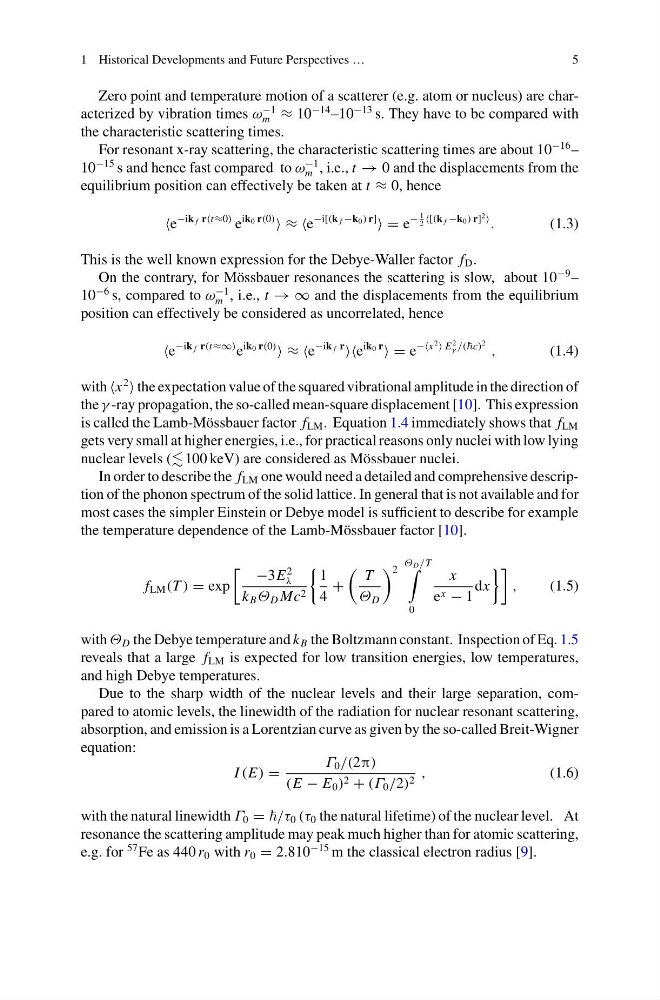
1 Historical Developments and Future Perspectives …
5
Zero point and temperature motion of a scatterer (e.g. atom or nucleus) are characterized by vibration times ω
−1
m ≈ 10
−14 –10
−13 s. They have to be compared with
the characteristic scattering times.
For resonant x-ray scattering, the characteristic scattering times are about 10
−16 –
10
−15 s and hence fast compared to ω
−1
m , i.e., t → 0 and the displacements from the
equilibrium position can effectively be taken at t ≈ 0, hence
e
−ik f r(t≈0) e
ik 0 r(0)
≈ ≈e
−i[(k f −k 0 ) r]
= e
−
1
2 [(k f −k 0 ) r]
2
.
(1.3)
This is the well known expression for the Debye-Waller factor f D .
On the contrary, for Mössbauer resonances the scattering is slow, about 10
−9 –
10
−6 s, compared to ω
−1
m , i.e., t → ∞ and the displacements from the equilibrium
position can effectively be considered as uncorrelated, hence
e
−ik f r(t≈∞) e
ik 0 r(0)
≈ ≈e
−ik f r
e
ik 0 r
= e
−−x
2 E
2
γ /(c)
2 ,
(1.4)
with x
2
the expectation value of the squared vibrational amplitude in the direction of
the γ -ray propagation, the so-called mean-square displacement [10]. This expression
is called the Lamb-Mössbauer factor f LM . Equation 1.4 immediately shows that f LM
gets very small at higher energies, i.e., for practical reasons only nuclei with low lying
nuclear levels ( 100 keV) are considered as Mössbauer nuclei.
In order to describe the f LM one would need a detailed and comprehensive description of the phonon spectrum of the solid lattice. In general that is not available and for
most cases the simpler Einstein or Debye model is sufficient to describe for example
the temperature dependence of the Lamb-Mössbauer factor [10].
f LM (T ) = exp
−3E
2
λ
k B Θ D Mc 2
1
4
+
T
Θ D
2
Θ D /T
0
x
e x − 1
dx
,
(1.5)
with Θ D the Debye temperature and k B the Boltzmann constant. Inspection of Eq. 1.5
reveals that a large f LM is expected for low transition energies, low temperatures,
and high Debye temperatures.
Due to the sharp width of the nuclear levels and their large separation, compared to atomic levels, the linewidth of the radiation for nuclear resonant scattering,
absorption, and emission is a Lorentzian curve as given by the so-called Breit-Wigner
equation:
I (E) =
Γ 0 /(2π)
(E − E 0 ) 2 + (Γ 0 /2) 2 ,
(1.6)
with the natural linewidth Γ 0 = /τ 0 (τ 0 the natural lifetime) of the nuclear level. At
resonance the scattering amplitude may peak much higher than for atomic scattering,
e.g. for
57 Fe as 440 r 0 with r 0 = 2.810
−15 m the classical electron radius [9].
5
Zero point and temperature motion of a scatterer (e.g. atom or nucleus) are characterized by vibration times ω
−1
m ≈ 10
−14 –10
−13 s. They have to be compared with
the characteristic scattering times.
For resonant x-ray scattering, the characteristic scattering times are about 10
−16 –
10
−15 s and hence fast compared to ω
−1
m , i.e., t → 0 and the displacements from the
equilibrium position can effectively be taken at t ≈ 0, hence
e
−ik f r(t≈0) e
ik 0 r(0)
≈ ≈e
−i[(k f −k 0 ) r]
= e
−
1
2 [(k f −k 0 ) r]
2
.
(1.3)
This is the well known expression for the Debye-Waller factor f D .
On the contrary, for Mössbauer resonances the scattering is slow, about 10
−9 –
10
−6 s, compared to ω
−1
m , i.e., t → ∞ and the displacements from the equilibrium
position can effectively be considered as uncorrelated, hence
e
−ik f r(t≈∞) e
ik 0 r(0)
≈ ≈e
−ik f r
e
ik 0 r
= e
−−x
2 E
2
γ /(c)
2 ,
(1.4)
with x
2
the expectation value of the squared vibrational amplitude in the direction of
the γ -ray propagation, the so-called mean-square displacement [10]. This expression
is called the Lamb-Mössbauer factor f LM . Equation 1.4 immediately shows that f LM
gets very small at higher energies, i.e., for practical reasons only nuclei with low lying
nuclear levels ( 100 keV) are considered as Mössbauer nuclei.
In order to describe the f LM one would need a detailed and comprehensive description of the phonon spectrum of the solid lattice. In general that is not available and for
most cases the simpler Einstein or Debye model is sufficient to describe for example
the temperature dependence of the Lamb-Mössbauer factor [10].
f LM (T ) = exp
−3E
2
λ
k B Θ D Mc 2
1
4
+
T
Θ D
2
Θ D /T
0
x
e x − 1
dx
,
(1.5)
with Θ D the Debye temperature and k B the Boltzmann constant. Inspection of Eq. 1.5
reveals that a large f LM is expected for low transition energies, low temperatures,
and high Debye temperatures.
Due to the sharp width of the nuclear levels and their large separation, compared to atomic levels, the linewidth of the radiation for nuclear resonant scattering,
absorption, and emission is a Lorentzian curve as given by the so-called Breit-Wigner
equation:
I (E) =
Γ 0 /(2π)
(E − E 0 ) 2 + (Γ 0 /2) 2 ,
(1.6)
with the natural linewidth Γ 0 = /τ 0 (τ 0 the natural lifetime) of the nuclear level. At
resonance the scattering amplitude may peak much higher than for atomic scattering,
e.g. for
57 Fe as 440 r 0 with r 0 = 2.810
−15 m the classical electron radius [9].