

3 Quantum Optical Phenomena in Nuclear Resonant Scattering
147
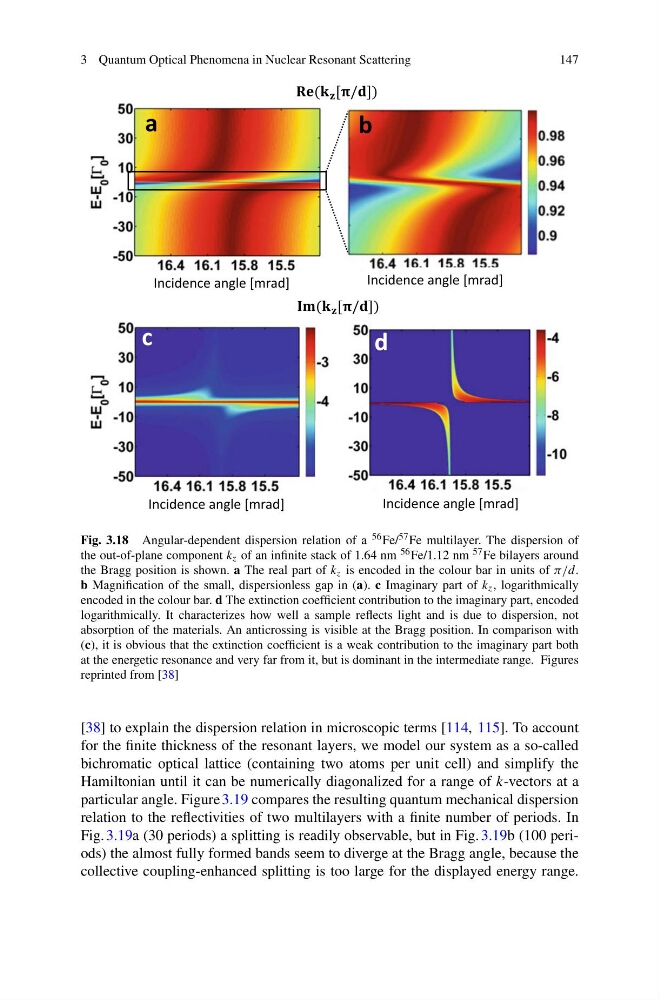
Fig. 3.18 Angular-dependent dispersion relation of a 56 Fe/ 57 Fe multilayer. The dispersion of
the out-of-plane component k z of an infinite stack of 1.64 nm 56 Fe/1.12 nm 57 Fe bilayers around
the Bragg position is shown. a The real part of k z is encoded in the colour bar in units of π/d.
b Magnification of the small, dispersionless gap in (a). c Imaginary part of k z , logarithmically
encoded in the colour bar. d The extinction coefficient contribution to the imaginary part, encoded
logarithmically. It characterizes how well a sample reflects light and is due to dispersion, not
absorption of the materials. An anticrossing is visible at the Bragg position. In comparison with
(c), it is obvious that the extinction coefficient is a weak contribution to the imaginary part both
at the energetic resonance and very far from it, but is dominant in the intermediate range. Figures
reprinted from [38]
[38] to explain the dispersion relation in microscopic terms [114, 115]. To account
for the finite thickness of the resonant layers, we model our system as a so-called
bichromatic optical lattice (containing two atoms per unit cell) and simplify the
Hamiltonian until it can be numerically diagonalized for a range of k-vectors at a
particular angle. Figure 3.19 compares the resulting quantum mechanical dispersion
relation to the reflectivities of two multilayers with a finite number of periods. In
Fig. 3.19a (30 periods) a splitting is readily observable, but in Fig. 3.19b (100 periods) the almost fully formed bands seem to diverge at the Bragg angle, because the
collective coupling-enhanced splitting is too large for the displayed energy range.
147
Fig. 3.18 Angular-dependent dispersion relation of a 56 Fe/ 57 Fe multilayer. The dispersion of
the out-of-plane component k z of an infinite stack of 1.64 nm 56 Fe/1.12 nm 57 Fe bilayers around
the Bragg position is shown. a The real part of k z is encoded in the colour bar in units of π/d.
b Magnification of the small, dispersionless gap in (a). c Imaginary part of k z , logarithmically
encoded in the colour bar. d The extinction coefficient contribution to the imaginary part, encoded
logarithmically. It characterizes how well a sample reflects light and is due to dispersion, not
absorption of the materials. An anticrossing is visible at the Bragg position. In comparison with
(c), it is obvious that the extinction coefficient is a weak contribution to the imaginary part both
at the energetic resonance and very far from it, but is dominant in the intermediate range. Figures
reprinted from [38]
[38] to explain the dispersion relation in microscopic terms [114, 115]. To account
for the finite thickness of the resonant layers, we model our system as a so-called
bichromatic optical lattice (containing two atoms per unit cell) and simplify the
Hamiltonian until it can be numerically diagonalized for a range of k-vectors at a
particular angle. Figure 3.19 compares the resulting quantum mechanical dispersion
relation to the reflectivities of two multilayers with a finite number of periods. In
Fig. 3.19a (30 periods) a splitting is readily observable, but in Fig. 3.19b (100 periods) the almost fully formed bands seem to diverge at the Bragg angle, because the
collective coupling-enhanced splitting is too large for the displayed energy range.