

3 Quantum Optical Phenomena in Nuclear Resonant Scattering
143
related to the phase arg(R) and the logarithm of the modulus log(|R|) of the cavity
reflectance R [36].
In the experiment, a cavity consisting of a Pd(2 nm)/C(20 nm)/
57 Fe(3 nm)/C(21
nm)/Pd(10 nm)/Si layer system was probed in grazing incidence, coupling the x-rays
into the fundamental mode. A magnetic field was applied along the beam direction in
order to align the magnetization of the nuclei in the so-called Faraday configuration.
In this setting, spontaneously generated coherences occur, which lead to a steep
linear dispersion [29]. Since full transparency of the medium corresponds to zero
intensity of the scattered x-ray, the cavity was designed to avoid full transparency in
order to measure the delay of the x-rays also on resonance. The single line analyzer
comprised a 10μm thick stainless steel foil (
57 Fe 55 Cr 25 Ni 20 ) mounted on a Doppler
drive, which generates a spectrally narrow pulse of about 10 ns duration with tunable
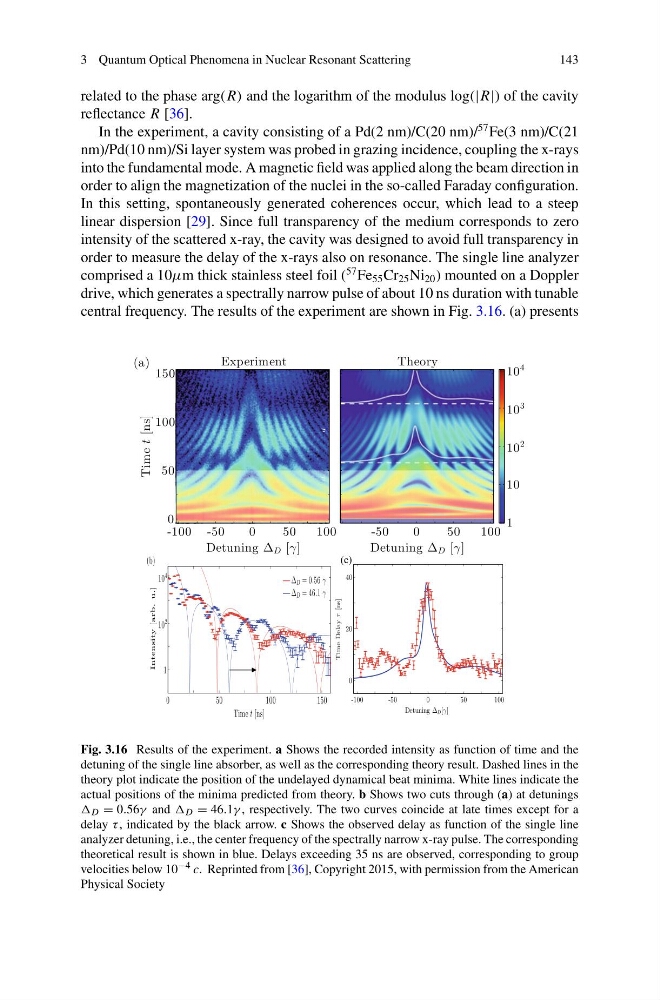
central frequency. The results of the experiment are shown in Fig. 3.16. (a) presents
Fig. 3.16 Results of the experiment. a Shows the recorded intensity as function of time and the
detuning of the single line absorber, as well as the corresponding theory result. Dashed lines in the
theory plot indicate the position of the undelayed dynamical beat minima. White lines indicate the
actual positions of the minima predicted from theory. b Shows two cuts through (a) at detunings
D = 0.56γ and D = 46.1γ , respectively. The two curves coincide at late times except for a
delay τ , indicated by the black arrow. c Shows the observed delay as function of the single line
analyzer detuning, i.e., the center frequency of the spectrally narrow x-ray pulse. The corresponding
theoretical result is shown in blue. Delays exceeding 35 ns are observed, corresponding to group
velocities below 10 −4 c. Reprinted from [36], Copyright 2015, with permission from the American
Physical Society
143
related to the phase arg(R) and the logarithm of the modulus log(|R|) of the cavity
reflectance R [36].
In the experiment, a cavity consisting of a Pd(2 nm)/C(20 nm)/
57 Fe(3 nm)/C(21
nm)/Pd(10 nm)/Si layer system was probed in grazing incidence, coupling the x-rays
into the fundamental mode. A magnetic field was applied along the beam direction in
order to align the magnetization of the nuclei in the so-called Faraday configuration.
In this setting, spontaneously generated coherences occur, which lead to a steep
linear dispersion [29]. Since full transparency of the medium corresponds to zero
intensity of the scattered x-ray, the cavity was designed to avoid full transparency in
order to measure the delay of the x-rays also on resonance. The single line analyzer
comprised a 10μm thick stainless steel foil (
57 Fe 55 Cr 25 Ni 20 ) mounted on a Doppler
drive, which generates a spectrally narrow pulse of about 10 ns duration with tunable
central frequency. The results of the experiment are shown in Fig. 3.16. (a) presents
Fig. 3.16 Results of the experiment. a Shows the recorded intensity as function of time and the
detuning of the single line absorber, as well as the corresponding theory result. Dashed lines in the
theory plot indicate the position of the undelayed dynamical beat minima. White lines indicate the
actual positions of the minima predicted from theory. b Shows two cuts through (a) at detunings
D = 0.56γ and D = 46.1γ , respectively. The two curves coincide at late times except for a
delay τ , indicated by the black arrow. c Shows the observed delay as function of the single line
analyzer detuning, i.e., the center frequency of the spectrally narrow x-ray pulse. The corresponding
theoretical result is shown in blue. Delays exceeding 35 ns are observed, corresponding to group
velocities below 10 −4 c. Reprinted from [36], Copyright 2015, with permission from the American
Physical Society