

3 Quantum Optical Phenomena in Nuclear Resonant Scattering
129
3.6.2 Quantum Optics of a Cavity Containing Resonant
Nuclei
Next we consider the effect of the nuclei on the cavity, restricting the discussion to
the single-excitation subspace spanned by the two collective states |G and |E. The
nuclei effectively act as a source term for x-ray photons in the empty cavity equation
of motion (3.40), which is modified to
d
dt
a = −(κ + i C )a +
2κ R a in − ig
∗
√
N |GE|,
(3.43)
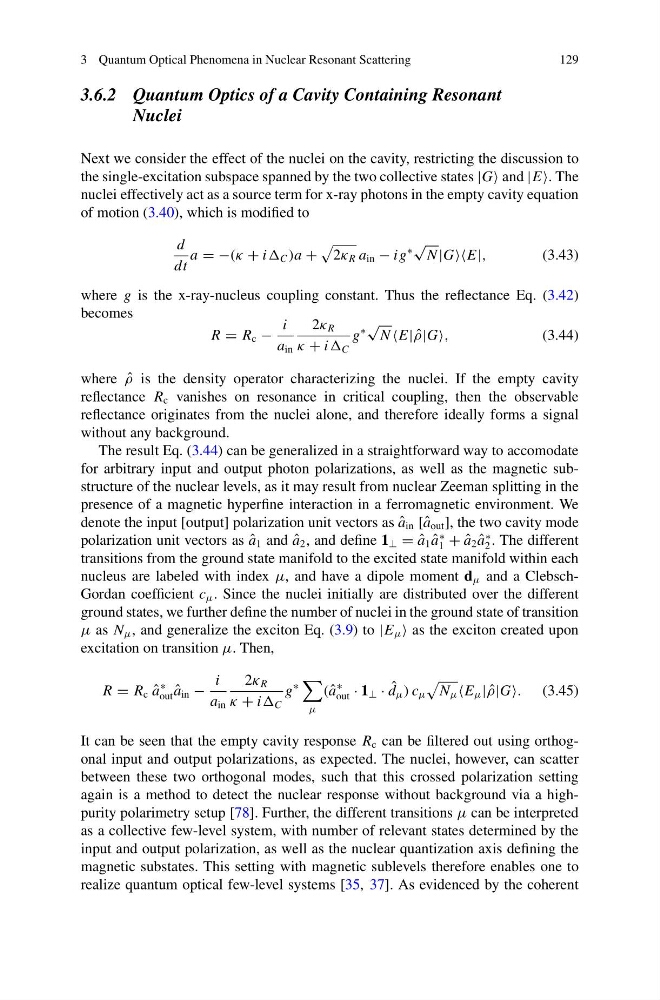
where g is the x-ray-nucleus coupling constant. Thus the reflectance Eq. (3.42)
becomes
R = R c −
i
a in
2κ R
κ + i C
g
∗
√
N E| ˆ
ρ|G,
(3.44)
where ˆ
ρ is the density operator characterizing the nuclei. If the empty cavity
reflectance R c vanishes on resonance in critical coupling, then the observable
reflectance originates from the nuclei alone, and therefore ideally forms a signal
without any background.
The result Eq. (3.44) can be generalized in a straightforward way to accomodate
for arbitrary input and output photon polarizations, as well as the magnetic substructure of the nuclear levels, as it may result from nuclear Zeeman splitting in the
presence of a magnetic hyperfine interaction in a ferromagnetic environment. We
denote the input [output] polarization unit vectors as ˆ
a in [ ˆ
a out ], the two cavity mode
polarization unit vectors as ˆ
a 1 and ˆ
a 2 , and define 1 ⊥ = ˆ
a 1 ˆ
a
∗
1 + ˆ
a 2 ˆ
a
∗
2 . The different
transitions from the ground state manifold to the excited state manifold within each
nucleus are labeled with index μ, and have a dipole moment d μ and a ClebschGordan coefficient c μ . Since the nuclei initially are distributed over the different
ground states, we further define the number of nuclei in the ground state of transition
μ as N μ , and generalize the exciton Eq. (3.9) to |E μ as the exciton created upon
excitation on transition μ. Then,
R = R c ˆ
a
∗
out ˆ
a in −
i
a in
2κ R
κ + i C
g
∗
μ
( ˆ
a
∗
out · 1 ⊥ · ˆ
d μ ) c μ
N μ E μ | ˆ
ρ|G. (3.45)
It can be seen that the empty cavity response R c can be filtered out using orthogonal input and output polarizations, as expected. The nuclei, however, can scatter
between these two orthogonal modes, such that this crossed polarization setting
again is a method to detect the nuclear response without background via a highpurity polarimetry setup [78]. Further, the different transitions μ can be interpreted
as a collective few-level system, with number of relevant states determined by the
input and output polarization, as well as the nuclear quantization axis defining the
magnetic substates. This setting with magnetic sublevels therefore enables one to
realize quantum optical few-level systems [35, 37]. As evidenced by the coherent
129
3.6.2 Quantum Optics of a Cavity Containing Resonant
Nuclei
Next we consider the effect of the nuclei on the cavity, restricting the discussion to
the single-excitation subspace spanned by the two collective states |G and |E. The
nuclei effectively act as a source term for x-ray photons in the empty cavity equation
of motion (3.40), which is modified to
d
dt
a = −(κ + i C )a +
2κ R a in − ig
∗
√
N |GE|,
(3.43)
where g is the x-ray-nucleus coupling constant. Thus the reflectance Eq. (3.42)
becomes
R = R c −
i
a in
2κ R
κ + i C
g
∗
√
N E| ˆ
ρ|G,
(3.44)
where ˆ
ρ is the density operator characterizing the nuclei. If the empty cavity
reflectance R c vanishes on resonance in critical coupling, then the observable
reflectance originates from the nuclei alone, and therefore ideally forms a signal
without any background.
The result Eq. (3.44) can be generalized in a straightforward way to accomodate
for arbitrary input and output photon polarizations, as well as the magnetic substructure of the nuclear levels, as it may result from nuclear Zeeman splitting in the
presence of a magnetic hyperfine interaction in a ferromagnetic environment. We
denote the input [output] polarization unit vectors as ˆ
a in [ ˆ
a out ], the two cavity mode
polarization unit vectors as ˆ
a 1 and ˆ
a 2 , and define 1 ⊥ = ˆ
a 1 ˆ
a
∗
1 + ˆ
a 2 ˆ
a
∗
2 . The different
transitions from the ground state manifold to the excited state manifold within each
nucleus are labeled with index μ, and have a dipole moment d μ and a ClebschGordan coefficient c μ . Since the nuclei initially are distributed over the different
ground states, we further define the number of nuclei in the ground state of transition
μ as N μ , and generalize the exciton Eq. (3.9) to |E μ as the exciton created upon
excitation on transition μ. Then,
R = R c ˆ
a
∗
out ˆ
a in −
i
a in
2κ R
κ + i C
g
∗
μ
( ˆ
a
∗
out · 1 ⊥ · ˆ
d μ ) c μ
N μ E μ | ˆ
ρ|G. (3.45)
It can be seen that the empty cavity response R c can be filtered out using orthogonal input and output polarizations, as expected. The nuclei, however, can scatter
between these two orthogonal modes, such that this crossed polarization setting
again is a method to detect the nuclear response without background via a highpurity polarimetry setup [78]. Further, the different transitions μ can be interpreted
as a collective few-level system, with number of relevant states determined by the
input and output polarization, as well as the nuclear quantization axis defining the
magnetic substates. This setting with magnetic sublevels therefore enables one to
realize quantum optical few-level systems [35, 37]. As evidenced by the coherent