

3 Quantum Optical Phenomena in Nuclear Resonant Scattering
125
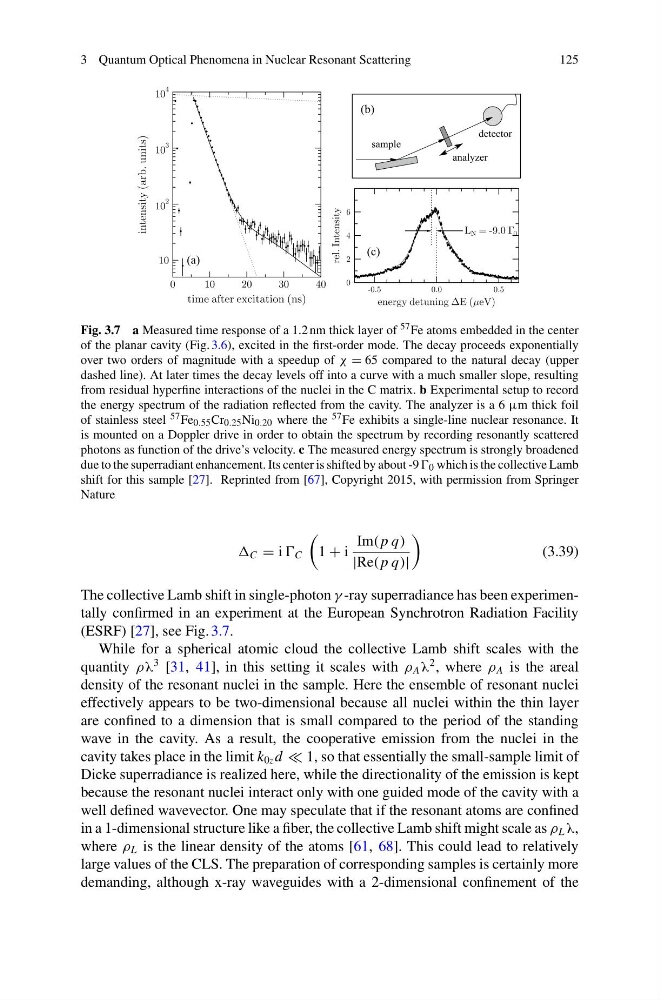
Fig. 3.7 a Measured time response of a 1.2 nm thick layer of 57 Fe atoms embedded in the center
of the planar cavity (Fig. 3.6), excited in the first-order mode. The decay proceeds exponentially
over two orders of magnitude with a speedup of χ = 65 compared to the natural decay (upper
dashed line). At later times the decay levels off into a curve with a much smaller slope, resulting
from residual hyperfine interactions of the nuclei in the C matrix. b Experimental setup to record
the energy spectrum of the radiation reflected from the cavity. The analyzer is a 6 μm thick foil
of stainless steel 57 Fe 0.55 Cr 0.25 Ni 0.20 where the 57 Fe exhibits a single-line nuclear resonance. It
is mounted on a Doppler drive in order to obtain the spectrum by recording resonantly scattered
photons as function of the drive’s velocity. c The measured energy spectrum is strongly broadened
due to the superradiant enhancement. Its center is shifted by about -9 0 which is the collective Lamb
shift for this sample [27]. Reprinted from [67], Copyright 2015, with permission from Springer
Nature
C = i C
1 + i
Im( p q)
|Re( p q)|
(3.39)
The collective Lamb shift in single-photon γ -ray superradiance has been experimentally confirmed in an experiment at the European Synchrotron Radiation Facility
(ESRF) [27], see Fig. 3.7.
While for a spherical atomic cloud the collective Lamb shift scales with the
quantity ρλ
3 [31, 41], in this setting it scales with ρ A λ
2 , where ρ A is the areal
density of the resonant nuclei in the sample. Here the ensemble of resonant nuclei
effectively appears to be two-dimensional because all nuclei within the thin layer
are confined to a dimension that is small compared to the period of the standing
wave in the cavity. As a result, the cooperative emission from the nuclei in the
cavity takes place in the limit k 0z d 1, so that essentially the small-sample limit of
Dicke superradiance is realized here, while the directionality of the emission is kept
because the resonant nuclei interact only with one guided mode of the cavity with a
well defined wavevector. One may speculate that if the resonant atoms are confined
in a 1-dimensional structure like a fiber, the collective Lamb shift might scale as ρ L λ,
where ρ L is the linear density of the atoms [61, 68]. This could lead to relatively
large values of the CLS. The preparation of corresponding samples is certainly more
demanding, although x-ray waveguides with a 2-dimensional confinement of the
125
Fig. 3.7 a Measured time response of a 1.2 nm thick layer of 57 Fe atoms embedded in the center
of the planar cavity (Fig. 3.6), excited in the first-order mode. The decay proceeds exponentially
over two orders of magnitude with a speedup of χ = 65 compared to the natural decay (upper
dashed line). At later times the decay levels off into a curve with a much smaller slope, resulting
from residual hyperfine interactions of the nuclei in the C matrix. b Experimental setup to record
the energy spectrum of the radiation reflected from the cavity. The analyzer is a 6 μm thick foil
of stainless steel 57 Fe 0.55 Cr 0.25 Ni 0.20 where the 57 Fe exhibits a single-line nuclear resonance. It
is mounted on a Doppler drive in order to obtain the spectrum by recording resonantly scattered
photons as function of the drive’s velocity. c The measured energy spectrum is strongly broadened
due to the superradiant enhancement. Its center is shifted by about -9 0 which is the collective Lamb
shift for this sample [27]. Reprinted from [67], Copyright 2015, with permission from Springer
Nature
C = i C
1 + i
Im( p q)
|Re( p q)|
(3.39)
The collective Lamb shift in single-photon γ -ray superradiance has been experimentally confirmed in an experiment at the European Synchrotron Radiation Facility
(ESRF) [27], see Fig. 3.7.
While for a spherical atomic cloud the collective Lamb shift scales with the
quantity ρλ
3 [31, 41], in this setting it scales with ρ A λ
2 , where ρ A is the areal
density of the resonant nuclei in the sample. Here the ensemble of resonant nuclei
effectively appears to be two-dimensional because all nuclei within the thin layer
are confined to a dimension that is small compared to the period of the standing
wave in the cavity. As a result, the cooperative emission from the nuclei in the
cavity takes place in the limit k 0z d 1, so that essentially the small-sample limit of
Dicke superradiance is realized here, while the directionality of the emission is kept
because the resonant nuclei interact only with one guided mode of the cavity with a
well defined wavevector. One may speculate that if the resonant atoms are confined
in a 1-dimensional structure like a fiber, the collective Lamb shift might scale as ρ L λ,
where ρ L is the linear density of the atoms [61, 68]. This could lead to relatively
large values of the CLS. The preparation of corresponding samples is certainly more
demanding, although x-ray waveguides with a 2-dimensional confinement of the